1973 – Just Before the Rapture =)

Great memories! It was 1973 and gas lines were wrapped to kingdom come. My college roommates and I would arrive at 5:00 AM, play guitar and shoot the breeze, all with hopes of adding a little petrol to our gas guzzling machines. The OPEC Oil Embargo was wreaking havoc and the Middle East was a chaotic mess with one skirmish after another … Watergate was in full swing and Tricky Dick was soon to resign under duress…it wouldn’t be long Lindsey told us, the end of the world was clearly near. Surely this was it. All the signs were in place. Thirty six years later… LoL 

I can’t recall the names of everyone but I’ll mention a few. George Davis, Gary Campbell (his sailboat), Gordon Weber, David Campbell, Jimmy Taylor, Bill Ferguson…Gosh, those were some great times. We had such good friends. Blessings to all!

Posted in 1973, 2nd Coming, Eschatology, Nixon | 5 Comments

The Destruction of the City of Jerusalem in 70 AD

It seems that precious few Christians possess even a modicum of historical perspective regarding the events surrounding the time between Christ’s bodily resurrection and ascension in AD 30, and the destruction of Jerusalem in AD 70.

Why is it that we are not taught these things vital to our comprehension of Scripture? Wouldn’t it be extraordinarily relevant to understand the times, events and conditions that existed as the Canon was being written and ultimately completed? Were the events leading up to and including the demise of the Temple in AD 70, a fulfillment of Bible prophecy? Most scoff at the idea. Preposterous they say. Instead of dismissing this possibility out of hand, wouldn’t it behoove us to be faithful Bereans seeing if “these things are so?” (Acts 17:11)

The majority of Christians today ascribe a still future fulfillment to both Jesus’ Olivet Discourse (Mt 24; Mk 13; Luke 21) and John’s Revelation. But have you ever wondered why this is the common belief, given the fact that Jesus told his disciples rather emphatically, “Truly, truly, I say to you, this generation will not pass away until all these things [not some] take place”? How can “this generation” refer to a generation 2,000 years future? If He wanted to suspend or elasticize the time clock, couldn’t Jesus have just as easily said, “that generation”, so as to introduce some level of ambiguity as to which generation He was referring?

(a few blogs back, we made a sound case HERE, arguing that “this generation” was directed specifically to those to whom Jesus was speaking. We contended that any other conclusion would be the result of presupposition and paradigm not exegesis. In other words, if we predetermined that Jesus could not have been referring directly to the generation at hand between AD 30-70, we must either change the meaning of generation [as some have tried] or we must add our own qualifiers, like “this generation that sees the signs” etc. Either way, in my view, the interpreter is playing with fire)

Most are unaware of the overwhelming evidence supporting the first century fulfillment of these predictions. May it never be, you say! If this is even a remote possibility why are so many (as I was) in the dark regarding these matters?

Although the first and third verse of Revelation’s first chapter confirm the near-term expectation of this prophetic fulfillment, why don’t people today embrace this timing?

The Revelation of Jesus Christ, which God gave Him to show His servants–things which must shortly take place. And He sent and signified it by His angel to His servant John, 2 who bore witness to the word of God, and to the testimony of Jesus Christ, to all things that he saw. 3 Blessed is he who reads and those who hear the words of this prophecy, and keep those things which are written in it; for the time is near. Revelation 1:1-3

Why don’t we search diligently for historical corroboration of the events that match the Revelation’s first century predictions. If the events recorded in the Revelation were to “shortly take place…for the time is near”, would it not be wise to see if these things actually took place shortly thereafter? I can hear the wheels turning as you read this.

We don’t look back 2,000 years for fulfillment we say, because we “know” these things are reserved for our future. Really? Isn’t this a leap of unbelief since we are ignoring the timing of these things while we allow our presuppositions to run amuck? Why are we, who pride ourselves in a literal interpretation of God’s Word, so quick to jettison the common, literal understanding of “shortly” and “near”? Doesn’t this bother us just a little?

Have you ever wondered where we obtain the Scriptural license justifying our alteration of word meanings like “shortly” and “near” to suit our own “private interpretations”? Aren’t we even a little concerned that we are dabbling rather precariously with the inspiration and inerrancy of God’s Word? Was God not able to communicate His plans clearly and effectively within the context of our finiteness? Isn’t the test of a prophet (Deut 18:18-22) such that his prophesied word would come to pass within the time constraints of his prophetic utterance?

If we faithfully ignore the timing of these prophecies, are we not a mite intellectually dishonest? Isn’t faithfulness predicated upon timely fulfillment of a promise? If the people in the Old Testament accepted the normative interpretional methods of the 21st century, would they have possessed the necessary means to determine the veracity of a prophet? If for example, the prophet Isaiah predicted the near term fall of the Babylonians to the Medes (Isaiah 13:1-22), would there have been any consequence to Isaiah if the Babylonians had not yet been defeated? Would Isaiah not have received swift rebuke for His inability to speak for the Lord?

Wail, for the day of the Lord is at hand! It will come as destruction from the Almighty. Isaiah 13:6

Let me share with you why I believe we have left clear interpretations of “shortly” and “quickly” and have thus ended with an interpretational free-for-all. First, as we read the uninspired footnotes of our Bibles, we find that the Revelation was written in approx 95-96 AD. Why is this significant and what impact does this have upon the time expectations with these first three verses? No events occurring shortly after AD 95-96 fit John’s prophetic description. Therefore, “things which must take place shortly” and “for the time is near”, must not mean what they appear to mean, or so we are told.

The truth is that once I realized the absolutely flimsy evidence of the “late date” (AD 96), and after I began to study both the internal and external proofs, it became clear to me that not only was the Revelation written prior to the destruction of Jerusalem in AD 70, but our entire Canon was comprised before this earth shattering event. In “Before Jerusalem Fell“, Kenneth Gentry makes a very compelling case for a mid AD 60s date, hence the book’s title.

The sheer fact that the War of the Jews, culminating in the Destruction of Jerusalem in AD 70, (which resulted in well more than a million Jewish deaths) is not mentioned in one book of Holy Scripture, should cause us pause and thus burden us to consider the reasons. Gentry’s 409 page tome (above), along with a plethora of audio/written evidence HERE, is available for your perusal. In my view, the correct dating, specifically of the Revelation, is absolutely crucial to the integrity of God’s Word.

A great deal of the impetus to treat time words and phrases like “things to take place shortly”, “for the time is near”, “He is coming quickly”, and “the time is at hand”, ambiguously, is gained by our attempt to justify the fact that the Revelation (as I mentioned earlier) has no immediate application regarding an AD 96 date. In other words, the events nearing the end of the first century don’t seem to have any correlation with the predicted calamities in the Revelation.

However, if one considers the probability of an AD 65 or 66 date, the events described in this very heavily sign-ifed book, along with the “all these things” from the Olivet, fit the time period from AD 66-70 like a glove.

I believe, if you truly look at the evidence while attempting as best you can to be objective, you may be shocked to find that every last sign/warning found in Matthew 24 (wars, earthquakes, famines, desolation; false Christs, gospel preached to the whole world, tribulation etc.) took place by the fall of the Temple in the annihilation of Jerusalem in AD 70. Just 40 years prior, Jesus prophesied that “the end of the age” would culminate with the destruction of Temple/Jerusalem at His Parousia (return with a consequential presence).

And Jesus said to them, “Do you not see all these things? Assuredly, I say to you, not one stone shall be left here upon another, that shall not be thrown down.” Matthew 24:2

With this as a backdrop, please prayerfully consider the extra-Biblical description of the fall of Jerusalem at the hands of the multi-national army lead by Rome. This brief historical outline regards the prophetic fulfillment of both Jesus’ Olivet (AD 30) and Jesus’ revelation to John 35 years later (AD 65). I believe it is imperative to be certain that when Jesus or one of the New Testament’s inspired writers said that something was near and right at the door, they were speaking the truth.

I’m confident that you will find the following account rather fascinating in so far as it fulfilled Jesus’ prediction 40 years earlier (a generation), that “not one stone will be left upon another.” May your faith be increased exponentially by the proof of God’s faithfulness to avenge His adversaries. (2 Thes 1:6-10)

________________________

The Destruction of Jerusalem

Translated from

Kirchenagenda für Ev.-Luth. Gemeinden

ungeänderter Augsburgischer Konfession.

Concordia Publishing House, St. Louis, Missouri, 1922.

D. J. Muehlenbruch, translator

As the time approached wherein God would at last send forth His wrath against Jerusalem and the Jewish people, even as the Lord Christ Himself had threatened, the entire Jewish kingdom was vexed at every turn. The high priests practiced tyranny against the other priests; there was hatred and jealousy among other officials, and from this mobs and all manner of divisive factions, and much robbery and murder was found in and around Jerusalem.

For this reason the Emperor Nero sent Gessius Florus to the Jewish lands. And, compared to him, the Jews were so obstinate in their greed, arrogance and wantonness, the Jews hunted down and killed five thousand of his men. The Jews were also fanatical, because of the will of God, about setting themselves against the Romans and revolting. When the Emperor Nero became aware of this he send Flavius Vespasianus and his son, Titus, to Syria.

Vespatian came to Galilee, which was heavily populated, and laid waste to everything; there being no end of murder, plundering, and fire. Many thousands of Jews were slaughtered, on one occasion as many as fifty thousand valiant men, together with women and children. The soldiers spared neither old nor young, neither the pregnant nor babes in arms. On one occasion Vespatian send six thousand young men as slaves to Achaia, to dig on the Isthmus. Thirty thousand Jewish combatants were sold into bondage. In desperation, five thousand threw themselves off of high cliffs.

At this time there was an admirable man, wise and judicious, a priest among the Jews, and once their leader in war, named Josephus. He had fled with several others to a cave near Jotapata after the first alarm, he had been captured and sent to Vespatian. Since he had prophesied to Vespatian that he would become emperor, he was permitted to live. And this same Josephus has written what we know of this history.

As this was taking place in Galilee, a great crowd of rapacious people, at the instigation of Johannes, one of the great men, came to Jerusalem, so that he might use this rabble to break up the regiment there. There was also much secret murder, robbery and plundering in Jerusalem. It also happened that several high priests were slaughtered, and much blood was spilled, even in the temple. Josephus wrote that twelve thousand of the best and noblest Jews were overtaken in this uproar, and had their houses and possessions given as plunder to the mob and the vulgar and lowly.

So it was, that even before agreeable weather returned, Jerusalem had been plagued with threefold misfortune, namely a war with Rome; with insurrection and all manner of mutiny; and tyranny, which had faction rising against faction, and with the knowledge of the rulers, shedding much blood.

Now, at the beginning of Winter, Vespatian heard that Nero was dead, besieged the city with Roman legions so that he might easily storm and take Jerusalem. Now, since Vespatian was recalled from his legions to become emperor, so that he might go to Egypt, and then to Italy, he gave commend of the Jewish campaign to his son, Titus.

Titus established his encampment hear to Jerusalem, and divided the legions to besiege the city from several sides. Meanwhile, a great host of people from all cities and regions were gathered in Jerusalem for the feast of Passover. There were also, as mentioned above, three factions in the city seeking to destroy unity and order. One element was the Temple faction, among these Eleazar, son of Simon, was the leader. The Zealots, an evil, hypocritical lot, hostile to the populace, belonged to this faction. In the lesser faction, Johannes, the source of all misfortune, as mentioned above, held sway. The principal faction was controlled by Simon, with the help of twenty thousand Idumeans, sought to save the city from the wantonness and determined intention of the Zealots. Many would have had these guests somewhere else, but they could not be gotten rid of.

When Titus saw that the city was overcrowded beyond counting, hastily armed and reinforced himself in order to lay siege to the city and, as Christ had foretold, to encircle it with wagons so that hunger might drive them to greater distress and anxiety. When the Jews saw this, they with all their might to hinder and prevent this, and to keep it from happening, but it was completed and they were out of lick; For our Lord God wanted to make an end of them.

The city of Jerusalem was well fortified and had three walls. Therefore the Roman forces approached in full force to storm the city; and after much work, the first and second walls conquered and taken. At this same time, an innumerable multitude of people died of hunger, as Josephus wrote. The best of friends would often come to blows over a small piece of bread; children would often rip food from their parents’ mouths. Neither brother nor sister had mercy upon the other.

A bushel of corn was more precious than gold. Driven by hunger, some ate manure; some, the cinches of their saddles; some, the leather stripped from their shields; some still had hay in their mouths when their bodies were found; some sought to escape starvation by means of their own filth. So many died of starvation that 115,000 corpses were found in the city and buried. Hegesippus reported that, at one gate alone, several thousand were carried out, and that 600,000 dies because of the siege.

Josephus reported that such a fearful, gruesome event occurred, that future generations would hardly be able to believe it. There was a respected woman, wealthy and well bred, across the Jordan; having fled Jerusalem in fear with some others. Now, since the city had been so grievously beset with hunger, (with what manner of crying and pain, one can only imagine) slaughtered her young child in the cradle, roasted half of it and ate it. When the soldiers came by looking for food, she set the remaining portion before them. The soldiers removed themselves from this gruesome scene, and having mercy upon the miserable woman, revealed this event to the lord of Jerusalem.

The Jews occupied the Castle Antonia, which was a strong fortress; they also occupied the temple compound, from which a stream flowed into the city. It cost more to conquer this fortress than all other the others combined.

Titus, however, fired up his men to storm the fortress by force. When the Romans had taken the castle, the trumpeter sounded a signal and all the Jews who had occupied the castle were slain or thrown from the walls; but some hurriedly escaped to the city in the darkness.

It is said that Titus wanted to spare the temple; but God decreed that it would not be spared. For after men had long walked and worked, and the Jews could not be moved, neither with threats or exhortations, to give up their fortified positions, the soldiers realized that the temple could only be conquered with fire; some of the men it afire. And in that hour the magnificent, exquisite and priceless building, which was celebrated far and wide, burned and was reduced to ashes.

The priests must beg and entreat pitifully to keep themselves alive; but the grace of God and men had run out. Titus, so Hegesippus writes, stated: “Now that their temple and services are gone, the priests are no longer needed.” This destruction of the temple occurred on the tenth day of the month of August.

But the Jews that remained, after the destruction of the temple, in the section of the city not conquered by the Romans, thought to surrender themselves and went to Titus. Although they had not waited too long to make peace, and they did petition for peace and freedom because they were starving and in great need, nothing came of it, as it was only a few days since the city had been taken. Meanwhile, uncountable numbers of people, driven by anxiety and the distress of unbearable hunger, ran from the city into the hands of the enemy camp; there they sold themselves cheaply. It was then that the soldiers became aware that a certain Jew was picking gold which he had swallowed our of his own excrement.

Thus a rumor began to spread throughout the entire camp. This rumor caused those soldiers who thought about it to believe that they could find gold in all the Jews who had come out of the city to their encampment. More than two thousand Jews were disemboweled in a single night; and many m ore have suffered the same fate had Titus not decreed that the captives should not be killed.

Finally, the entire city of Jerusalem was conquered, neither young nor old were spared. Then a decree went out that all miserable people who were incapable of offering any resistance should be spared. Also, Jerusalem was thoroughly plundered by the foe, razed, burned and left in ruin. Some buildings were left standing, so that a few Roman soldiers might have been able to stand watch there. Only a few devastated buildings and towers were left standing to indicate that a city had once been there.

Thus the city of Jerusalem was destroyed and razed on the eighth day of September, in the fifth month of the siege.

From the host of captives Titus sent seventeen thousand healthy, young and strong men to Alexandria as quarry slaves. Many Jews were sold as cheaply as animals. Two thousand were distributed across the entire roman empire to become players in the spectacles, and to be torn apart by wild beasts in the arenas.

The total number of captives who remained alive came to ninety-seven thousand; however, at the beginning of the siege, ten times one hundred thousand were in the city, the majority of them strangers and not residents, although all were of Jewish descent and blood.

Thus Jerusalem, the most celebrated city in all of the East, came to a miserable and lamentable end, as had been prophesied, in the seventieth year after the birth of Christ our Lord.

(For a more complete account of the events leading up to the destruction of Jerusalem, you may find it great benefit to download and read George Holford’s 1805 account of, “The Destruction of Jerusalem, An Absolute and Irresistible Proof of the Divine Origin of Christianity.)

____________________________________

***NOTE: Proving exact dates within the historical timeline are extremely difficult. The Jewish calendar is primarily lunar, with each month beginning on the new moon. The problem with strictly lunar calendars is that there are approximately 12.4 lunar months in every solar year, so a 12-month lunar calendar loses about 11 days every year and a 13-month lunar calendar gains about 19 days every year. The months on such a calendar “drift” relative to the solar year. On a 12 month calendar, the month of Nissan, which is supposed to occur in the spring, occurs 11 days earlier each year, eventually occurring in the winter, the fall, the summer, and then the spring again. To compensate for this drift, an extra month was occasionally added; a second month of Adar. The month of Nissan would occur 11 days earlier for two or three years and then would jump forward 29 or 30 days, balancing out the drift.


According to www.hebcal.com, in A.D. 70 the 1st of Tishrei was on September 22. But they add this warning: “WARNING: Results for year 1752 C.E. and before may not be accurate. Hebcal does not take into account a correction of ten days that was introduced by Pope Gregory XIII known as the Gregorian Reformation.” (Provided by David Curtis, Pastor, Berean Bible Church)

Posted in Updates | Leave a comment

Barack “Anti-Christ” Obama? – Gary DeMar

Prophecy pundits are at it again! Listen how Gary explains passages from Isaiah and Luke in reference to “Satan falling as lightning (baraq) from heaven” (Luke 10:18). See what can happen when reading the Word with preconceived notions (as well as mistranslating your Bible)! To see the video that sparked this rebuttal, click HERE.

Posted in Updates | Leave a comment

“This Generation Shall Not Pass Away Til All These Things Be Fulfilled”

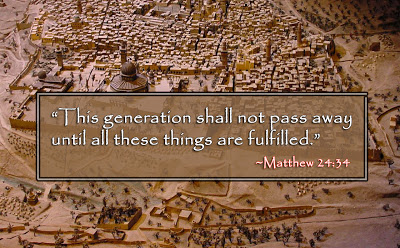
When you read Matthew 24:34 from Jesus’ Olivet Discourse (Matt 24; Mark 13, Luke 21), how do you interpret the phrase “This Generation” in the context of “shall not pass away until “all these things be fulfilled“? Is it possible that we are living in the “This Generation” to which Jesus was referring? Since reading Hal Lindsey’s “The Late Great Planet Earth” in the fall of 1972 (the first Christian book I ever read), I have been told time and again that we are living in the terminal generation.

And the secular predictions are harmonically converging as well, with the Mayan calendar’s Doomsday set for December 21, 2012. Is the cosmic realignment going to create a polar shift of catastrophic proportions? Is Jack Van Impe’s prediction of “The end of days 2012” Scripturally plausible? Are “All these things” finally upon us? Inquiring minds want to know.

Does all this obsession with “the end” sound familiar? Are you growing weary feeling driven and tossed by the winds of these perpetual prophetic speculations?
Before we begin dissecting what some have called the most confusing verse in the Bible, let me offer two rather common refrains that I believe are birthed out of frustration with the incessant prognostications.

1. Studying eschatology seems like a lesson in futility. It’s a colossal waste of both time and energy attempting to understand this whole end times prophecy conundrum.

2.     No man can know the day nor the hour since Jesus’ return would be like a thief in the night. 

I think it’s quite natural to feel confused and perplexed. I felt that way for decades. I was one of the panmillennials, who figured it would all pan out in the end so why bother.

Over the past few years I have come to a very different conclusion. As I survey the eschatological landscape, one’s modern day “end times” views (most of us have them even if they aren’t well defined in our minds) are making a huge difference in the way we approach the future and the way we live in the present. Eschatology has become the proverbial tail that wags the dog. In my view, we mustn’t be subject to the winds of the self-proclaimed prophecy experts. Consider their wise counsel but not without being a faithful Berean to see if these things are so. (Acts 17:11).

When I say that I believe it is possible to know the timing of these things, some immediately bristle and argue that Jesus said “no man knows the day or the hour.” So then why did He speak of the season which was confined to “this generation”? As a matter of fact, Jesus and the NT writers were crystal clear on this point. As we shall see, remaining watchful was a key component of Christ’s Olivet Discourse. (Matthew 25:1ff) Jesus warned that it was absolutely crucial for first century Christ-followers to remain vigilant since life and death depended upon their level of alert. The Apostle Paul wrote that the children of darkness were the ones who would be overcome by the thief, not the children of light. (1 Thess 5:1-11)

Have you ever wondered why Jesus was so deliberate in laying out the events and signs that were to precede His visitation (parousia: 2nd coming) if no one was to have even a remote clue of the Father’s timing? What was the point of the proceeding readiness parables (parable of the 10 virgins etc) if their “watching” would prove unfruitful and unnecessary?

“Therefore be on the alert, for you do not know which day your Lord is coming. 43 “But be sure of this, that if the head of the house had known at what time of the night the thief was coming, he would have been on the alert and would not have allowed his house to be broken into. Matthew 24:42-43

As I alluded to above, the Apostle Paul, writing some 20 years later, crystallized and clarified both of Jesus’ thief and childbirth analogies.

For you yourselves know full well that the day of the Lord will come just like a thief in the night. 3 While they are saying, “Peace and safety!” then destruction will come upon them suddenly like labor pains upon a woman with child, and they will not escape. 4 But you, brethren, are not in darkness, that the day would overtake you like a thief; 5 for you are all sons of light and sons of day. We are not of night nor of darkness; 6 so then let us not sleep as others do, but let us be alert and sober. 1 Thessalonians 5:2-6

Notice not only the coming “thief” but also to the “labor pains” that Jesus referenced in Mt 24:8. A thief in the night does not take those who were watching and waiting by surprise. And it should be remembered that Paul is writing specifically to the Thessalonians, not to us. He’s warning them to be “alert and sober”, for destruction would come upon those who weren’t paying close attention to the signs and the seasons. *We must consider the primacy of the original audience (audience relevance), because a passage can’t mean (today) what it never meant (back then). 

So let’s move on with the presumption that not only are these things worth considering, but both Jesus and Paul made it clear that preparation and readiness were imperative.

Just prior to Matthew 24:34 we read:

“Now learn the parable from the fig tree: when its branch has already become tender and puts forth its leaves, you know that summer is near; 33 so, you too, when you see all these things, recognize that He is near, right at the door. Matthew 24:32-33

Jesus spent the prior 31 verses sharing with His devout followers not only what to expect in the ensuing years (post Cross), but also the sequence of those unfolding events and signs, such that the watchful would know when Jesus’ return was “right at the door”. While it is correct that they were not to know the specific day or the exact hour of Jesus’ return (Mt 24:36), Jesus said, “when you see all these things, recognize that “He is near, right at the door.” The same prophecy “experts” who argue that we are not to know the timing of Jesus’ parousia (coming with a consequential presence), tell us that His coming will be soon. Isn’t this a bit hypocritical? Think about the timing of His 2nd coming (some would refer to His coming in judgment) in terms of Jesus’ childbirth analogy, 

“But all these things are merely the beginning of birth pangs.” Mt 24:8

Matthew 24:34 set the duration of the pregnancy analogy. “This generation” is equated with the 9 months of a pregnancy. Jesus confined the timing of “all these things” to a generation (approx. 40 years) from that very day of the Olivet. Jesus was not speaking of a distant generation 2,000 years removed. We can be certain of that. So it was the “this generation” backdrop all of the New Testament writers were considering as the Holy Spirit honed and refined their understanding of the last things.

This is the reason we find the New Testament teaming with what we refer to as “imminent” time sensitive statements regarding Jesus’s coming. And it should be noted… the closer in proximity of the Canonical writings to 70 AD, the more imminent the language. Not one statement regarding the return of the Lord is unaccompanied by a near term time referent. Don’t you find that rather curious? Consider these few…

Peter: The end of all things is near; therefore, be of sound judgment and sober spirit for the purpose of prayer.1 Peter 4:7 (AD 63)

Paul: But this I say, brethren, the time is short, so that from now on even those who have wives should be as though they had none, For the form of this world is passing away. 1 Corinthians 7:29, 31 (AD 57)

John: Little children, it is the last hour; and as you have heard that the Antichrist is coming, even now many antichrists have come, by which we know that it is the last hour.1 John 2:18 (AD 61-62)

Hebrews:For you have need of endurance, so that after you have done the will of God, you may receive the promise: 37 “For yet a little while,And He who is coming will come and will not tarry.Hebrews 10:36-37 (AD 62-63)

James:Therefore be patient, brethren, until the coming of the Lord. The farmer waits for the precious produce of the soil, being patient about it, until it gets the early and late rains. 8 You too be patient; strengthen your hearts, for the coming of the Lord is near.9 Do not complain, brethren, against one another, so that you yourselves may not be judged; behold, the Judge is standing right at the door.James 5:7-9 (AD 61-62)

John:The revelation of Jesus Christ, which God gave him to show to his servants the things that must soon take place. He made it known by sending his angel to his servant John,… 3 Blessed is the one who reads aloud the words of this prophecy, and blessed are those who hear, and who keep what is written in it, for the time is near.Revelation 1:1,3 (AD 62-63)

Were these men confused? Were they wrong? Are we not stepping in very dangerous murky waters even questioning these men’s inspired testimony? It appears they were simply following the lead of their Savior. Notice the correlation between Jesus’, “when you see all these things, recognize that He is near, right at the door” and His brother James’ “Behold, the Judge is standing right at the door”. What was prophetic 30 years earlier at the Olivet, was soon to become a reality. Let’s again consider Jesus’ time parameter statement.

Verily I say unto you, this generation shall not pass, till all these things be fulfilled. Matthew 24:34

What was it that prompted Jesus to make this rather startling statement? Jesus had just finished pronouncing the 7 woes against the “teachers of the law and the Pharisees” who sat in the seat of Moses. He concluded his righteously indicting tongue-lashing with, “Verily I say unto you, All these things shall come upon this generation.” Matthew 23:36 (KJV)

Does the language “all these things” and “this generation” sound familiar? Do these identical phrases have a connection to Matthew 24:34? Quite curiously, some commentators say that these two verses (Mt 23:36 and Mt 24:34) do not reference the same “all these things” or even the same generation. Why do they come to this conclusion, since by shear common sense these two passages would appear to be integrally entwined?

Many of the same commentators have written concerning Matthew 24:34, that it is one of the most confusing verses in the Bible. C.S. Lewis, one of the greatest apologists of the 20th century, in “The world’s Last Night” remarked, “it is certainly the most embarrassing verse in the Bible.”

Is it really “embarrassing” and “confusing“? Why would they make such statements, since it seems so straightforward and abundantly clear? Quite frankly, I believe it’s simply the result of being unwilling (due to presupposition) to accept the most obvious implication. If I have learned anything in the last 4 years of study, it is that we all have biases which create our paradigm (worldview).

There’s certainly nothing wrong with creating and maintaining a worldview, and actually it is imperative that we develop a sound foundation. It adds order and sanity to life. However, the problem is not having a paradigm but not recognizing that our biases may be in discord with Scripture. We must first recognize our bias and match it against God’s Word. Often I have found my presuppositions at odds with the Bible and I, therefore, need to change course. 

So how could “all these things”, which includes all the events and signs leading up to Jesus’ parousia (coming with a consequential presence), have taken place within “this” generation (which was the first century generation that spanned approx. 40 years (30 AD [Cross] to 70 AD [Destruction of Jerusalem] )?

First we must allow ourselves to be cornered and corralled by Scripture before we attempt to figure out how these things can be. Simply by submitting to the possibility that “all these things” actually took place within that first century generation almost 2,000 years ago (and therefore not still unfulfilled today) is step one. It’s helpful to realize that it is neither evil nor heretical to consider that what was imminent to Jesus’ followers, actually took place within the timing they predicted.

“This” is a near demonstrative, which simply means that it refers to something specific, something at hand. If I say “this house”, everyone knows that I’m speaking about one specific house of which I am either sitting in or pointing to. “This generation” could only have been referring to the generation at hand. Jesus would have used the more nebulous “that generation” had He desired to refer to a time centuries or millennia in the future.

Consider the following from the book of beginnings:

And the LORD said unto Noah, Come thou and all thy house into the ark; for thee have I seen righteous before me in this generation. Genesis 7:1 (KJV)

Is there any commentary on this planet that does not assume that “this generation” is referring to the current generation in which Noah was living? So then why do these same commentators persist in changing the meaning of “this generation” in Matthew 24:34? Presupposition. Since Jesus could not (in their view) be referring directly and specifically to both the Pharisees in Matthew 23:36 and the disciples in Matthew 24:34, they are forced to alter the meaning of “this generation” or add qualifiers to the text that are nowhere to be found e.g. “The generation that sees the signs”. Once we allow our preconceptions to dictate what Jesus or the Canon writers actually said, the game is over. How can we come to THE TRUTH if we deny the Holy Spirit inspired words in Scripture?

I have found it rather odd that the folks who proudly proclaim a literal interpretation of the Bible are the first to distort, ignore or deny the most obvious and literal meaning of these time referents.

Scofield attempted to change the meaning of “generation” (genea) to race (genos). Read in the context of “race” this verse makes absolutely no sense. And why C.I. Scofield even tried to alter the meaning of genea, when Jesus used “tribes” (referring to “race”) just a few verses prior (Mt 24:30), is truly a mystery. Sadly, the infamous Scofield Notes, that donned the pages of most Bibles until recently (since many alternatives have been made available), have led many astray.

Generation(s) appears in the NASB 37 times, of which 23 specifically point to the generation at hand: “this generation”, “this perverse generation”, “this evil generation”, “you unbelieving and perverse generation”, “this adulterous and sinful generation”.

Is it hermeneutically (science of interpretation) expedient and intellectually dishonest to separate Jesus’ “this generation” of Matthew 24:34 from the other 22 references specifically relating to THE generation to which Jesus was addressing?

Jesus was directly addressing His disciples, warning THEM (not us) of the things that were to take place in the unfolding first century generation (not in the year 2009 and beyond). Every bit of Matthew 24 was fulfilled within Jesus’ “this generation” time commitment. However, it is absolutely amazing how few are even aware of the historical events between AD 30 and AD 70. Why are we not more familiar with the historical writings of Josephus and Tacitus? Could it be that these things do not fit neatly into the “Left Behind” eschatology that is so prevalent today? 

It is my view that these men (Tacitus & Josephus no friends to Christianity), were used by God to provide adequate testimony corroborating the fulfillment of Holy Scripture. Although these extra-Biblical writings cannot be considered inspired, they are extremely valuable in fleshing out the events that included the War of the Jews and the destruction of Jerusalem in AD 70.

Since our churches for the most part are not teaching the historical surroundings of the New Testament, few have even a remote clue that line by line, Jesus’ Olivet predictions were utterly and completely fulfilled. Not one stone of that magnificent Temple was left upon another, as the days of Christ’s vengeance came like a thief in the night against that wicked Christ-killing first century generation.

Behold, He is coming with the clouds, and every eye will see Him, even those who pierced Him; and all the tribes of the earth [land] will mourn over Him. So it is to be. Amen. Revelation 1:7

because these are days of vengeance, so that all things which are written will be fulfilled.Luke 21:22

How could “those who pierced Him” see Him coming on the clouds in the year 2009  or beyond? I surely had no idea how utterly amazing the prophetic fulfillments were. As a matter of fact, I was initially shocked and then rather dismayed because I wondered how I could have been a student of Scripture for 33 years and not heard a word of this.

Consider these prophesied events and signs from Matthew 24 as they were fulfilled within “This Generation” of the first century:

1. Many will come in My name, saying, ‘I am the Christ,’ and will mislead many.
2. Wars and rumors of wars … Nation will rise against nation
3. Various places there will be famines and earthquakes

But all these things are merely the beginning of birth pains. [These are NOT signs]

4. They will deliver you to tribulation, and will kill you
5. Many will fall away and will betray one another and hate one another
6. Many false prophets will arise and will mislead many, because lawlessness is increased, most people’s love will grow cold
7. This gospel of the kingdom shall be preached in the whole world [oikoumene not kosmos] as a testimony to all the nations, and then the end will come.

Therefore when you see the ABOMINATION OF DESOLATION

8. those who are in Judea must flee to the mountains
9. woe to those who are pregnant and to those who are nursing babies in those days
10. pray that your flight will not be in the winter, or on a Sabbath.
11. then there will be a great tribulation, such as has not occurred since the beginning of the world until now, nor ever will.

Behold, I have told you in advance

But immediately after the tribulation of those days

12. THE SUN WILL BE DARKENED, AND THE MOON WILL NOT GIVE ITS LIGHT, AND THE STARS WILL FALL from the sky [Isaiah 13, 34], and the powers of the heavens will be shaken.
13. And then the sign of the Son of Man will appear in the sky
14. And then all the tribes of the earth [ge: land] will mourn
15. and they will see the SON OF MAN COMING ON THE CLOUDS OF THE SKY with power and great glory.

Jesus said that the “all these things” listed above would transpire within the first century generation to which He was speaking. The inerrancy of Scripture depends on it. We can continue to believe as we’ve been told or we can be faithful Bereans who were more noble than their Thessalonian compatriots because they examined the Scriptures (OT) daily “to see if these things are so.” (Acts 17:11)

And if you are inclined to believe in some sort of double fulfillment (which is nowhere licensed by the text) consider this. How was it possible for the Gospel to have been preached to “all the world” twice? How can there be two tribulations “such as has not occurred since the beginning of the world until now, nor ever will“? The phrase “nor ever will” precludes a future duplicate expectation. And there cannot be two “this generations”.

Let’s be honest. The only reason there’s even an attempt to ascribe to multiple executions of the Olivet is due to empiricism, which is often an enemy of the truth. Since planet earth does not look like the post-parousia utopia we’ve come to expect (errant paradigm), we are forced to read into the text that which is not there. Few fess up to the dirty little secret that explodes this Christ-honoring utopian existence of the millennium. In the last chapter of the Revelation, Jesus (through the angel to John) tells us that things are not supposed to be all that rosy in this post 2nd coming world.

Blessed are those who wash their robes, so that they may have the right to the tree of life, and may enter by the gates into the city. 15 Outside are the dogs and the sorcerers and the immoral persons and the murderers and the idolaters, and everyone who loves and practices lying. Revelation 22:14-15

This is a picture of exactly what we have today. We, who are part of the New Jerusalem (Gal 4:21-31) have access to the tree of life (and declared righteous by His blood) ,while those outside this spiritual city continue to do the things that come naturally. We live in a spiritual Kingdom. Our gates are always open to those who will come by faith. It is our task to invite those outside the city walls of this Heavenly Jerusalem (as we once were), to come and dine with the King.

The Spirit and the bride say, “Come.” And let the one who hears say, “Come.” And let the one who is thirsty come; let the one who wishes take the water of life without cost.Revelation 22:17

My suggestion is that we consider altering our view of Jesus’s cloud coming to fall inline with the same cloud comings we find in the Old Testament, therefore, doing no damage to the plain meaning of the Holy Writ.

Lastly, in order to add perspective, it must be noted what it was that prompted Jesus’ “end times” monologue.

Jesus came out from the temple and was going away when His disciples came up to point out the temple buildings to Him. 2 And He said to them, “Do you not see all these things? Truly I say to you, not one stone here will be left upon another, which will not be torn down.” Matthew 24:1-2

In the light of this astonishing statement regarding the destruction of the temple, the disciples asked the following question:

As He was sitting on the Mount of Olives, the disciples came to Him privately, saying, “Tell us, when will these things happen, and what will be the sign of Your coming, and of the end of the age?” Matthew 24:3

First it should be noted that some have attempted to explode this verse into two or three questions. Only a person reading their presuppositions into the text would attempt to parse this question into multiple questions. What the disciples simply and straightforwardly want to know, is when this razing of the Temple is going to happen? (at that point this awe inspiring edifice was 44 years into the building process and was only completed a few years (AD 64) before it was utterly destroyed)

Now consider Jesus’ response. He didn’t qualify their question and He didn’t break it down into sections with various fulfillment time sequences. And He surely didn’t chide them for asking the pregnant “when” question. Even though they weren’t fully cognizant of the implications of His coming (since they didn’t even understand He was leaving), just prior to the Transfiguration Jesus had told them that some of them would witness this horrific event.

“For the Son of Man is going to [mello: about to] come [erchomai: to come] in the glory of His Father with His angels, and will then repay every man according to his deeds . 28 “Truly I say to you, there are some of those who are standing here who will not taste death until they see the Son of Man coming in His kingdom.” Matthew 16:27-28

We don’t have the time here to fully address the above passage, but suffice it to say, many commentators have assumed Jesus was speaking of His Transfiguration or perhaps Pentecost. Glory, Angels and Judgment were not all facets of either event. And since the Transfiguration and Pentecost were only 6 days and 60 days future, it seems rather preposterous (sorry for the strong term) to believe that Jesus could have been making such an abrupt statement were He referring to a time when every disciple (with the exception of Judas) was still very much alive. According to this startling statement, Jesus made clear that only “some” would still be alive to “see the Son of Man coming in His kingdom.” But the fact is that there would be “some”. Unless there are “some” who are still alive today (2009), this statement gives us no wiggle room. Much like “this generation” Jesus once again timestamped His coming. 

And even earlier Jesus was laying the groundwork for the timing of His coming.

“But whenever they persecute you in one city, flee to the next; for truly I say to you, you will not finish going through the cities of Israel until the Son of Man comes. Matthew 10:23

Who was it that will not have finished “going through the cities of Israel until the Son of Man comes”? “Us?” No, the same “you” to whom Jesus was speaking in Matthew 16:27-28 and in the Olivet Discourse of Matthew 24:34.

It was this direct teaching of Jesus that the Holy Spirit used to teach the timing of 2nd coming [or as some prefer, His coming in judgment] to Jesus’s devout followers. Matthew 24:34 doesn’t stand alone. It, taken in consort with Matthew 10:23 and Matthew 16:27-28, provides the framework that was fleshed out in the New Testaments letters/epistles.

Atheists are having a heyday with these things i.e. too many Christian’s unwillingness to realize that Jesus was unequivocally speaking to and about His contemporaries. It’s my view that if we don’t develop a reasonable answer based upon logic and sound interpretational principles, that we are going to continue to lose ground and the shipwrecked faith’s of many more will become ever-present realities. I believe the following timing parameters were fulfilled within the time constraints predicted. Sadly, the Church at large has no viable answer to these verses since they are void of historical context. 

Timing Parameters of the 2nd Coming

1. Before Jesus’ disciples finished going through the cities of Israel (Mt 10:23)
2. While some of those who heard Jesus preach were still alive (According to Acts 1, Jesus often had a following of well over 100 people) (Mt 16:27-28)
3. Within a generation (Mt 24:34)

If you would like a detailed analysis of the fulfillment of Matthew 24, read the linked document, “The Destruction of Jerusalem, An Absolute and Irresistible Proof of the Divine Origin of Christianity“. Written in 1805, George Holford uses the timely fulfillment of the events recorded in Matthew 24 as “an absolute and irresistible proof of the divine origin of Christianity.”


Posted in 2nd Coming, Eschatology | 2 Comments

Petra’s Color Song – What a Savior!

Posted in Updates | Leave a comment

The Psychological Effects of Failed Promies

Meet my Aussie friend John. He has a parable to share with you that in his view is a microcosm of today’s church.

Posted in Eschatology, Premillennialism | Leave a comment

Is Jesus Coming Soon?

The third of three program Gary DeMar has done on the inconsistency with which most Christians interpret eschatology and creation. If we demand a literal 6 day creation in Genesis 1, but yet argues a “day is as a thousand years” per 2 Peter 3:8 relative to the Lord’s return, there is a blatant inconsistency ready to be attacked.
Posted in Updates | Leave a comment

Eschatology Matters – Gary DeMar

In my view, if we don’t begin to confront the current most prevelent eschatological paradigm (dispensational premillennialism), I believe our culture will continue to slip further into the moral morrass in which we find ourselves today. We are almost 40 years removed from Lindseys “Late Great Planet Earth” and it seems apparent that at least in part, Lindsey’s view has become a propheteic inevitabilty. Many see the declining conditions, both economic and moral, as a prophetic fulfillment, but I believe it is nothing more than a self-fulfiilling prophecy based upon poorly crafted theology. Please consider Gary’s thoughts!

Gary DeMar’s American Vision is, in my opinion, the foremost Christian organization attempting to bring the salt and light of the Gospel to the world. In Gary’s efforts to do this he has encountered eschatological presuppositions that he believes run contrary to those efforts. Although eschatology is not a foundational issue within our faith, it truly is the driving force behind our expectations. Sadly, Gary believes, as do I, that these expectations do not line up with God’s Word and are hamstringing our efforts to be ambassadors of Christ.

Posted in Updates | Leave a comment

The Sky Angel Cowboy

This is truly a wonderful story of the power and simplicity of the Gospel. Meet Logan the Sky Angel. You will be blessed by this young boy’s clarity of faith.

Posted in Updates | Leave a comment

Phenom Bryce Harper – Product of Evolution?

I realize many phenoms never make it to the grand stage. Arrogance, injury or any number of things keep some of the most talented young men and women from being all they were designed to be.

Nevada’s Bryce Harper is the most impressive baseball talent I’ve ever seen, especially at such a young age (16). Near the advent of his sophomore season, during the national prep home run derby at Tropicana Field in Tampa, he won the contest with a 502 foot blast that would have orbited Yankee Stadium! Given the way mere pop-ups are flying into the cheap seats, it may have found its rest in Fenway Park! And it was no fluke. He had a number of moon shots that registered over the 475′ mark, and was the only participant to hit an oppo bomb.

I reject the hyped titles like “Chosen One”, “Child Prodigy” etc. but there’s a definite attraction to those who are at the extreme end of the bell curve. So although I am to a degree aiding in this kind of idol infatuation, I thought it worth the risk and put this boy’s skill in perspective…the fact is that this young man is not a product of chaotic evolutionary chance, where the genetic tumblers mutated to create the perfect baseball specimen. Bryce Harper has been fearfully and wonderfully made by the Grand Designer, and it’s always refreshing for those who have been given such talent to recognize the origin of their gift.

If you’d like to read a little bit more about this amazing young talent, the following articles augment the above video. I must say, the accompanying music’s a bit annoying but what you witness will overcome the sound. Seeing is believing, well except for the contrived and manipulated Chris Angel videos pawned as real. 🙂

Brycepunches his ticket to Cooperstown at age 16
VegasHigh Schooler Makes Powerful Impression

Where does all lead? I hope, if this boy has not already realized it, that he comes to understand he has a special talent that has been bestowed upon him by His Creator. Surely diligence has played a role in his development, but you don’t hit towering 200′ plus Little League homers at the age of 7 purely by an effective exercise regimen and a ton of bp.

Why have I chosen to highlight something that seems to have very little spiritual relevance? I believe these kinds of anomalies point to the existence of a Master Designer. Eric Liddell of Chariots of Fire fame aptly stated,I believe that God made me for a purposebut He also made me fast, and when I run, I feel His pleasure.”

My hope is that Bryce soon begins to “feel His pleasure” when he hits a towering blast. Just as Tim Tebow, the freakish Heisman Trophy winning UF football specimen recognizes His God-given abilities, I pray that Bryan Harper also names of the name of Christ and spreads the Gospel throughout the world.

Posted in Updates | 5 Comments

2,000 Years and Counting

A women’s lifetime of dreams is upon her. Other than her commitment to Christ many years earlier, the most magnificent day has finally arrived. She is about to wed the love of her life. While readying herself in the bride’s quarters she can hardly contain herself. Soon she will walk those few glorious steps down the aisle to meet her man.

As she waits patiently she’s given word that the groom has not yet arrived. Of all days to be late! But there’s no cause for alarm since there’s still time. She knows in her heart that he’ll be along any minute so she tries as best she can to relax. As her mind runs wild, she begins to wonder if something’s gone awry—her groom has always been abundantly faithful.

The bride’s spirit is quieted somewhat as she’s given word that he will “soon” appear at the altar awaiting his beautiful bride. Minutes pass and the bride continues to sit without her beloved as tensions begin to rise. Another word from the groom’s best man is such heartening news—he is now said to be arriving “shortly”. The anticipation grows with these more imminent words but still no groom as the clock keeps ticking and the guests grow impatient, evidenced by their ensuing chatter.

A note of certainly has sprung from the groom’s entourage and the maid of honor whispers the good news to the bride saying, “It’ll be a very little while”. He must be right outside the church she surmises. She’s hardly able to contain her eager anticipation. Her hopes continue to heighten. The rush is coming. Her heart begins pounding wildly. Another encouraging report saying, “it’s the last hour”, his coming is “at hand”. Her enthusiasm crescendos to a new pinnacle. She can hardly stand still. Her Groom is about to appear. She can feel his presence!

Now hours have passed and no Groom is in sight. All the guests but the parents have returned to their respective homes. The bride, sobbing and downtrodden, experiences untold sorrow. “But he was on his way. Why didn’t he come? And why did they continue to tell us that he’d be here soon?” She felt the epitome of rejection, telling her maid of honor that it would have been better to have never loved than to go through this tortuously agonizing trial.

Days pass and still no Groom as the bride grew increasingly despondent. Weeks and still no sign of him. Not even a Word from his parents. Years are now in the books and although the bride was clearly grief stricken, she had moved on. Her faith was irreparably shattered, no longer able or willing to trust her Groom even if He did one day return.

Scriptures behind the above underlined hyper-linked words: “Soon”: Rev 1:1; “Shortly: Rev 22:6; “Very little while”: Heb 10:37; “Last hour”: 1Jn 2:18; “At hand”: 1Pet 4:7;

_____________________________

Did Jesus fulfill His promises to the first century Christians who were the direct recipient of these imminent promises? Like the unfaithful groom to that expectant bride (above), I believe the results of non-fulfillment would have been catastrophic. Carrying out those predictions in the time-honored manner in which they were prophesied, would have been absolutely vital to the survival of those heavily persecuted first century Christ-followers.

And if you say in your heart, ‘How may we know the word that the Lord has not spoken?’— 22 when a prophet speaks in the name of the Lord, if the word does not come to pass or come true, that is a word that the Lord has not spoken; the prophet has spoken it presumptuously. You need not be afraid of him. Deuteronomy 18:21-22 (ESV)

It is my conviction that neither Jesus nor His 2nd Testament authors spoke presumptuously. However, if in the prevailing belief today, God did not carry out His “second coming” plans within the “this generation” (first century) time frame stipulated by Jesus, how then do we consider God faithful under the rules He laid down in Deut 18? Faithfulness is predicated upon timely fulfillment. How could any prophet be judged either truthful or presumptuous if there are no time constraints placed on their prophecies?

The God we serve has never been late for anything and I don’t believe Jesus needed to purposely confuse His 1st century followers nor the immediate generations to follow, in order to artificially create a sense of perpetual expectancy. If there was a concerted attempt to deliberately mislead by using clearly understood speech (like shortly and at hand etc.), why is that not considered lying? I understand why we attempt to do it because we don’t like the implications but don’t you think we’d be better off stopping these kinds of private interpretations and force ourselves to deal with understanding these statements in context?

The atheists are picking up on this and are beginning to turn up the heat. In my view, we will continue to lose influence as long as we allow this kind of interpretational free for all where plain language is totally distorted. Men like Dan Barker, a preacher turned atheist, base their doubts in part upon the premise of the wedding parable. So the reason for their atheism has nothing to do with Scriptural veracity or consistency and everything to do with their common Church-ordained misinterpretations of Scripture.

Throughout human history “soon” may have had a slightly varied meaning. In the first century with camels dominating the dusty roadways, “soon” and “shortly” may not have had the exact same urgent intensity that we give them today. However, there is no scenario where “in a very little while” or “quickly” could possibly be stretched 2,000 years.

Every detail of Jesus life, from birth to death, was with a watchmaker’s precision, meticulously orchestrated by the Father. Nothing escapes His sovereignty. The redemptive design was conceived before the foundation of the world. God’s plans are never foiled. Unfortunately the wedding parable is a consistent logical extension of what most believe concerning God’s last days eschatological appointment.

Only a faithless generation (in which I was firmly entrenched for 33 years) lacks the confidence to comprehend the real time faithfulness of God as laid out in the NT. If Jesus was not faithful to the heavily persecuted direct recipients of His and His NT author’s time laden promises, why do we expect Him to be faithful to us? Isn’t faithfulness predicated upon the timely fulfillment of a promise?

Posted in Updates | Leave a comment

It’s a Matter of Time

Throughout the Scriptures we should remember that God is communicating to His finite creatures not to Himself. God created the day before He created man. Time has been a consistent throughout human history…and without it we would languish in chaos and confusion.

Think about a world where time is meaningless. Jesus said, “Sleep and take your rest later on. See, the hour is at hand, and the Son of Man is betrayed into the hands of sinners. What if the disciples wondered which “at hand” Jesus was referring…the “soon” variety or the “indefinite period” version, where a day can be a thousand years? Once you destroy the meaning of time, communication drastically loses focus and purpose and Scripture becomes a free-for-all interpretational nightmare.

How about God telling Joshua to march around the walls of Jericho for seven, 1,000 year days? 🙂

References to time are laced throughout Scripture and thankfully we understand what “soon”, “at hand”, “shortly and “in very a little while” mean…well that is until we arrive at the passages that involve prophecy. Then all of a sudden we invoke the 2 Peter 3:8 clause and time becomes rather elastic. As famous theologian/philospher R.C. Sproul argues, giving way to this fallacy has allowed a huge breach in Scriptural integrity. In his book, “The Last Days According to Jesus”, R. C. writes, This generation will by no means pass away,” Jesus said in the Olivet Discourse, “till all these things are fulfilled.” [Matt 24:34] “These things” include “the Son of Man coming on the clouds of heaven.” Critics like Bertrand Russell (author of “Why I Am Not a Christian“) cite this passage as proof that Christ’s teaching was “defective.” Sproul believes Christians have not always answered these critics convincingly.”

Do we truly answer them convincingly? I surely don’t think we have. We offer equivocation and excuses and in my view don’t rightly handle the Word of Truth. Doesn’t it bother you that we (modern day Christians) have willingly ignored the first century imminent 2nd coming claims of Christ? If He said that He would return (parousia, which means arrival with a consequential presence) while some of His devout followers were still alive (Matt 16:27-28) why is it that we choose to disbelieve Him?

I think it has everything to do with the presuppositions that create our paradigm (worldview). We confuse the nature of His intended return and therefore are forced to ignore His stated timing? This kind of thing bothered me a great deal and is what originally motivated my extensive journey that thankfully brought me back to Christ. Although my views concerning things eschatological have radically changed, my commitment to the inspiration of God’s Word has increased one hundred fold.

No literature is functional without a concrete view of time, yet when we come to Scripture we’ve been duped to believe that time can suit our fancy. An attorney was once asked, “How long is soon?” “As long as you like”, he replied. Funny? Not so fast. Not when it comes to the Word of God.

Have you ever asked yourself why we began interpreting time schizophrenically? Why when Jesus made the emphatic “this generation” claim (not “that” generation),we refuse to take Him at His word? Why when 2,000 years ago Peter wrote, The end of all things is near” (1 Pet 4:7), when Paul penned, “the time is short…the form of this world is passing away” (1 Cor 7:29, 31), or as John proclaimed, “The world is passing away…children it is the last hour,” (1 John 2:17-18) do we choose to ignore these rather explicit statements in context as though they’re addressed directly to us? How have we drifted so far off the course of time integrity?

Do we do it with extra-Biblical literature? Does my wife Debbie ever mysticize time in her writings? (BTW, shameless plug: “Mom Needs Chocolate“is hot off the press – it would make a wonderful Mother’s Day gift!) Do we do it when we communicate with one another? Is there anything in the Bible that encourages us to ignore time references as though they don’t exist? In other words, did Jesus, Paul, John or Luke ever tell their followers to take time relatively or figuratively? Is time ever allegorized as per a parable? Are there any instances of its abuse in the OT? I believe our willingness to destroy the integrity of time has lead to a whole host of inspiration issues.

Let’s follow the usage of a time word and see how it’s been interpreted. The Greek work “tachos”, means “quickly, shortly, soon”. It appears 7 times in the NT including the 3 verses directly below.

And behold, an angel of the Lord suddenly appeared and a light shone in the cell; and he struck Peter’s side and woke him up, saying, “Get up quickly.” And his chains fell off his hands. (Acts 12:7)

And I saw Him saying to me, ‘Make haste, and get out of Jerusalem quickly, because they will not accept your testimony about Me.(Acts 22:18)

Festus then answered that Paul was being kept in custody at Caesarea and that he himself was about to leave shortly. (Acts 25:4)

In each of the verses above, is there any question that “tachos” meant quickly or shortly? Now consider “tachos” as it was used by John the Revelator in both the first and last chapters of Revelation:

The Revelation of Jesus Christ, which God gave Him to show to His bond-servants, the things which must soon take place; and He sent and communicated it by His angel to His bond-servant John, (Rev 1:1)

And he said to me, “These words are faithful and true “; and the Lord, the God of the spirits of the prophets, sent His angel to show to His bond-servants the things which must soon take place. (Rev 22:6)

How can we justify extending the meaning of these words from “soon” to 2,000 years? Real flesh and blood people were counting on the imminent implications of the promises contained in this Book. Put yourself in the mind of one of the direct recipients of the Revelation. You were one who was with Jesus just prior to His death/resurrection, when He said, “Truly I say to you, there are some of those who are standing here who will not taste death until they see the Son of Man coming in His kingdom.” (Matthew 16:28)

It’s now some 37 years later (AD 67) and John’s Revelation is delivered to your church in Pella. (No it wasn’t written in AD 96) You recently arrived at Pella after heeding Jesus’ admonition to flee Jerusalem when you saw the Holy City surrounded by armies (Luke 21:20-21). Now hear the Word of the Lord! As the scroll is read aloud, you are heartened to the point of tears by the very first verse: “The Revelation of Jesus Christ, which God gave Him to show to His bond-servants, the things which must soon take place.” Finally your long wait is about to end. Your Savior is going to silence the mockers (2 Pet 3) and return in judgment upon the clouds of His glory within the generation He promised! Hallelujah! As the reading continues you are captivated by the rich imagery and apocalyptic language. Much of it is familiar to you as you recognize the many quotes from the prophets of old.

When the reader reaches the 2nd to the last verse of the final chapter you hear the familiar refrain. “Surely I am coming soon? (Rev 22:20) Don’t you feel unspeakable joy? Finally the vindication Paul promised just a few years ago. “For after all it is only just for God to repay with affliction those who afflict you, 7 and to give relief to you who are afflicted and to us as well when the Lord Jesus will be revealed from heaven with His mighty angels in flaming fire, 8 dealing out retribution to those who do not know God and to those who do not obey the gospel of our Lord Jesus. (2 Thes 1:6-9) And slightly later in 2 Thes you remember hearing, “We who are alive and remain…” Aren’t you excited?!!!

(to be continued…)

Posted in Updates | Leave a comment

Humanists Offer Cash for Rapture Victims

The following is a parody written by a humanist. It may be offensive to some but quite frankly I’ve grown weary of being mocked for what I believe is the profoundly bad theology trumpeted by the majority of Christians. I don’t want to be insensitive toward those that have been raised on this kind of eschatology (as I was), but I would like to know how long we’re going to hang on to this failed system that in my opinion makes a mockery of the veracity of Christ’s claims. As times worsen it seems to do nothing but embolden the prognosticators.

Jesus was both emphatic and specific about the timing of His return. He said that he would return (parousia) before his disciples had gone through the cities of Israel (Matt 10:23), while some of His followers were still alive (Matt 16:27-28) and all within a generation. (Matt 24:34).

We simply cannot allow for one misapplied and grossly misunderstood verse (2 Peter 3:8-9) to nullify every imminent NT statement. Doing so questions the integrity of God’s Word. How could any prophet be held accountable if there wasn’t the demand for a timely execution of that which was prophesied? (Deut 18:22) Why couldn’t the false prophet have simply invoked the old ” one day is as a thousand years” alibi?

___________________________________


Live Last Days in Comfort

The Center for InquiryWest is making an unprecedented offer to their fundamentalist fellow citizens: Live out your last days in cash-rich comfort before the Rapture hits.


“We’ve been hearing about the coming Rapture for years now, so we decided to earmark thousands of dollars for the purchase of cars, boats, houses and other valuable assets,” said Center for Inquiry-West Executive Director James Underdown. “ We will pay 10¢ on-the-dollar for people’s (soon-to-be) meaningless earthly possessions — to anyone who truly believes the rapture is at hand.”


CFI says it will streamline the sales process for those who think they have no time to waste and take possession of properties a year or two into the future. By that time, the rapture will have passed, and earthly goods will be of no use to the sellers who will have ascended to Heaven by then.

The Centers for Inquiry are an Amherst, NY-based, international organization of rationalists who feel the recent paranoia surrounding an imminent rapture is not founded in reason. The best-selling Left Behind series of books have planted unfounded, modern, end-of-the-world notions in millions of believers. Belief in similar notions have been linked to the White House.

“All we’re saying is ‘Put your money where your mouth is’”, Underdown added. “If you think this is really going to happen, we ca n help.”

——-

To inquire about a deferred-possession sale of hard assets, call James Underdown at (323) 666-9797 ext 101.

____________________________________

We must be able to answer the charges of the agnostics, the atheists, the Muslims and anyone who questions the inspiration and integrity of God’s Word. Can you answer the claims of the atheist in the following video? We must be prepared to give an answer for the hope with which we Believe (1 Pet 3:15).

Posted in Updates | 1 Comment

My Friend’s Kid Does the Tithing Rap

This is Pastor Ken Weaver’s son Brett doing a little tithing rap. Ken was a college roommate, a groomsman in my wedding and remains a great friend. Brett’s the one of the right. This is really good stuff. The photo below the video is a picture of my college roommates. (From L to R is at top: Bart, Me & George; bottom: Ken & Steve)

Tithe Rap from First Baptist Church of Starke on Vimeo.

Posted in Updates | Leave a comment

The Gospel in 6 Minutes – John Piper

1 Thessalonians 5:9-11 (ESV) For God has not destined us for wrath, but to obtain salvation through our Lord Jesus Christ, 10 who died for us so that whether we are awake or asleep we might live with him. 11 Therefore encourage one another and build one another up, just as you are doing.

Posted in Updates | Leave a comment