
At the outset, let me explain my intent. I will use parts of the following sermon as a teaching tool, attempting to provide a critical analysis using sound rules of interpretation.
[Pastor Abney said] “If you’re new to Bell Schoals, I want you to know we make it our aim every week to study the Bible. Not my opinion, not your opinion. We believe that God has given us an incredible word. We believe he’s made his will for us known and we make it our aim to study His word and his will every week.” (full sermon below)
I wholeheartedly agree with Pastor Abney. God has given us His incredible, inerrant, infallible, and inspired Word! In it alone is the foundation of all truth. And it should be the goal of every pastor to proclaim it as written. As he said, we must not be engaged in merely sharing our opinions of God’s word. “For the word of God is living and active, sharper than any two-edged sword, piercing to the division of soul and of spirit, of joints and of marrow, and discerning the thoughts and intentions of the heart.” (Hebrews 4:12) I truly believe that the Bible is living, active and transformative. The more we read it the more it changes us into the likeness of Jesus.
(2 Timothy 3:14-17) But as for you, continue in what you have learned and have firmly believed, knowing from whom you learned it 15 and how from childhood you have been acquainted with the sacred writings, which are able to make you wise for salvation through faith in Christ Jesus. 16 All Scripture is breathed out by God and profitable for teaching, for reproof, for correction, and for training in righteousness, 17 that the man of God may be complete, equipped for every good work.
In Bible studies it’s traditional to go around the room giving people an opportunity to say what a verse or passage means. Though it’s good to hear what others think, I don’t really care what someone thinks a passage means… I want to know what it actually means. In other words, if their conclusions are rooted in sound interpretive principles, it won’t be a mere guess. Does that make sense? I don’t want to demean anyone’s views, but if those conclusions are not derived from sound rules of interpretation, they may be errant. It’s not “your truth”, “my truth” or “anyone’s truth”, but rather “THE truth”. There is only one truth.
The Bereans who lived a few miles north of the Thessalonians, examined the Scriptures daily attempting to line up their views with what Jesus and the inspired Apostles taught. “Now these Jews were more noble than those in Thessalonica; they received the word with all eagerness, examining the Scriptures daily to see if these things were so.” (Acts 17:11) So, our goal is to be like the Bereans as they diligently examined God’s word. (The map below shows the locations of Berea and Thessalonica – spelled Thessaloniki today)
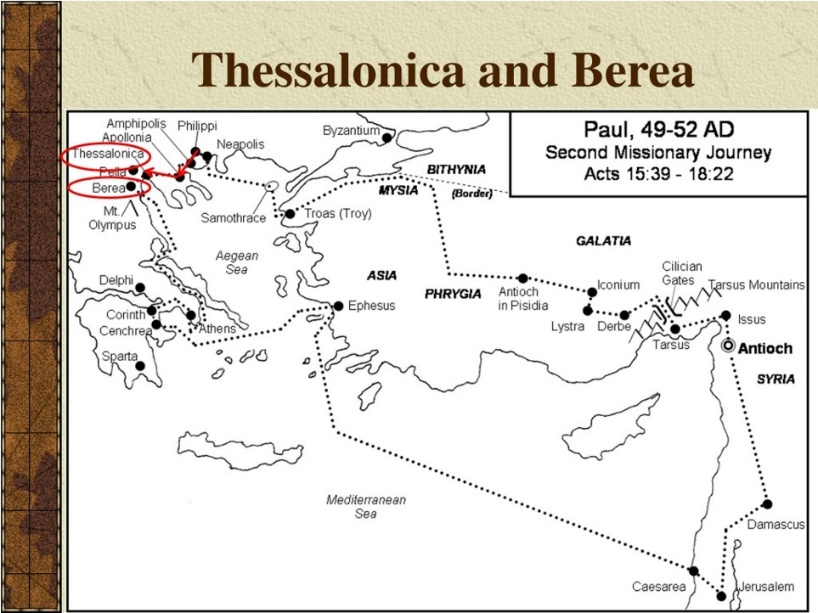
You may immediately say to yourself: I have no formal biblical training, so how can I become like the Bereans? How can I learn to separate truth from error?
Make no mistake, the Apostle Paul put the onus on us, those endowed with the Holy Spirit (which we receive after our faith profession in the shed blood of Jesus which covers our sin) to discern what the Bible teaches. This is not an obligation that we can slough off on the pastor or the church leaders. It is incumbent upon us to be students of God’s Word. With diligence we can become faithful Bereans.
Rules of Biblical Interpretation
Following are 6 overarching hermeneutical principles (which means science of interpretation) that will help us in this endeavor.
1. Exegete (pull out) rather than eisegete (read into):
These two words are rarely used outside a biblical setting, but they’re nonetheless important to understand. We must do everything in our power to avoid reading our own presuppositions and biases into Bible passages which is our natural tendency. Rather, we must “pull out” what the inspired authors were conveying. Too often people have the tendency to eisegete (read into) passages which only serve to muddy the waters. We all do it. But it’s something we must be aware of and guard against.
J.I. Packer, author of the best-selling 1973 book “Knowing God” was considered one of the most influential evangelicals in North America. He wrote about the presuppositions we bring to the Bible and how they impact what we read:
“We do not start our Christian lives by working out our faith for ourselves; it is mediated to us by Christian tradition, in the form of sermons, books and established patterns of church life and fellowship. We read our Bibles in the light of what we have learned from these sources; we approach Scripture with minds already formed by the mass of accepted opinions and viewpoints with which we have come into contact, in both the Church and the world… It is easy to be unaware that it has happened; it is hard even to begin to realize how profoundly tradition in this sense has molded us. But we are forbidden to become enslaved to human tradition, either secular or Christian, whether it be “catholic” (universal) tradition, or “critical” tradition, or “ecumenical” tradition. We may never assume the complete rightness of our own established ways of thought and practice and excuse ourselves the duty of testing and reforming them by Scriptures.”
In other words, it should not be underestimated how our beliefs formed by life experiences impact how we interpret the Bible. We don’t begin with a clean slate. If we merely accept the opinions of others, two things can happen:
1. We may affirm the errant views of others.
2. Even if those views are accurate, merely appropriating those views without serious investigation, short-circuits the exploratory process and deep convictions are never formed. And to defend our faith requires confidence in those views, which can only come through diligent study.
Peter exhorted his readers to, “always be prepared to make a defense [apologia] to anyone who asks you for a reason for the hope that is in you;” (1 Peter 3:15)
So, when in Bible study, as others share their opinions, if we follow the 5 interpretive rules below, we can determine if what they’re saying is correct.
2. Audience Relevance:
This means exactly as it sounds. We need to first determine the relevance of a passage to the original audience. For example, when we read Paul’s letters to the Colossians or the Ephesians, we must view everything through their first-century lens. Similarly, if we read Paul’s first letter to the Thessalonians or his second epistle to Timothy as though they were written directly to us in 2026, we will undoubtedly miss the points Paul was attempting to convey. I cannot overstress the importance of this too often ignored principle.
Casually reading the Bible is of great value, but if we want to develop sound doctrinal conclusions, we need to study it which requires understanding audience relevance. Viewing a passage in context is of absolutely essential.
This principle of first considering the supremacy of the original audience is vital to understanding all Bible passages, and if ignored makes it virtually impossible to interpret Bible prophecy, which is time and context sensitive. By that I mean that if the Apostle Paul wrote that something was about to happen, given the fact that he wrote his epistles almost two thousand years ago, we must assume that it already took place. Though that seems obvious, we’ve been conditioned to ignore this simple rule.
For example. To the church at Corinth Paul wrote:
“I think that in view of the present distress it is good for a person to remain as he is. 27 Are you bound to a wife? Do not seek to be free. Are you free from a wife? Do not seek a wife. 28 But if you do marry, you have not sinned, and if a betrothed woman marries, she has not sinned. Yet those who marry will have worldly troubles, and I would spare you that. “the appointed time has grown very short. From now on, let those who have wives live as though they had none, 30 and those who mourn as though they were not mourning, and those who rejoice as though they were not rejoicing, and those who buy as though they had no goods, 31 and those who deal with the world as though they had no dealings with it. For the present form of this world is passing away. (1 Corinthians 7:29-31)
First, we need to identify all words that refer to the original audience like verb tenses, time sensitive words and pronouns. “Present distress”; “Are YOU bound to a wife?”; “The appointed time has grown very short”; “For the present form of this world is passing away”.
If we ignore these components of speech and read this passage as though Paul just dropped this letter on our doorstep, we would be forced to conclude that we should not marry. But Paul was referring to conditions that existed at that time which were in the very distant past. We no longer heed Paul’s warning to “remain as we are” because we don’t live in what Paul described as “this present distress.” In AD 57, they were enduring persecution that was about to become severe. The “appointed time” had grown very short. The old covenant sacrificial system was about to permanently pass away, the Jewish-Roman war would begin within 10 years (AD 67-70), and the Temple would soon be destroyed (AD 70).
When Paul wrote, “for the present form of this world is passing away”, notice that it was passing away 2,000 years ago. “Is passing away” is present tense. It was passing away then, not now. It makes no sense if Paul was referring to the end of the world, because it’s not been in the process of passing away since the first century. I believe Paul was referring to the passing of the Old Covenant system, not the gradual end of the cosmos.
In the book of Hebrews, written in approximately AD 63, Paul wrote, “In speaking of a new covenant (Jeremiah 31), he makes the first one obsolete. and what is becoming obsolete and growing old is ready to vanish away.” (Hebrews 8:13) This was seven years before the temple’s destruction when the Old Covenant was “ready to vanish”. The Temple, which was the hub of the sacrificial system, was razed to the ground by the Romans in September of AD 70, marking the Old Covenant’s end.
The point is that we must not read Paul’s imminent warning of distress as though it applies directly to us today because we are not living in “the present distress” which typified the conditions at that time. In addition, Paul referred to the time being short. Time cannot be short then and be short today, 2,000 years later. It can’t be interminably short. So, the admonition to remain as they were, is no longer applicable to us today.
You would not believe how many read “in view of the present distress” and assume Paul is referring to difficult times in our day. It’s tragic that so many make this simple mistake of ignoring the original audience.
To further demonstrate the concept of audience relevance, consider the following from the Apostle Paul’s second letter to the Thessalonians. I would encourage you to read the whole chapter, but for brevity, let’s look at these few verses. Again, focus on Paul’s reference to “you” (which are the Thessalonians).
“…since indeed God considers it just to repay with affliction those who afflict YOU, 7 and to grant relief to YOU who are afflicted as well as to us, when the Lord Jesus is revealed from heaven with his mighty angels…” (2 Thessalonians 1:6-7)
Many Christians read the above as though they are both the “you” and the “us”, but that’s not the way to read the Bible. This is a letter of instruction to the church at Thessalonica, not a theological thesis. Just like receiving a letter from your mom, this was Paul’s correction and encouragement to them at that time. These letters were addressed to beleaguered Christians of Paul’s day.
Consider how the Y’all Bible Version renders these same two verses. One of this translators’ goals was to draw the distinction between “you” singular and “you” plural, which has been lost in most modern translations:
since it is righteous for God to repay with affliction those who afflict y’all, and to give relief to y’all who are afflicted with us.” (2 Thessalonians 1:6-7)
Was the Apostle Paul referring to us in our day or did these words pertain directly to the Thessalonians? Who was it that was afflicted and to whom did the Apostle promise would be granted relief? The Thessalonians, right?
*As a disclaimer, it should be noted that even if a passage wasn’t written directly to us, we can find general application. For example, we can correctly conclude that if God was faithful to the Thessalonians at that time, then we can be assured that he will be faithful to us as He works all things for our good. (Romans 8:28)
To properly understand 1st Thessalonians, we must first remember that the primary focus should always be on the direct recipients. We should never lose sight of the fact that this special promise, “to grant relief to YOU who are afflicted,” applied directly to the Thessalonians and all persecuted Christians at that time. Paul assured them (not us) that they would be granted relief and that their persecutors received their just penalty.
In AD 66, when Jerusalem was surrounded by armies the first time, Josephus (a Jewish historian) wrote that when the Romans inexplicably pulled back, the Christians fled in mass to the mountain regions of Pella…heeding Jesus’s warning to flee Judea when they saw “Jerusalem surrounded by armies” (Luke 21:20). In the wake of Jerusalem’s destruction, 1.1 million Jews had died and 100k had been taken captive. God indeed was faithful to avenge his beloved followers as He poured out his wrath on that wicked and perverse Christ-killing generation. (Matthew 23:36)
Consider yet another example. As Jesus and His disciples were on the Mount of Olives looking down at the magnificent temple (that had been under construction for approximately 44 years), Jesus said, “See that no one leads YOU astray.” (Matthew 24:4) Right after telling them that this amazing edifice would be destroyed, and before he began explaining what they would witness leading up to it’s dissolution, Jesus specifically warned them (not us) not to be misled by false prophets and false Christs. Was this a warning for us today? No, it was to Jesus’s faithful followers who were gathered around.
Approximately 6-9 months earlier, Jesus told His followers that some would live to see these things in their lifetimes.
“For the Son of Man is going to come in the glory of His Father with His angels, and will then repay every person according to his deeds. 28 “Truly I say to you, there are some of those who are standing here who will not taste death until they see the Son of Man coming in His kingdom.” (Matthew 16:27-28)
This concept of audience relevancy is quintessential to our understanding of the Bible just as it is when reading any piece of literature… however, much more the Word of God. Since the late 1800s when dispensationalism was becoming the dominant interpretive system, we have traveled far off course in this regard, too often ignoring the original audience.
Looking further into this Olivet passage, it again should not escape our notice to whom Jesus was referring in verse 9? “Then they will deliver YOU up to tribulation and put YOU to death, and YOU will be hated by all nations for my name’s sake. (Matthew 24:9)
Concerning this verse, a famous pastor who once shepherded over 10,000 said, “They killed Jesus. They killed all the apostles. We’re all going to be persecuted…”
So, what in the following passages would lead anyone to believe that Jesus was referring to our generation? Let’s look at the other Gospel accounts regarding persecution. Notice the consistent references to “you” and “your”.
“But before all these things, they will lay their hands on you and persecute you, turning you over to the synagogues and prisons, bringing you before kings and governors on account of My name.” (Mark 13:9)
“But be on your guard; for they will hand you over to the courts, and you will be flogged in the synagogues, and you will stand before governors and kings for My sake, as a testimony to them.” (Luke 21:16)
But you will be betrayed even by parents, brothers and sisters, other relatives, and friends, and they will put some of you to death,” (Luke 21:12)
Considering that Jesus was speaking directly to His disciples, it’s both puzzling and troubling that this famous pastor would insist that these sordid expectations are meant for us. Clearly, many have been persecuted and even martyred down through the centuries due their association with Jesus. But to whom was Jesus warning? Us? Was Jesus prophesying that all Christians throughout history and specifically twenty-first century Christians, would be delivered up to tribulation and put to death?
As absurd as this sounds, that’s exactly what this pastor was stating. Though many have suffered for the sake of Christ since His ascension, and many today are being severely persecuted in Muslim and Communist countries for their Christian testimonies, the above prophetic decree is not about us. Sadly, twenty-first century Christians have become so egocentric, narcissistic and myopic that they believe everything is about them and their twenty-first century generation. This reminds me of the 1972 Carly Simon hit single, “You’re So Vain.” Chorus:
You’re so vain
You probably think this song is about you
You’re so vain (you’re so vain)
I’ll bet you think this song is about you
Don’t you? Don’t you?
Given the current state of interpretational affairs, it would be more like:
You’re so vain,
You probably think this passage is about you
You’re so vain (you’re so vain)
I’ll bet you think this passage is about you
Don’t you, don’t you?
I recently heard someone use the term narcigesis, which is even more descriptive than eisegesis to portray our current interpretational climate.
So, whether a Christian was martyred in the fifth or the fifteenth century, it would not be a prophetic fulfillment of the above passages because the YOU pertained to those who lived in “this perverse generation” (Matthew 17:7) And God made certain that through first-century historians Josephus and Tacitus (neither were Christians), their accounts of this time period were preserved for our edification. The uninspired extra-Biblical sources, they prove the historical fulfillments of Jesus’s prophetic words, thus further testifying that Jesus truly was the Messiah.
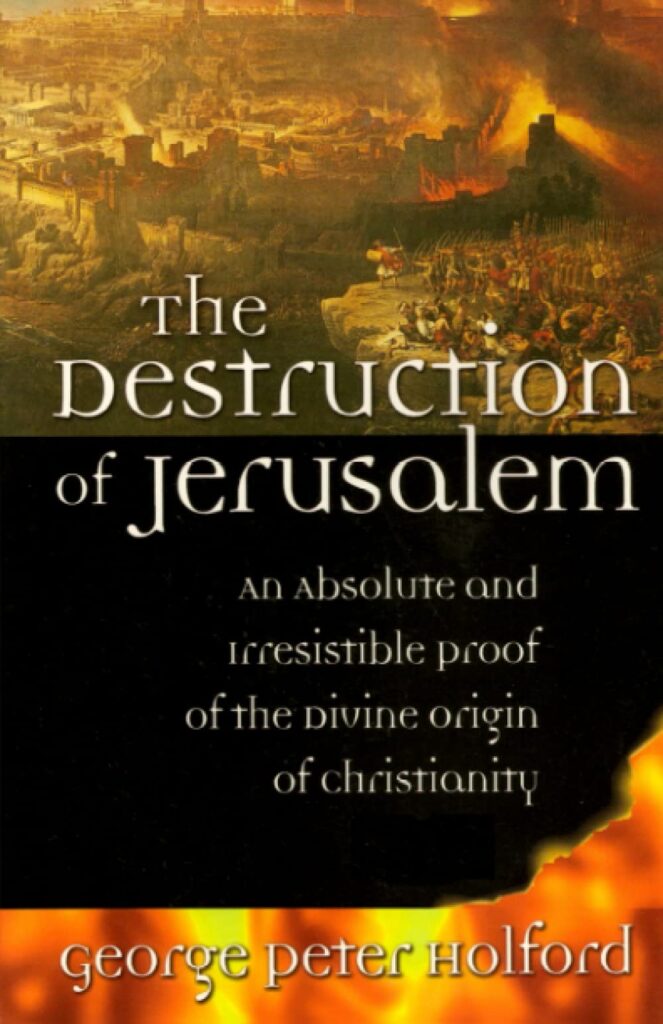 In 1805, George Peter Holford harnessed the amazing power of those historical accounts in: THE DESTRUCTION OF JERUSALEM: AN ABSOLUTE AND IRRESISTIBLE PROOF OF THE DIVINE ORIGIN OF CHRISTIANITY: Including a narrative of the calamities which befel the Jews, so far as they tend to verify our Lord’s predictions relative to that event. With a Brief Description of the City and the Temple. Talk about a long title! This excellent resource offers historical proof that the events Jesus prophesied in the Olivet Discourse occurred between Jesus’s ascension in AD 30 and the destruction of Jerusalem in AD 70.
Holford recounted the ever-present persecution of the first century believers.
“In the very infancy of the Christian church, these unmerited and unprovoked cruelties began to be inflicted. Our LORD, and his forerunner John the Baptist, had already been put to death; the Apostles Peter and John were first imprisoned, and then, together with the other Apostles, were scourged before the Jewish council; Stephen after confounding the Sanhedrim with his irresistible eloquence, was stoned to death; Herod Agrippa “stretched forth his hands to vex certain of the church,” (Acts 12:1) beheaded James the brother of John, and again imprisoned Peter, designing to put him to death also; St. Paul pleaded before the Jewish council at Jerusalem, and before Felix the Roman governor, who trembled on the judgment-seat, while the intrepid prisoner “reasoned of righteousness, temperance, and judgment to come!” (Acts 24:25)
Tacitus, a Roman senator and historian who was hostile to Christianity (which makes his testimony especially valuable) explicitly connected the Christian persecution to Nero’s blame-shifting for the Great Fire:
“Mockery of every sort was added to their deaths. Covered with the skins of beasts, they were torn by dogs and perished, or were nailed to crosses, or were doomed to the flames and burnt, to serve as a nightly illumination, when daylight had expired… Nero offered his gardens for the spectacle.” Tacitus, Annals 15.44
So, just as Jesus prophesied, the disciples were hated by both the Christ-rejecting Jews and the Romans and many of died as martyrs.
3. The Bible was written FOR us, but it was not written directly TO us.
This interpretive principle piggybacks “audience relevance”. We need to consider that when we read Paul’s letters to Timothy, for example, he was specifically addressing Timothy. God’s Word never excludes modern day readers, but it’s our responsibility to determine what it meant to Timothy before finding application. We are essentially reading someone else’s mail when we read the Bible because everything has a context and we are not the original target audience of anything written in either the Old or New Testaments.
So, how does this play out for us when reading these letters almost 2,000 years after they were written? As quoted earlier, we know that,
“All Scripture is breathed out by God and profitable for teaching, for reproof, for correction, and for training in righteousness, 17 that the man of God may be complete, equipped for every good work.” (2 Timothy 3:16-17)
Therefore, every word on every page of the Bible was written to teach, reprove, correct and train Christians of all ages in righteous living. Every jot and tittle was preserved for our edification. We must seek a balanced approach, neither ignoring the original nor take “audience relevance” to the extreme, realizing that even if a passage had a first century target audience, every word is for our understanding and betterment.
To recap, we must first determine what a passage meant to the original audience before we begin attempting to apply it to us. I am being intentionally redundant at this point to make clear that too often this assumption is ignored. Too many act as though the Bible arrived with the morning’s paper. Christians are so quick to find personal application that they don’t first take the time to understand what a passage meant to the original audience. And this is recipe for causing a doctrinal crisis.
4. God neither lies nor misleads. Hopefully no Christian would be audacious enough to call God a liar. (Hebrews 6:18) “so that by two unchangeable things in which it is impossible for God to lie, we who have taken refuge would have strong encouragement to take hold of the hope set before us.” But the reality is that the way many interpret the Bible, they unwittingly call God’s integrity into question. Let me be clear. Of course they wouldn’t couch it this way, but the truth is that’s exactly what they do. I’ll explain that in a moment but first some ground rules.
If a prophet of God proclaimed that something was about to take place, and if that event does not take place in the near term, he was a false prophet. This was clearly spelled out in Deuteronomy 18:18-22.
18 I will raise up for them a prophet like you from among their brothers. And I will put my words in his mouth, and he shall speak to them all that I command him. 19 And whoever will not listen to my words that he shall speak in my name, I myself will require it of him. 20 But the prophet who presumes to speak a word in my name that I have not commanded him to speak, or who speaks in the name of other gods, that same prophet shall die.’ 21 And if you say in your heart, ‘How may we know the word that the Lord has not spoken?’— 22 when a prophet speaks in the name of the Lord, if the word does not come to pass or come true, that is a word that the Lord has not spoken; the prophet has spoken it presumptuously. You need not be afraid of him.
God made it abundantly clear that He does not look favorably on those who purport to speak for Him. God said, “that same prophet shall die” who presumes to speak a word in the Lord’s name that He has not inspired them to speak. Whatever God speaks through a prophet must come to pass within the time parameters set or he is not speaking words from God. There is no wiggle room. However, many wrongly assume that’s there’s a fudge factor with God’s prophetic word… that He graded first-century prophets/Apostles on a curve.
They argue that since God is eternal, He is not bound by time. Therefore, when God’s inspired prophet or author says that something must happen soon, He isn’t bound by time constraints. Though it is true that God is infinite where time is meaningless, His finite creatures to whom the Bible was written are bound by the time clock God created at the world’s foundation. Think about it this way. How could a prophet presuming to speak for God be charged with a false prophecy if the time duration to fulfillment is completely ignored? It took me many years to come to this simple but critical realization. The timing of a prophecy is integral to the prophecy.
Following is an example. Let’s return to Matthew 24. As Jesus sat on the Mount of Olives overlooking the magnificence of the massive temple, He told His disciples,
“YOU see all these, do YOU not? Truly, I say to YOU, there will not be left here one stone upon another that will not be thrown down.”
Jesus predicted that the Temple would be razed to the ground. But when? Thirty-two verses later in Matthew’s Olivet account, Jesus predicted the unimaginable when He emphatically stated, “Truly, I say to you, THIS GENERATION will not pass away until all these things take place.” (Matthew 24:34)
One incredible event encompassed in “all these things” was the complete annihilation of the Temple which Jesus said would happen within 40 years (a biblical generation). And though there was Roman oppression of the Jews, at that time there was a relative peace throughout the Roman Empire called the Pax Romana. So, just as Jesus predicted, within 40 years, the Temple was completely destroyed during the AD 67-70 Jewish war with Rome. So, this was not just a startling prediction but an amazing fulfillment, proving once again the divinity of Christ. It’s really a shame that we don’t teach first century history in our Sunday schools and Bible studies. More on the destruction Jerusalem later.
So, “all these things” regard the predicted events and conditions in the preceding verses (Matthew 24:3-33) which include false Christs, wars and rumors of wars, famines, earthquakes, persecution, martyrdom, the abomination of desolation and the great tribulation. All within “this generation.” Not “that generation” or some future generation. Do you see how important the time parameter, “this generation,” is regarding these predictions?
Further, do you realize the significance that if the things contained in Jesus’s Olivet prophecy did not take place within a generation, Jesus would be guilty of false prophecy? Therefore, failing the Deuteronomy 18 test. Attempting to read their own eschatology into the narrative, some have changed what Jesus actually said by arguing that what Jesus meant was “the generation that sees these signs”. I’m sorry but that’s not what Jesus said no matter how much one wants to believe it. It’s a sad commentary when Christians are so infatuated with their paradigm that they’re willing to change what Jesus actually said.
In “This generation”, an article appearing on DeadRight.net, the author wrote: “The Bible records Jesus using the word “generation” 13 times, when you harmonize the parallel accounts. Taken separately, Matthew records 9 times, Mark 4 times and Luke 11 times, for a total of 24 verses. In every case, Jesus is referring to the Jews alive at that moment in time. (30-33 AD)” “This generation” or a derivative thereof, was used 24 times in the three synoptic accounts. Consider the following passage which preceded the Olivet Discourse in Matthew’s account. Jesus emphatically stated that “all these things” would come upon “this generation.”
34 “Therefore, behold, I am sending you prophets and wise men and scribes; some of them you will kill and crucify, and some of them you will flog in your synagogues, and persecute from city to city, 35 so that upon you will fall the guilt of all the righteous blood shed on earth, from the blood of righteous Abel to the blood of Zechariah, the son of Berechiah, whom you murdered between the temple and the altar. 36 Truly I say to you, all these things will come upon this generation. (Matthew 23:34-36)
It seems very strange that the same pastors and theologians who believe that Jesus was speaking about a generation 2,000 years future in Matthew 24, but in the above passage when the same language is used as Jesus excoriated the Pharisees, they admit that “this generation” referred to the first century generation. I find that rather disingenuous.
Let’s revisit J.I. Packer’s statement regarding presuppositions:
“We read our Bibles in the light of what we have learned from these sources; we approach Scripture with minds already formed by the mass of accepted opinions and viewpoints with which we have come into contact, in both the Church and the world.”
Well known Bible prophecy experts are no less immune than we are to having “minds already formed” when they open their Bibles. They are beholden to a system that forces them to deny that “this generation” actually meant “this generation.” Let that sink in.
And because of the prophecy experts’ credibility (authority bias), many Christians follow their lead and assume that through God’s prophets, God sometimes said that something was about to happen that might remain unfulfilled for centuries or even millennia. This simply cannot be!
To put it bluntly, this would be equivalent to calling God a liar. Think about it. How then could the prophet’s legitimacy be questioned if the time of fulfillment is as crucial to the prophecy as the event prophesied? To put it mildly, God did not think well of those who wrongly proclaimed something on His behalf. Again, this would call God’s integrity into question. I know that sounds harsh, but the reality is that when a person interprets the Bible and concludes that the event prophesied did not happen within the stated time parameter e.g. “soon”, “quickly”, “shortly”, “at hand”, “this generation” etc., it should be obvious that there is something wrong with their interpretation of that passage, and not that something is inherently wrong with God’s word. The Bible is infallible. So, if an event was prophesied to happen soon and if we are convinced that it did not happen soon, we have three choices.
-
- We can question the integrity and inspiration of the Bible. Which would be catastrophic. OR
- We can attempt to alter what the passage says or provide an excuse for non-fulfillment. OR
- We can assume that our understanding of the way that prophecy was supposed to be fulfilled is wrong and then attempt to determine why.
For example, look at God’s warning that came through the prophet Ezekiel. Let me set this up for you. The people of his day continued to argue that just because God warned that their disobedience would lead to their impending judgment, God would delay His judgment as if it was an idle threat. As such God was ignored and the people kept sinning. God would say that something was near and the people would retort, “the days grow long, and every vision comes to nothing.”
In other words, they basically mocked God saying that He was all talk and no action. So, they ignored God’s threats of judgment. Then notice God’s sharp reaction. “For there shall be no more false vision or flattering divination within the house of Israel… God continued: “But say to them, the days are near, and the fulfillment of every vision… For I am the Lord; I will speak the word that I will speak, and it will be performed. It will no longer be delayed.”
Do you see it? Writing almost 600 years before Christ, God made clear through Ezekiel that He was not a God of forever delays. “Thus says the Lord God: None of my words will be delayed any longer, but the word that I speak will be performed, declares the Lord God.” God was very serious about the timely fulfillment of His promises and predictions. He is not a God of confusion where He forever promises things that “must shortly take place” (Revelation 1:1) that remain unfulfilled for thousands of years.
Now, let’s hear from the Apostle Paul in his AD 64 letter to the Hebrews regarding delays: “For you have need of endurance, so that when you have done the will of God you may receive what is promised. For, “Yet a little while, and the coming one will come and will not delay;” God is not a God of delays.
Read the entire Ezekiel 12 passage below for context:
21 And the word of the Lord came to me: 22 “Son of man, what is this proverb that you have about the land of Israel, saying, ‘The days grow long, and every vision comes to nothing’? 23 Tell them therefore, ‘Thus says the Lord God: I will put an end to this proverb, and they shall no more use it as a proverb in Israel.’ But say to them, The days are near, and the fulfillment of every vision. 24 For there shall be no more any false vision or flattering divination within the house of Israel. 25 For I am the Lord; I will speak the word that I will speak, and it will be performed. It will no longer be delayed, but in your days, O rebellious house, I will speak the word and perform it, declares the Lord God.”
26 And the word of the Lord came to me: 27 “Son of man, behold, they of the house of Israel say, ‘The vision that he sees is for many days from now, and he prophesies of times far off.’ 28 Therefore say to them, Thus says the Lord God: None of my words will be delayed any longer, but the word that I speak will be performed, declares the Lord God.” (Ezekiel 12:21-28)
Did you catch that? “None of My words will be delayed any longer.” So, why do pastors continue to encourage us to violate God’s decree and pretend that God can’t keep time?
5. Context is king
This is yet another facet of the interpretive diamond. Nothing can be properly understood without understanding the context in which a book or passage was written. For example, consider the following verse that’s on Hallmark cards, signs and placards everywhere: “For I know the plans I have for you’—this is the Lord’s declaration—‘plans for your well-being, not for disaster, to give you a future and a hope’” (Jeremiah 29:11, CSB). Is this truly a promise guaranteeing wellbeing for all who trust God? Considering the persecution of the Apostles, health wealth, and prosperity weren’t exactly hallmarks of their personal experiences. As the author of Hebrews wrote, “For you had compassion on those in prison, and you joyfully accepted the plundering of your property, since you knew that you yourselves had a better possession and an abiding one.” (Hebrews 10:34)
Further, consider the Apostle Paul’s rather tumultuous journey since following Jesus.
“Five times I received at the hands of the Jews the forty lashes less one. 25 Three times I was beaten with rods. Once I was stoned. Three times I was shipwrecked; a night and a day I was adrift at sea; 26 on frequent journeys, in danger from rivers, danger from robbers, danger from my own people, danger from Gentiles, danger in the city, danger in the wilderness, danger at sea, danger from false brothers; 27 in toil and hardship, through many a sleepless night, in hunger and thirst, often without food, in cold and exposure. 28 And, apart from other things, there is the daily pressure on me of my anxiety for all the churches. Not exactly a life of prosperity!
In an article titled, “How Jeremiah 29:11 is Far Better When You Properly Interpret It,” Brian Chilton helps us understand this verse in context. He wrote, “The verse has been often misapplied as it has become a staple for graduation Hallmark cards, plaques, and knick-knacks. For some, the verse holds a promise that God will never allow the person to suffer bad experiences or trouble.”
Chilton then wrote, “It is critically important to note that Jeremiah 29:11 is part of Jeremiah’s letter to the Israelites who would become Babylonian exiles. This is key to understanding the context of the verse. If the interpreter misses this point, he or she will not comprehend the nature of the verse. Quite frankly, I do not know that anyone would want this to be their graduation theme because God is telling the nation that they are about to experience difficult days ahead.”
Chilton went on, “Jeremiah 29:11 can be likened to Romans 8:28 which states, “We know that all things work together for the good of those who love God, who are called according to his purpose” (Rom. 8:28, CSB). In like manner, God tells those who would be exiled, “I will restore your fortunes and gather you from all the nations and places where I banished you … I will restore you to the place from which I deported you” (Jeremiah 29:14, CSB). While the people would face severe difficulty in their days ahead, they could live with the assurance that God would restore the fortunes of their people and their land. Similarly, we are part of the community of God’s people. We do not always get things right. Quite honestly, we probably mess up more than do right. Nonetheless, God has a better day coming for his children—a day where there will be no more tears, no more pain, no more heartache, no more divisions, and no more death (Rev. 21:3–4).
This is a masterclass on how to employ both the principles of audience relevance and context is king. As you can see, we must not apply Jeremiah 29:11 directly to us in our day since it was a promise given to the Israelites who were about to endure severe hardship. So, what does this verse/passage mean for us. As Chilton wrote, it’s just like the promise of Romans 8:28, where God assures us that He is sovereignly working all things for the good of those who love Him. It doesn’t mean that we won’t go through times of severe hardship, but what it does mean is that God will always be with us through it. What you may find astounding is how many Christians cling to Jeremiah 29:11 as though it guarantees their health and wealth. This is an excellent lesson on how to consider the context of a Bible passage.
6. The Analogy of Faith
This hermeneutical principle (science of interpretation) posits that the Bible interprets itself. No other manmade document is so internally consistent. We must interpret the Bible with the Bible. To understand the Bible, there’s no inherent need to appeal to extra-biblical sources. The Bible is never self-contradictory. We must interpret that which is unclear through the lens of what is clear. Therefore, we are cautioned to take obscure, difficult to understand passages or verses and make doctrines out of them. Rather, we should interpret the more confusing verses through the lens of other clearly understood passages, always with the understanding that the Bible is never contradictory.
Consider this “apparent contradiction” regarding how Judas was said to have died. If the Bible wasn’t internally consistent, we wouldn’t expect harmonization with these two different accounts.
(Matthew 27:5) “…he went away and hanged himself.” Then in (Acts 1:18) “…falling headlong, he burst open in the middle and all his bowels gushed out.”
Are these two accounts contradictory? Matthew wrote that Judas died by hanging while Dr. Luke seems to argue that he died bursting open after falling. Given that there are no contradictions how can this be reconciled?
Both are describing the same death from different points of view. Judas hanged himself and his body later fell (due to decay, after the rope broke or was cut down) and burst open on impact. So, Matthew emphasized the cause of death while Acts emphasized the aftermath.
Let’s consider the analogy of faith from a different perspective by returning to Jesus’s Olivet Discourse. This regards the synergy between the Old and New Testaments. Do you remember when Jesus was on the Mount of Olives looking down at the Temple explaining the things that would take place within their generation (Matthew 24:34)? Jesus warned, “Immediately after the tribulation of those days the sun will be darkened, and the moon will not give its light, and the stars will fall from heaven, and the powers of the heavens will be shaken.” (Matthew 24:29) What’s your immediate impression? Doesn’t this sound like earth ending astrological events were on their horizon? Since it’s often assumed that Jesus was prophesying the end of the cosmos, and because this has not happened, it must refer to our future annihilation.
In the book of Revelation (the Apostle John’s version of the Olivet Discourse), we find very similar language.
“When he opened the sixth seal, I looked, and behold, there was a great earthquake, and the sun became black as sackcloth, the full moon became like blood, 13 and the stars of the sky fell to the earth as the fig tree sheds its winter fruit when shaken by a gale. 14 The sky vanished like a scroll that is being rolled up, and every mountain and island was removed from its place.”(Revelation 6:12-14)
As we read this kind of “decreation,” poetic language, the $64k question is: How are we to understand the threat of Jesus’s warning? Is this to be taken literally/naturally as so many assume? When the disciples understood these two passages, do you think they assumed that stars would fall from the sky ending our planet? Can you imagine what would happen if the stars fell to the earth? Even a fallen meteor could destroy a major city.
So, how should we interpret Jesus’s decree? Should we read this passage in a vacuum? Should we look to see if this type of language was used by the Old Testament prophets? Indeed. The disciples would have been familiar with similar apocalyptic language usages? Jesus’s prophetic warnings were almost direct quotes from Old Testament prophets. For brevity, let’s consider two OT passages from the prophet Isaiah. In the passage below, notice both the timing of fulfillment (verse 6) and the nature of judgment (earth shaken “out of its place”).
Wail, for the day of the Lord is near; as destruction from the Almighty it will come! 7 Therefore all hands will be feeble, and every human heart will melt. 8 They will be dismayed: pangs and agony will seize them; they will be in anguish like a woman in labor. They will look aghast at one another; their faces will be aflame.
9 Behold, the day of the Lord comes, cruel, with wrath and fierce anger, to make the land a desolation and to destroy its sinners from it. 10 For the stars of the heavens and their constellations will not give their light; the sun will be dark at its rising, and the moon will not shed its light. 11 I will punish the world for its evil, and the wicked for their iniquity…
13 Therefore I will make the heavens tremble, and the earth will be shaken out of its place, at the wrath of the Lord of hosts in the day of his fierce anger. (Isaiah 13:5-13)
The “day of the Lord” (which refers to God’s judgment) was “near.” Time sensitive words were to be taken literally and seriously, not delayed for thousands of years. To interminably put off punishment on the people to whom were angering God, and then carry out that punishment hundreds of years later on a completely different group of people, would punish the wrong villains. When God said that judgment was near, he meant it.
Isaiah 13 refers to the fall of Babylon to the Medes in 539 BC. (read verse 1 – “The oracle concerning Babylon which Isaiah the son of Amoz saw.”) This begs the question: Do the historical and/or scientific records validate the prophesied events as having taken place exactly as stated i.e. “the earth shaken out of its place?” In other words, did the heavens actually shake and did the earth move out of its orbit, which would have ended all life on earth? The answer is obvious.
So, we learn from the Old Testament how Jesus’s disciples would have understood this type of language, which is very similar to the apocalyptic, decreation language contained in the two New Testament passages above. God used these astronomical descriptions prophetically, as He empowered one nation to judge another contemptable nation. Therefore, when we read the New Testament, the same language should be understood similarly to that of the Old Testament prophets and therefore not to be taken as woodenly literal.
Let’s look at the next passage from Isaiah.
Their slain shall be cast out, and the stench of their corpses shall rise; the mountains shall flow with their blood. 4 All the host of heaven shall rot away, and the skies roll up like a scroll. All their host shall fall, as leaves fall from the vine, like leaves falling from the fig tree. (Isaiah 34:3-4)
In Isaiah 34, the prophet announced the desolation of Bozrah the capital of Edom late in the sixth century BC. (read verse 6 – “For the Lord has a sacrifice in Bozrah, a great slaughter in the land of Edom”) If this passage was taken literally/physically, it would be assumed that the sky rolled up like a scroll. As we know these kinds of astrological events didn’t take place as stated because these symbolic words marked the coming annihilation of Bozrah.
The bottom line is that the Bible is never in conflict with itself. It is self-interpreting and perfectly synergistic. Jesus was using language from the OT which would have been understood by His Jewish followers. They wouldn’t have believed that stars were going to actually fall to the earth. Rather, they knew that this was judgment language used against the wicked and perverse Christ-killing generation of Jews.
I hope you can see how important it is to employ sound rules of interpretation when reading and studying the Bible. If we don’t, we can make the Bible say anything we want it to say. Anything to support our presuppositions. And that’s exactly what has happened, especially with Bible prophecy interpretations over the past 150 years.
[Pastor said] “We have the highest rates of anxiety, depression, and suicide in the history of the world. It’s not even close”.
Is this true? I’m not intentionally trying to nitpick, but we need to be faithful Bereans in every regard. We should avoid cynicism and unhealthy criticism, but pastors and church leaders aren’t immune to making unintentionally false statements.
Does the pastor not realize that there have been far darker times in human history than what we’re experiencing today? I believe the reason for the pastor’s statement is in part due to his preconceived biases. He expects that things are worse than they have ever been and will continue to decline. This is baked into the way he reads the Bible. But as we have already seen under the “audience relevance” section, that there were far darker times going all the way back to the the first century, especially prior to the destruction of Jerusalem in AD 70.
Let’s evaluate his statement about anxiety, suicide and depression against the backdrop of recent history. According to this chart, the suicide rates from approximately 1905 until 1945 were significantly higher than they are today. From that time, they steadily dropped until they reached a low in the year 2000. 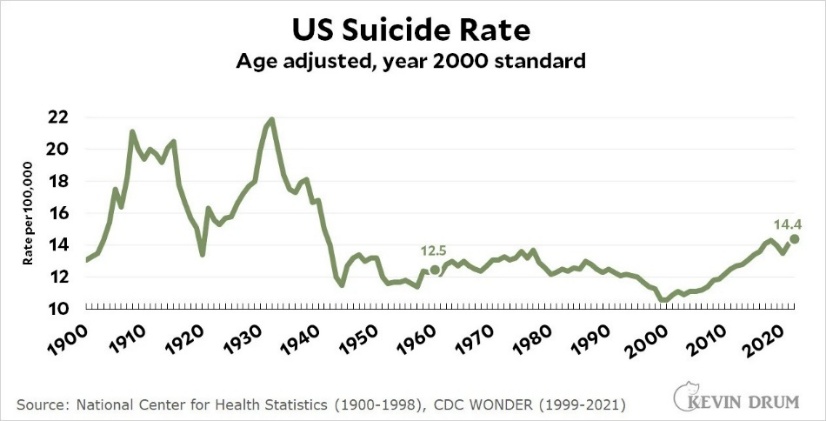
Do we have a mental illness problem today? Of course. But to make a statement detached from reality is problematic at best. It feeds a narrative that is simply untrue i.e. that we’re facing unprecedented times of despair. Rates of suicide and depression often peak during severe economic hardship. In the early 1930s during the Great Depression, you can see the spike in suicides to 22 per 100,000.
What you will find is that many pastors paint a very gloomy picture of our future in large part because they’ve accepted what I believe are unsupported eschatological (end times) conclusions that things must get worse until Christ’s second coming. This glass half empty mentality has pervaded the church since well before I became a Christian in 1972. In large part this pessimistic view comes from not employing sound principles of interpretation.
The short video below dispels the myth that the laundry list of negativities found in 2 Timothy 3:1-13 is a warning for us, today. It was Paul alerting Timothy at that time (mid AD 60s) of the conditions that Timothy would encounter in the last days of the Old Covenant system.
That said, acknowledging the struggles we’re facing is not defeatist. It simply points to how much further we must travel considering far worse times behind us. When society condones men playing women’s sports. When transgenderism becomes accepted if not glorified. When sexual deviancy is celebrated. When assassination culture reaches epic proportions. When class warfare is magnified and the mayor of our most renowned city is an avowed Islamic Marxist… It’s easy to understand the increased level of pessimism. However, by every metric, not only have things been far worse throughout history, the reason for the last 50 years of the west’s societal declines is at least in part the result of a self-fulfilling prophecy.
Said in another way, if we are told ad nauseum that things must get worse and that there’s no possibility of reversal, Christians naturally take themselves out of the game and the vicious cycle continues. Case in point. In 1982, When Debbie (my wife) and I were in our 20s, we picketed abortion clinics with some church friends who were committed to the sanctity of human life. One day following our Sunday morning church service, a passionate gentleman who believed Jesus’s return was imminent, chastised me for us wasting our time trying to save babies while attempting to reform culture. He essentially said that our efforts were futile, much like polishing brass on a soon sinking ship. The goal to makes disciples is not necessary to save culture, but as the Gospel pervades all areas of life, it will have a purifying effect. When God is exalted and His principles are followed, societies change. Contrarily, when we expect defeat this mentality impacts everything.
This pessimistic view has pervaded the church to the point that the worse things get the closer many Christians think Christ’s return will be. It’s sadly ironic, but I’ve actually heard some believers revel in the darker times thinking that temporal increases of immorality will speed up the Lord’s return. If this is what the Bible predicts, then so be it, but I think this view is demonstrably false.
Before I came to the conclusions I now hold, the question I kept asking myself was why, after 2000 years of Kingdom advancement, is the Gospel destined to fail? Why would Jesus grow a band of 12 young Galileans into a billion worldwide Christ followers, only to mandate that it’s all going to crash and burn? Does that make sense to you? It doesn’t to me since our mission to disciple the nations is far from over.
In the Forest Frank video linked below, Forest said, “It is an angst for the return of Christ, for the return of justice. Jesus Christ is the only way and He’s coming back soon, get your life right because we don’t know if today is our last day.” I love this guy! His passion for Jesus is heartening and infectious. Of course we want to make crooked things straight. We want justice to prevail. But to be honest, I’ve been hearing this “He’s coming back soon” mantra since I became a Christian. That’s 54 years of the constant refrain, “Christ is coming soon.” We have so tortured the word soon that it has become virtually meaningless.
In 1772, John Newton wrote Amazing Grace, one of the most inspiring and uplifting songs ever written. In the final stanza began the words, “The earth shall soon dissolve like snow, the sun forbear to shine…” So, 254 years ago, John Newton expected that the earth was nearing its final breath. This short-term expectation of earth’s annihilation was not new, but the drumbeat has grown ever louder.
This is problematic since as the proverb says, “Hope deferred makes the heart weary.” Have you ever waited expectantly for something that you were told was about to happen? The anticipation grows exponentially as you think the time is growing ever shorter. But then, what you were expecting soon, is delayed. Ultimately it never happens. The harsh reality of unfulfilled promises set in. Initially it causes significant disappointment, but eventually it often turns to disillusionment.
Few consider the impact of failed promises. Years ago, a pastor was preaching through the book of James. When he landed on the fifth chapter he read these words, “You also, be patient. Establish your hearts, for the coming of the Lord is at hand. 9 Do not grumble against one another, brothers, so that you may not be judged; behold, the Judge is standing at the door.” (James 5:8-9) (written AD 61-62)
Language like “Is at hand” and “is standing at the door” created significant imminent expectations among James’s readers. The pastor, in an attempt to explain why the coming of the Lord was not actually at hand, told us that James was simply trying to motivate the beleaguered Christians by telling them that Christ’s return in judgment was “at hand”. In other words, the pastor admitted that James, the brother of Jesus and an inspired New Testament author, was using situational ethics where the ends, keeping the Christians engaged and motivated during severe persecution, justified the means, basically lying.
Of course, the pastor never said or even implied that James intentionally lied but that was the net effect. He would never accuse God of impropriety because he’s a godly man with a very refreshing love for the Lord. But the reality is that if we tell someone something that we know not to be true, no matter what our motivation, isn’t it still a lie? Did God ever sanction His inspired Bible authors to lie, even if for a good cause?
I find it sad that we have come to the place where these kinds of excuses have become palatable to the masses. The Bible stands on its own merit. No one should feel the need to apologize for the Word of God. Every word is true and it’s vitally important that we treat it that way. God neither misspeaks nor makes mistakes and he certainly doesn’t employ subterfuge. Why is it that the Bible is the only book ever written where readers have rendered time sensitive words meaningless… i.e. soon can be a long time and a long time can be soon?
My Journey
After more than 20 years as a Christian, I finally came to the realization that there was something very wrong with the way God’s word was being interpreted regarding Bible prophecy. I think this is the Achilles Heel of Christianity.
What started as me merely being unsettled by the accepted eschatological conclusions, turned into a comprehensive skepticism. Kind of a deconstruction before it became fashionable. I had no answers, but I began questioning the kind of interpretational methodology used to form a stream of false conclusions. Every time a Middle East skirmish broke out, a massive earthquake would rock the world, or a school shooting would shock our collective senses, what has been the common refrain? Jesus must be coming soon! Every negative event evoked, “Surely I am coming soon. soon.” Amen. Come, Lord Jesus!” (Revelation 22:20) And they never stop to realize that this verse was written almost 2,000 years ago. How can Jesus be interminably coming soon?
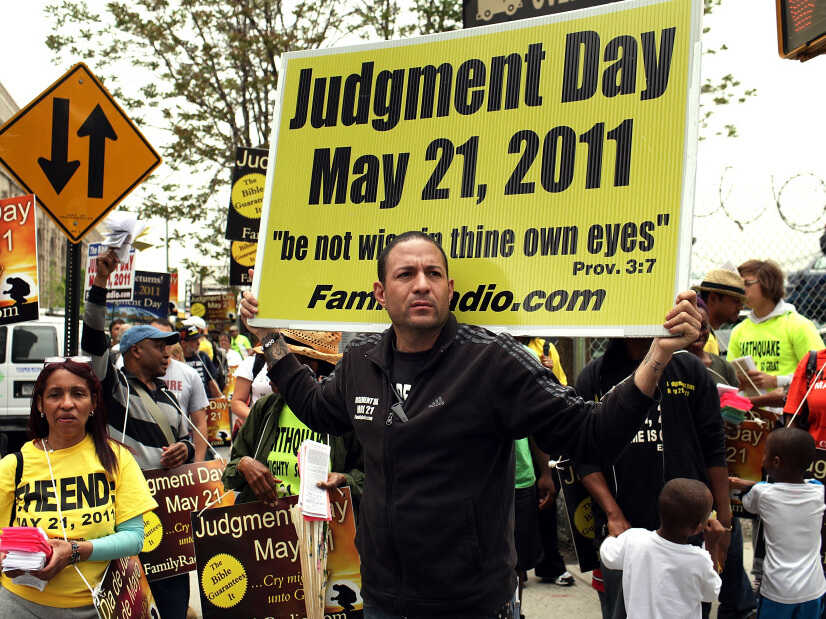 Ever since Christ’s ascension in AD 30, there have been constant predictions of the world’s end. This long list of failed expectations testifies to the interpretive problems. And this has created a palpable skepticism of the Bible’s credibility. Whether specific dates have been set e.g. Harold Camping’s Judgment Day of May 21, 2011, or whether pastors have constantly told us that the end is near, they have the same net negative effect. It calls into question the Bible’s integrity and inspiration. Instead of questioning the eschatological system that continues to drive these false prophetic conclusions, too many question the Bible.
Let me stop at this point and make clear that there is a viable biblical solution to what may appear to be an insurmountable dilemma. So, just know that I have utmost confidence that God’s word, if properly interpreted, is bulletproof. Therefore, we don’t have to settle for a system that forsakes many of the interpretative principles I’ve outlined.
Almost every New Testament reference to Christ’s coming in judgment is couched in near-term language. And that should be telling. Is it possible that what was imminently expected actually took place? In other words, the first century Christians expected some sort of coming in their lifetimes just as the opening 3 verses in the book of Revelation unequivocally state.
“The revelation of Jesus Christ, which God gave him to show to his servants the things that must soon take place. He made it known by sending his angel to his servant John… 3 Blessed is the one who reads aloud the words of this prophecy, and blessed are those who hear, and who keep what is written in it, for the time is near. (Revelation 1:1,3)
The New Testament is replete with this kind of imminence. Any fifth grader who hasn’t been steeped in interpretational subterfuge would believe that the signified events in the Revelation “must take place shortly”, “for the time is near”, cannot support a 2,000-year delay.
So, if whatever is described in the highly symbolic book of Revelation correlates with the events prophesied by Jesus in the Olivet, that means that those events were expected between AD 30 and AD 70 (a biblical generation). The question is, did they happen or not? We know historically through the writings of Josephus, Tacitus and others, that in AD 70, after a 3 1/2 year Roman siege of Jerusalem, the Temple was destroyed just as Jesus predicted. And “all these things” that I referenced earlier in Matthew 24, took place exactly as prophesied. It’s all documented. So, why are we still looking for future fulfillments, either pretending that these things never happened or, with no biblical license to do so, demanding that they must be fulfilled again?
How can we preach the Gospel to the whole world again? (Matthew 24:14) How can we have another great tribulation “such as has not occurred since the beginning of the world until now, nor ever will again.” (Matthew 24:20) Will there be another abomination of desolation that must be fled from flat-roofed Judean houses? What happens if I live in Florida? (Matthew 24:15). Will “The sun be darkened, and the moon will not give its light, and the stars will fall from the sky, and the powers of the heavens will be shaken”, again? (Matthew 24:30) How can it be that we “will see the Son of Man coming on the clouds of the sky with power and great glory”, again?
Once Bible prophecy experts begin making the rules up as we go, there’s no end to the absurd lengths they will travel to avoid the obvious i.e. that nowhere does the Bible predict multiple fulfillments of the NT prophecies. I recently heard a brilliant Bible apologist give an outstanding interpretation of the Olivet Discourse, showing how everything was fulfilled within a generation of Jesus’s statements, only to watch him say, with no biblical authority whatsoever, that’s it’s all going to happen again. And if “this generation” referred to that wicked and perverse Christ-killing generation, will we have another “this generation” to identify when it might happen again? Where does it end? Another virgin birth? Another baptism? Another crucifixion? Ludicrous you say? Not any more than leading people to believe that the AD 67-70 siege on Jerusalem and the razing of the Temple was simply a dress rehearsal.
How is it possible that so many eschatological experts and pastors of our day have ignored the elephant in the room i.e. that Jesus’s words must be fulfilled within the time parameter Jesus set? They do so because they read the Bible through the lens of their deeply engrained presuppositions. And many Christians follow suit because they were neither taught sound hermeneutics nor first century history. So, instead they read Matthew 24 as though all the references to “you” (the disciples) are us, and the prophesied events are all still in our future.
But thank goodness things are changing. TBN (Trinity Broadcasting Network) reaching 175 nations in every inhabited continent and a potential of a billion viewers, is shaking up the status quo. From its founding, TBN has been a major proponent of the interpretive principles that spawned Hal Lindsey’s Late Great Planet Earth and Tim LaHaye’s Left Behind Series. Combined, approximately 110 million copies have been sold which has served to engrain this “pessimillennial” outlook into our collective psyche. And this excludes the 5 Left Behind movies, spanning from the years 2000 to 2023.
Since its inception in the early 1970s, TBN has been promoting a rapture-believing, antichrist/mark-of-the-beast-fearing, great-tribulation-expecting mantra which includes the forever imminent return of Christ. It’s been a dispensationalist hotbed in its interpretation of the Bible. In the below video, a panel of 4, Dudley Hall, David Holland, and Mike Hayes sat down with Matt Crouch, son of Paul Crouch, TBN’s founder, and they openly discussed their converging journeys. (48 minute video)
As they began to dig in, I was dumbfounded… in a good way. They discussed the prophetic events of Matthew 24 (the Olivet Discourse) and the book of Revelation (the Apostle John’s version of the Olivet in more poetic, apocalyptic language) and how the traditional view of the end times has been missing important details surrounding the timeline of events. It was astonishing that at TBN of all places, they realized “maybe there’s a different way to look at this” i.e. an opposing eschatological system that is at serious odds with today’s most dominant view which was popularized by the Scofield Reference Bible in the early 1900s.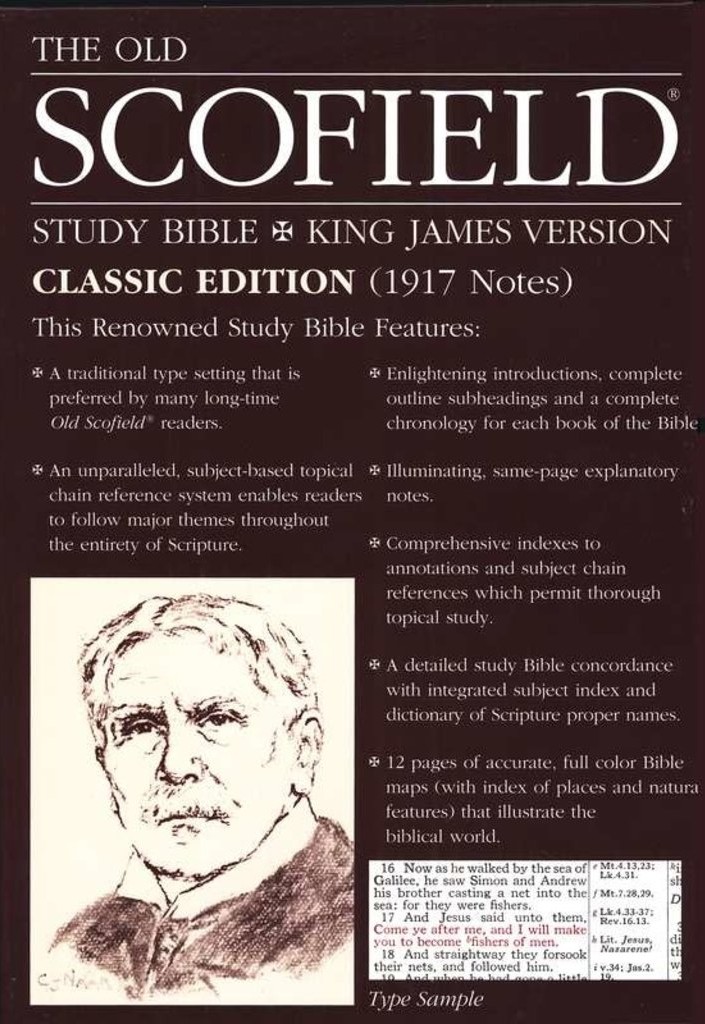
These men have recently undergone an eschatological makeover of epic proportions… an earth-shattering paradigm change. The humility of admitting that they had been wrong for 5 decades, and the boldness of putting truth over finances is heartening. It takes a great deal of courage to change direction so significantly… especially since most of their viewers have been saturated with the sacrosanct end times system these men are now rejecting.
These men believe that bad theology has hamstrung the church’s mission causing unnecessary Middle East wars and doom and gloom expectations for far too long. TBN’s airing of conversations like this will dramatically shift perspectives and alter expectations for years to come. And this could not come too soon.
Consistently, I’ve found that many pastors and theologians have not employed the 6 principles I outlined above. Though those interpretational principles are taught in our seminaries, often the goal was to indoctrinate, rather than teach students how to think i.e. how to study the Bible. This kind of inculcation encourages pastors to eisegete (read into) passages which conform to their predetermined conclusions. So, oftentimes what we were taught remains what we still believe because those presuppositions are never challenged. Does that make sense?
Are Earthquakes and Natural Disasters on the Rise?
Consistent with this pessimistic worldview, many pastors purport that earthquakes and natural disasters are on the rise. They make this claim to support their conclusion that, just as Jesus predicted, “…there will be famines and earthquakes in various places” (Matthew 24:7b) and it’s all happening now.
In 1994, Grant R. Jeffery, a popular Bible prophecy teacher, claims Jesus’s prediction was being fulfilled: “However, since A.D. 1900, the growth in major earthquakes has been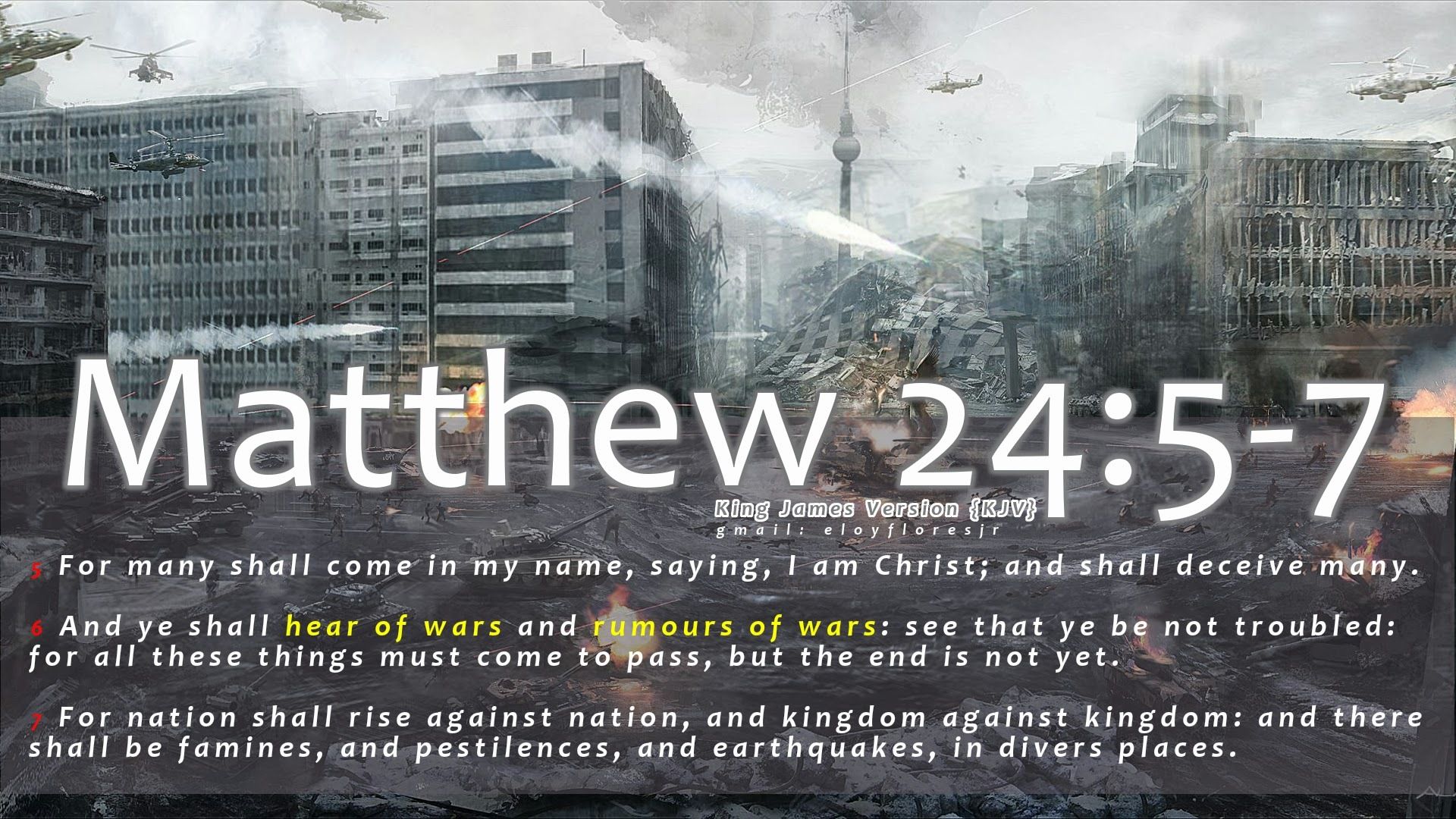 relentless. From 1900 to 1949 it averaged three major quakes per decade. From 1949 the increase became awesome with 9 killer quakes in the 1950’s; 13 in the 60’s; 56 in the 1970’s and an amazing 74 major quakes in the 1980’s. Finally, in the 1990’s as [sic] the present rate, we will experience 125 major killer quakes in this decade.”
Are these reliable facts or is this cherrypicked data to support a conclusion?
In Earthquakes and the End Times: A Geological and Biblical Perspective, Steven A. Austin and Mark L. Strauss, concluded:
“Contrary to these prophecy teachers, no obvious trend is found indicating an abnormal increase in the frequency of large earthquakes during the last half of the twentieth century. Neither is there a noteworthy deficiency of earthquakes in the first half of the century. Graphical plots of global earthquake frequency indicate overall a decreasing frequency of earthquakes through the century. The decades of the 1970s, 80s and 90s experienced a deficit of larger earthquakes compared to earlier decades of the century.”
The reality is that global records going back about 100+ years do not show a statistically significant upward trend in the number of very large earthquakes (e.g. > magnitude 7 or magnitude 8+). There have been 15-20 quakes per year going back centuries. So, why is it presumed that earthquakes are on the rise? I can’t speak to the motivations of Jeffrey, Lindsey and the many other Bible prophecy experts who makes these claims, but they appear to develop a thesis and then attempt to prove it using favorite data.
With regard to “last days” plagues found in the book of Revelation, there was rampant 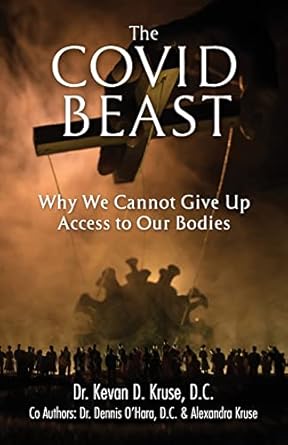 speculation that Covid-19 would usher in the return of Christ. In The Covid Beast: Why We Cannot Give Up Access to Our Bodies, written in early 2021, the author wrote the following: “Is Covid the mysterious “cause” the Bible said would give rise to the beast government of Revelation? The Bible warned us of a deception so great that, if it were possible, it would deceive the very elect. Yet, as we speak, there is a coordinated move by the world’s governments to require mandatory access to our bodies. They are even threatening us with not being able to buy and sell unless we have a vaccine passport.”
Though I agree with the author that we need to vehemently oppose this kind of tyranny, I knew at the time that Covid had nothing to do with Bible prophecy. During a span of 4 years (1347-1351), the Black Plague killed between 75,000,000 and 200,000,000 out of 400,000,000 (20-50%). By contrast, Covid killed approximately 7,000,000 of the world’s 7,900,000,000 population (.08%). And the number of Covid deaths were inflated due to the way hospitals were compensated.
Regarding famines. Acts 11:27-30 records a “great famine” over all the Roman Empire.
“Now in these days prophets came down from Jerusalem to Antioch. 28 And one of them named Agabus stood up and foretold by the Spirit that there would be a great famine over all the world [oikoumene – Roman Empire] (this took place in the days of Claudius). 29 So the disciples determined, every one according to his ability, to send relief to the brothers living in Judea. 30 And they did so, sending it to the elders by the hand of Barnabas and Saul.”
Josephus, a Jewish historian, specifically mentioned a severe famine in Judea, where Queen Elena of Abiabene imported grain from Egypt to relieve starvation. Plus there are severe grain shortages in AD 40-41, AD 51 and AD 62. The famine conditions leading up to the Jewish / Roman War (AD 66-70) significantly intensified as the Roman sieges cut off food supplies. Internal conflict within the walls of Jerusalem destroyed the stored grain.
Josephus wrote,
“The famine was too hard for all other passions, and it is destructive to nothing so much as to modesty; for what was otherwise worthy of reverence was in this case despised; insomuch that children pulled the very morsels that their fathers were eating out of their mouths, and what was still more to be pitied, mothers did the same to their infants.” — Josephus, The Jewish War 5.10.3
“The houses were full of dead women and children, and the lanes of the city were full of the dead bodies of the aged. The children also and the young men wandered about the marketplaces like shadows, all swelled with famine, and fell down dead wheresoever their misery seized them.” — War 5.10.3
Josephus later records a specific incident illustrating the extremity of the famine: *I apologize for the sickening anecdote, but it shows the level of sheer desperation as this once great city was turned into a death trap.
“She then attempted a most unnatural thing; and snatching up her son, who was a child sucking at her breast, she said, ‘O thou miserable infant! For whom shall I preserve thee in this war, this famine, and this sedition?’ … She then killed her son, and roasted him, and ate the one half of him, and kept the other half by her concealed.” — War 6.3.4
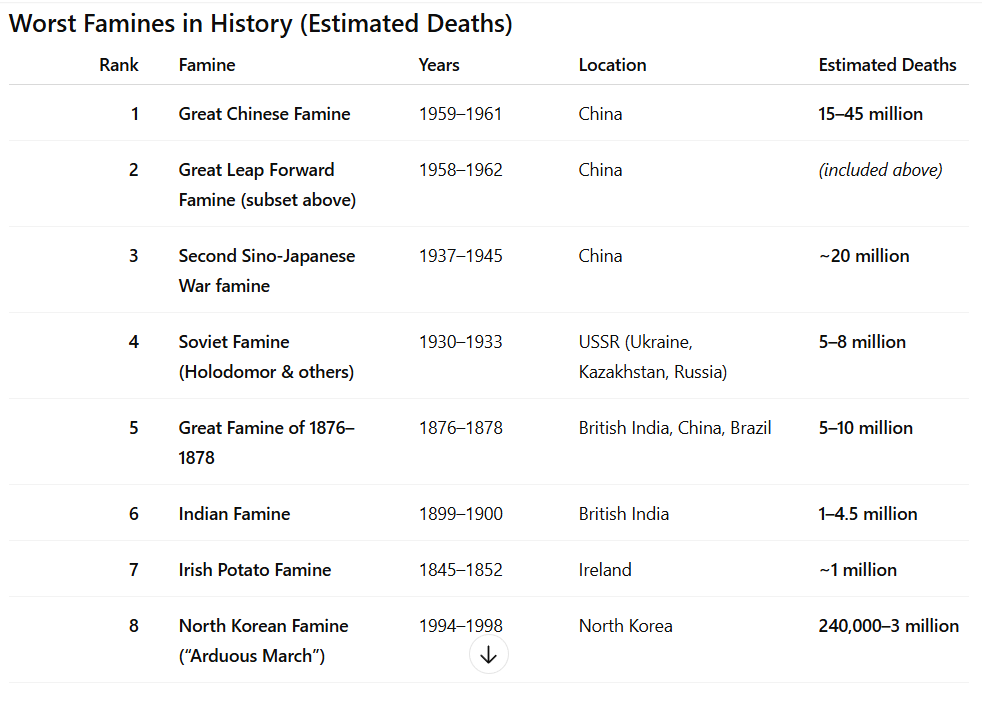
Though there were worse famines in history (chart above), the point is that the famines recorded between AD 30-70 show the uncanny nature of fulfilled prophecy. Sadly, too many Christians know very little about the events between Jesus’s resurrection and the destruction of Jerusalem in AD 70.
Newspaper Exegesis
One of the main problems with our modern-day approach to Bible study is that people hold a newspaper in one hand and the Bible in the other, and they attempt to match the two. Reading current events into the Bible is an issue that must be addressed. This dubious method of interpretation ignores most if not all of the first 6 hermeneutical rules I outlined above. But it’s still the dominant choice of prophetic assumptions.
In many ways one can argue that globally things are actually improving as the Gospel continues to proliferate. The churches in China and Africa are booming in spite of the heavy persecution. Sat7, a satellite ministry that brings Christian programming behind the Muslim curtain, is showing a massive increase in viewership. Christianity is not on the decline anywhere, except for western and northern Europe… and that is largely due to mass Muslim migration. Therefore, we must not continue to buy into the delusion that there’s nothing we can do to reform culture through the Gospel. I do not believe that Jesus’s mandate to make disciples of all nations will return void. I believe that Jesus will give us the power through His Holy Spirit to cover the whole earth with His glory. Audacious? Not really because the Bible teaches an overcoming Gospel.
You are from God, little children, and have overcome [nikao] them; because greater is He who is in you than he who is in the world. (1 John 4:4)
For whoever has been born of God overcomes [nikao] the world; and this is the victory that has overcome the world: our faith. 5 Who is the one who overcomes the world, but the one who believes that Jesus is the Son of God? (1 John 5:4)
If individually we have become overcomers, then why are we supposed to fail collectively? That makes no sense. If, through faith in Jesus we have overcome the world through the power of the Spirit that resides in us, why has it become an accepted assumption that the body of Christ will lose to evil? Clearly, we had a rocky start but if we compare where Christianity was then to where it is today, it’s night and day.
First century Jewish persecution of Christians
It’s definitely not been a straight upward assent toward victory since Jesus rose on the 3rd day, 1996 years ago, but there has been a steady increase of Christ’s government (Isaiah 9:6). After having their Messiah crucified in AD 30 (due of course to false accusations), the Jews mercilessly persecuted Christians for the next 36 years until they became entrenched in a war with Rome, and then became the hunted. This corroborates both Jesus’s parable targeting the Jews and their persecution of Christians.
And the vine-growers took his slaves and beat one, killed another, and stoned another. 36 Again, he sent other slaves, more than the first; and they did the same things to them. 37 But afterward he sent his son to them, saying, ‘They will respect my son.’ 38 But when the vine-growers saw the son, they said among themselves, ‘This is the heir; come, let’s kill him and take possession of his inheritance!’ 39 And they took him and threw him out of the vineyard, and killed him. (Matthew 21:35-39)
“Therefore, behold, I am sending you prophets and wise men and scribes; some of them you will kill and crucify, and some of them you will flog in your synagogues, and persecute from city to city, (Matthew 23:34)
“Then they will hand you over to tribulation and kill you, and you will be hated by all nations because of My name.(Matthew 24:9)
Let’s consider the biblical testimony as it relates to Jesus’s predictions of heavy persecution:
- Jesus’ crucifixion (c. AD 30) The Romans carried out Jesus’s crucifixion, but Jesus was executed due to the insistence of the Jewish leaders and people. So when Pilate saw that he was gaining nothing, but rather that a riot was beginning, he took water and washed his hands before the crowd, saying, “I am innocent of this man’s blood; see to it yourselves.” 25 And all the people answered, “His blood be on us and on our children!” 26 Then he released for them Barabbas, and having scourged Jesus, delivered him to be crucified. (Matthew 27:24-26)this Jesus, delivered up according to the definite plan and foreknowledge of God, you [Jews] crucified and killed by the hands of lawless men [Romans]. (Acts 2:23)
In other words, “You crucified and killed” → assigns moral responsibility to Peter’s Jewish audience (especially in the sense of rejection and handing Jesus over). “by the hands of lawless men” → identifies the Romans as the ones who carried out the physical execution (crucifixion was a Roman method).
- Stephen’s martyrdom (Acts 7) — likely early AD 30s.
- Paul’s own persecution of Christians before his conversion (Acts 8–9).
- James the son of Zebedee executed by Herod Agrippa I (Acts 12:2, c. AD 44).
- James the brother of Jesus executed around AD 62 by High Priest Ananus ben Ananus (reported by Josephus, Antiquities 20.9.1).
Then, in the latter AD 60s, just as Jesus warned, He empowered a multinational force led by the Roman army to crush the Jewish rebellion. (It should be noted that this doesn’t implicate Jews living today any more than it makes 21st century Americans responsible for evils of 19th century slavery.)
Consider this from Luke’s Gospel account regarding the war that would take place within that first century generation.
43 For the days will come upon you, when your enemies will set up a barricade around you and surround you and hem you in on every side 44 and tear you down to the ground, you and your children within you. And they will not leave one stone upon another in you, because you did not know the time of your visitation.” (Luke 19:43-45)
In September of AD 70, after a 5-month siege (April 14, AD 70 – Sept 9, AD 70), the Titus led Roman forces killed 1.1 million Jews; another 100k were taken into captivity; Jerusalem was destroyed; and the Temple was razed to the point that not one stone was left upon another…just as Jesus had prophesied forty years earlier (Matthew 24:2). The Kingdom was indeed taken away from the Jews, and it was given to all people who would come to Jesus by faith (including Jews). Many assume that the promises to Israel were unconditional and eternal. I’m not sure why Christians don’t take Jesus seriously.
43 Therefore I tell you, the kingdom of God will be taken away from you and given to a people producing its fruits. 44 And the one who falls on this stone will be broken to pieces; and when it falls on anyone, it will crush him.” 45 When the chief priests and the Pharisees heard his parables, they perceived that he was speaking about them. (Matthew 21:43-45)
If that was not clear enough, consider how the Christ-rejecting Jews were characterized by the Apostle Paul approximately 30 years after Jesus issued the above threat. Who, according to the Apostle is the true Jew? One born of the flesh or by the Spirit?
28 For no one is a Jew who is merely one outwardly, nor is circumcision outward and physical. 29 But a Jew is one inwardly, and circumcision is a matter of the heart, by the Spirit, not by the letter. His praise is not from man but from God. (Romans 2:29-29)
Later in Romans, Paul made this argument concerning the true offspring of Abraham. Who were Abraham’s children? Those born according to the flesh or the children of promise?
6 But it is not as though the word of God has failed. For not all who are descended from Israel belong to Israel, 7 and not all are children of Abraham because they are his offspring, but “Through Isaac shall your offspring be named.” 8 This means that it is not the children of the flesh who are the children of God, but the children of the promise are counted as offspring. (Romans 9:6-8)
Then just a few years later in the Revelation of Jesus Christ, Jesus (through the angel) stated, “They say they are Jews and are not”. What does Jesus mean? Notice that the Christ rejecting Jews were considered a “synagogue of Satan.”
“‘I know your tribulation and your poverty (but you are rich) and the slander of those who woo that they are Jews and are not, but are a synagogue of Satan. (Revelation 2:9)
Can the Bible be clearer that physical descendancy means virtually nothing? So, who are the true children of Abraham? Those who trust Christ as savior. It has nothing whatsoever to do with birthright (as is presumed by far too many) and everything to do with faith in Christ.
7 Know then that it is those of faith who are the sons of Abraham… 9 So then, those who are of faith are blessed along with Abraham, the man of faith… 28 There is neither Jew nor Greek, there is neither slave nor free, there is no male and female, for you are all one in Christ Jesus. 29 And if you are Christ’s, then you are Abraham’s offspring, heirs according to promise. (Galatians 3:7, 9, 28-29)
Below Peter explained who the actual recipients of this new Kingdom are. All those who come to Christ in faith have become living stones built into a spiritual house. Jews, Americans, Arabs, Chinese and Russian etc. Notice the language. “You are a chosen race.” To whom is Peter speaking? Christians! Those who trust Jesus as Savior, regardless of nationality or race.
4 As you come to him, a living stone rejected by men but in the sight of God chosen and precious, 5 you yourselves like living stones are being built up as a spiritual house, to be a holy priesthood, to offer spiritual sacrifices acceptable to God through Jesus Christ. 6 For it stands in Scripture: “Behold, I am laying in Zion a stone, a cornerstone chosen and precious, and whoever believes in him will not be put to shame.”
7 So the honor is for you who believe, but for those who do not believe, “The stone that the builders rejected has become the cornerstone,” 8 and “A stone of stumbling, and a rock of offense.” They stumble because they disobey the word, as they were destined to do.
9 But you are a chosen race, a royal priesthood, a holy nation, a people for his own possession, that you may proclaim the excellencies of him who called you out of darkness into his marvelous light. 10 Once you were not a people, but now you are God’s people; once you had not received mercy, but now you have received mercy. (1 Peter 2:4-10)
Christians are a “chosen race, a royal priesthood, a Holy nation.” At that time this included both Jews and Gentiles who had become one in Christ. The dividing wall of separation was forever torn down.
12 remember that you [Gentiles] were at that time separated from Christ, alienated from the commonwealth of Israel and strangers to the covenants of promise, having no hope and without God in the world. 13 But now in Christ Jesus you who once were far off have been brought near by the blood of Christ. 14 For he himself is our peace, who has made us both one and has broken down in his flesh the dividing wall of hostility (Ephesians 2:12-14)
Where are we going?
Since the days of the early Church, Christians have endured centuries of darkness and persecution. The Church has grown from a ragtag group of 13 (Jesus plus His 12 disciples) to approx. 2 billion! I realize counted in that 2 billion are Christians in name only, but regardless, there has been a massive increase. And the Kingdom of Christ continues to grow in spite of pockets of decline.
So, even though things are not as we want them to be, given the opportunity to be alive at any point in history, when would you choose? I’d pick 2026! That said, why do you think this pastor is so pessimistic? In other words, what in the way he interprets the Bible, causes him (and many like him) to believe that after this supposed delay he spoke about, Jesus is coming soon only after the world crashes and burns?
I believe there is a level of historical ignorance within today’s Christian culture that I find disturbing. Simply consider the past 150 years:
- Between 1861-1965, the Civil War’s death toll was approximately 700,000 or 2.3% of the 31,000,000 population. Times were very bleak, and one could understand why the pessimistic eschatology many cling to today began to take root shortly thereafter. Not the end?
- In 1918, The Spanish flu killed between 50,000,000 and 100,000,000! But during Covid when many pastors said that we were living in the most perilous times in human history, why did so few die in comparison? So, then why wasn’t 1918 the end?
- World War 1 resulted in 17,000,000 deaths. Not the end?
- Then, 10 years later, the Great Depression brought upon severe economic hardship as suicides rose to the highest point in U.S. history. Kids were stealing bread just to survive. Still not the end?
- World War 2 resulted in the deaths of more than all wars put together, 85,000,000, which was 3-4% of the world’s population. And, as we know now, that wasn’t the end either.
And if we traveled back to the 1st century when Christians were heavily persecuted by both the Jews and then the Romans… or if we travel through the dark ages… or the Black Plague that killed 35-40% of Europe… or when Tyndale was martyred because he dared translate the Bible into English. I could go on but I think the picture is clear. Yes, there have been times of pervading darkness and times of incredible wickedness, but through it all the Gospel of Jesus Christ has continued to march on. So, when people attempt to declare our times as the gloomiest in human history, it’s nothing short of laughable.
And when pastors paint this kind of doom and gloom tapestry, attempting to match every modern-day event with Bible prophecy, it’s not only intellectually lazy since they apparently don’t know history, it has a chilling effect. And not only do they lose credibility (kind of like the boy who cried wolf) but they when it causes Christians to think we’re nearing the end, what’s the point in trying to defy the inevitable?
Since I became a Christian in my senior year of high school in 1972, this drumbeat of negativity has pervaded the sermons of many pastors, the music of many Christian artists and the books of modern prophecy writers. Pessimistic expectations have had an immeasurably negative effect on the body of Christ. I almost quit college because we were told by the “experts” that Jesus was returning any minute. And this has been the case for my entire life. I don’t think most of us realize how this has affected the growth and maturity of Christ’s kingdom. It’s a known fact that short-timers in the military (those who have only 6 months left of service) are virtually ineffective. So, since so many Christians believe we’re nearing the end, how is this any different in it’s overall effect?
This eschatological-induced psychosis has detached us from reality. And Forrest Frank has been just another casualty. That short Forest Frank video is a perfect case in point. Clearly passionate for the Lord, but tragic that he, like most influential Christians, are continuing to send a defeatist message. But I don’t blame him in the least. He’s just a product of what he’s been taught. He thinks that the worse things become, the closer we are to Christ’s return. As I’ve written, this viewpoint has largely been responsible for the malaise that has sidelined so many Christians for too long. There are married couples in my former church who said they initially decided not to have children since they were convinced that the world was about to completely descend into darkness.
I never thought I would get married, much have kids or grandkids. By the time my wife was pregnant with our first child (1982), I was told that this was a terrible time to bring a child into the world, which was followed up with a quotation from Jesus’s Olivet Discourse, “But woe to those women who are pregnant, and to those who are nursing babies in those days!” (Matthew 24:19) My son is now 43! Do you see how destructive these eschatological presuppositions have been? Had I listened to these eschatological zealots who have been wrong about everything, I wouldn’t have two beautiful children and 5 outstanding grandchildren.
From the first century, Christians were convinced that the Gospel was going to overcome the world (which I believe is biblically supported). John, writing in the AD 60s during the reign of Nero, even in persecution made clear that Christ is greater than the world. He is our overcomer. John authored some very encouraging words when he wrote, “You are from God, little children, and have overcome them; because greater is He who is in you than he who is in the world.” (1 John 4:4)
How can we believe in this overcoming Gospel for our personal lives but not extrapolate it collectively to what should be an overcoming Church? If Christ is greater than the Devil why do we expect defeat? The emotional schizophrenia is truly sad. On the one hand we believe that Jesus can overcome all obstacles and on the other, we expect the Church’s influence to go down in flames only rescued by a rapture. After Charlie Kirk’s death, TPUSA chapters exploded along with the purchase of Bibles. So, we’re optimistic within our overriding and pervading pessimism but it doesn’t last long. Now with the Iran conflict the prophecy pundits are working overtime convincing us that the apocalypse is around the corner.
If not for the mid-1800s when pessimistic interpretational systems became predominant, the world would probably be very different today. Henry Ford once said, “Whether you think you can, or you think you can’t—you’re right.” When you expect defeat, you will most often be defeated. We have not had the impact on the world that we should have had for that very reason.
[Pastor said] “So, here’s the main reason we wait. Peter said, “You can’t overlook this, with the Lord one day is like a thousand years, and a thousand years is like one day.” Peter’s like, “Time is a relative construct.” Okay? So, he says, “Do not overlook this with the Lord, right? One day is like a thousand years. A thousand years like a day.” So then he says this. So the Lord does not delay his promise. You think it’s delayed. It’s not in his economy.”
If you can’t unravel this convoluted logic, you are not alone. By delaying, God’s not actually delaying because delaying is not in His economy? That was painful to read and no less painful to watch. Doublespeak is an understatement. The Bible was written to finite man. If God was writing to Himself there would be no time sensitive words in the Bible. None. Why would some things be considered soon while others far if God is timeless? It makes no sense. God’s authors are communicating His truth in our economy. So, a delay is in fact a delay. God knows how to tell time. He’s the one who created 24-hour periods. God is not the author of confusion. He doesn’t used different weights and measures to disorient His beloved followers.
So, what are we to do with verses like the following? “Festus then answered that Paul was being kept in custody in Caesarea, and that he himself was about to leave shortly [tachos] (Acts 25:4). Some pastors would have us believe that “shortly” means with extreme speed as in Revelation 1:1, even though there’s not a single verse using tachos in that matter. Can we assume that Festus might wait for 10 years and then sprint like crazy? These are the kinds of absurdities created by trying to fit our presuppositions into the Bible.
We learn just verses later, “After Festus had spent no more than eight or ten days among them, he went down to Caesarea, and on the next day he took his seat on the tribunal and ordered that Paul be brought.” Shortly actually meant shortly. And it means the same in every context. So, if anyone tries to tell you that these time sensitive words can be manipulated and elasticized to mean whatever we want them to mean, run! The Bible must not be abused in this manner. I don’t want to be too harsh, but we can’t take these kinds of personal liberties with God’s word. It’s untoward.
[Pastor said] He is right on time because he’s patient with us not wanting any to perish, but all to come to repentance. You want [to know] the main reason right now the Lord hadn’t come back to pour out his wrath on these nut jobs in the world today that are making life difficult? You know why he hadn’t? Because he’s a God of radical unconditional love.”
First, let’s consider the pastor’s comment, “to pour out his wrath on these nut jobs in the world today.” To be clear, the target of God’s wrath was upon the Christ-killing generation of Jews who were severely persecuting the church, not “nut jobs in the world today making life difficult.” We already looked at this next passage extensively in the audience relevance section. It’s relevant here as well.
(2 Thessalonians 1:7-9) and to grant relief to you who are afflicted as well as to us, when the Lord Jesus is revealed from heaven with his mighty angels 8 in flaming fire, inflicting vengeance on those who do not know God and on those who do not obey the gospel of our Lord Jesus. 9 They will suffer the punishment of eternal destruction, away from the presence of the Lord and from the glory of his might…”
The beleaguered Thessalonians were granted relief while their Jewish oppressors were destined for “punishment of eternal destruction.” This has nothing whatsoever to do with anyone alive today no matter their level of evil. Notice who it was that would incur God’s wrath.
(Hebrews 10:29-30) 29 How much worse punishment, do you think, will be deserved by the one who has trampled underfoot the Son of God, and has profaned the blood of the covenant by which he was sanctified, and has outraged the Spirit of grace? 30 For we know him who said, “Vengeance is mine; I will repay.” And again, “The Lord will judge his people.” 31 It is a fearful thing to fall into the hands of the living God.
Written in approximately AD 64, the author (whom I believe was Paul), warned that God would judge those who “trampled underfoot the Son of God.” He would soon “judge His people.”
This is exactly what Jesus had prophesied 34 years earlier.
(Matthew 21:18-19) In the morning, as he was returning to the city, he became hungry. 19 And seeing a fig tree by the wayside, he went to it and found nothing on it but only leaves. And he said to it, “May no fruit ever come from you again!” And the fig tree withered at once.
The fig tree was a metaphor for the Jews. They were about to be excised from God’s Kingdom.
(Matthew 21:31b-32) “Truly, I say to you, the tax collectors and the prostitutes go into the kingdom of God before you [the Jews]. 32 For John came to you in the way of righteousness, and you did not believe him, but the tax collectors and the prostitutes believed him. And even when you saw it, you did not afterward change your minds and believe him.
As the Jews continued plotting to murder their Messiah, Jesus was threatening their demise.
(Matthew 21:35-45) And the tenants took his servants and beat one, killed another, and stoned another. 36 Again he sent other servants, more than the first. And they did the same to them. 37 Finally he sent his son to them, saying, ‘They will respect my son.’ 38 But when the tenants saw the son, they said to themselves, ‘This is the heir. Come, let us kill him and have his inheritance.’ 39 And they took him and threw him out of the vineyard and killed him.
Jesus was speaking about himself.
When therefore the owner of the vineyard comes, what will he do to those tenants?” 41 They said to him, “He will put those wretches to a miserable death and let out the vineyard to other tenants who will give him the fruits in their seasons.”
42 Jesus said to them, “Have you never read in the Scriptures: ‘The stone that the builders rejected has become the cornerstone; this was the Lord’s doing, and it is marvelous in our eyes’? 43 Therefore I tell you, the kingdom of God will be taken away from you and given to a people producing its fruits.
44 And the one who falls on this stone will be broken to pieces; and when it falls on anyone, it will crush Him.” 45 When the chief priests and the Pharisees heard his parables, they perceived that he was speaking about them. 46 And although they were seeking to arrest him, they feared the crowds, because they held him to be a prophet.
These judgment parables were intense and specific. They weren’t targeting hideous men like Adolf Hitler, Joseph Stalin, Genghis Khan, Ivan the Terrible or even Nero. As evil as these men were, they have nothing to do with the wrath that was to be poured out against that wicked and perverse first-century generation of Christ rejectors.
Following is how the first-century historian, Josephus, characterized the Jews who rejected Jesus and had Him murdered.
“It is therefore impossible to go distinctly over every instance of these men’s iniquity. I shall therefore speak my mind here at once briefly: – That neither did any other city ever suffer such miseries, nor did any age ever breed a generation more fruitful in wickedness than this was, from the beginning of the world.” (Flavius Josephus, Wars of the Jews, Book 5, Chapter 10, Section 5)
Compare Josephus’s description of the wicked and perverse generation to Jesus’s thrashing of the religious elite that would soon have Him crucified.
29 “Woe to you, scribes and Pharisees, hypocrites! For you build the tombs for the prophets and decorate the monuments of the righteous, 30 and you say, ‘If we had been living in the days of our fathers, we would not have been partners with them in shedding the blood of the prophets.’ 31 So you testify against yourselves, that you are sons of those who murdered the prophets. 32 Fill up, then, the measure of the guilt of your fathers. 33 You snakes, you offspring of vipers, how will you escape the sentence of hell?
34 “Therefore, behold, I am sending you prophets and wise men and scribes; some of them you will kill and crucify, and some of them you will flog in your synagogues, and persecute from city to city, 35 so that upon you will fall the guilt of all the righteous blood shed on earth, from the blood of righteous Abel to the blood of Zechariah, the son of Berechiah, whom you murdered between the temple and the altar. 36 Truly I say to you, all these things will come upon this generation. (Matthew 23:29-36)
The outcome? Was this an idle threat? Did it occur within “this generation”? Indeed it did! Their days were, in fact, numbered.
As testified in The Jewish War (Book VI, ch. 9) regarding the Roman-Jewish war from AD 66-70, Josephus wrote:
- 1,100,000 Jews died during the siege of Jerusalem (AD 70)
- 97,000 were taken captive
These are astronomical numbers which include: Deaths from famine, disease, internal violence, and Roman slaughter. Pilgrims were trapped in Jerusalem for Passover, which Josephus said greatly inflated the population.”
Not one stone would be left upon another
Regarding the massive Jerusalem temple, Jesus made an incredibly startling statement to His disciples. (Matthew 24:1-2) Jesus left the temple and was going away, when his disciples came to point out to him the buildings of the temple. 2 But he answered them, “You see all these, do you not? Truly, I say to you, there will not be left here one stone upon another that will not be thrown down.” Temple construction began in approx. 20 BC and was fully completed by AD 63, roughly 83 years later. Because Jesus’s prophetic statements about the destruction We know it had to have been obliterated within a generation and Josephus confirms Jesus’s prediction.
Josephus wrote: “I suppose that had the Romans made any longer delay in coming against these villains, the city would either have been swallowed up by the ground opening upon them, or been overflowed by water, or else been destroyed by such thunder as the country of Sodom perished by; for it had brought forth a generation of men much more atheistical than were those that suffered such punishments; for by their madness it was that all the people came to be destroyed.” — The Jewish War 6.9.4 (§410)
Josephus was especially emotional when describing the burning of the Temple:
“As the flames went upward, the Jews made a great clamor… one might have thought the hill itself, on which the Temple stood, was seething hot, as full of fire on every part of it.”— The Jewish War 6.5.1 (§271–272)
And Josephus emphasized that Titus did not intend to destroy the magnificent temple, though it happened anyway:
“Titus supposing the house itself might yet be saved, came in haste… but neither exhortations nor threatenings could restrain the soldiers.” — The Jewish War 6.4.7 (§254–266)
The Temple was burned despite Titus’s wishes:
“As for the house itself, God had for certain long ago doomed it to the fire; and now that fatal day was come, according to the revolution of ages.” — The Jewish War 6.4.5 (§250)
The sacred inner sanctuary was consumed by fire:
“The flame was carried a long way, and made an echo, together with the groans of those that were slain… one would have thought that the hill itself was boiling over from its base.” — The Jewish War 6.5.1 (§271–272)
Then regarding the complete dissolution of the Temple:
“Caesar gave orders that they should now demolish the entire city and Temple… it was so thoroughly laid even with the ground by those that dug it up to the foundation, that there was left nothing to make those that came thither believe it had ever been inhabited.” — The Jewish War 7.1.1 (§1–3)
So, just as Jesus prophesied, the temple was razed to the ground and Jerusalem, the once great city, was obliterated. Some contend that the Wailing Wall was not torn down so that nullifies Jesus’s prophecy that not one stone be left on another. But this is incorrect.
The Western retaining wall (Temple Mount platform) remained. However, Josephus was referring to the Temple proper, not the massive retaining walls. Those walls supported the Temple Mount but were not the Temple itself. When I visited Israel, our Israeli guide referred to the remains as the Temple Platform.
Moving on to the pastor’s 2 Peter 3:8 reference. But do not overlook this one fact, beloved, that with the Lord one day is as a thousand years, and a thousand years as one day. He argued that God is indifferent to His time commitments. I beg to differ.
Is he unaware that Peter, writing less than one year earlier (approximately AD 63) wrote, “The end of all things is near?” (1 Peter 4:7) If “near” could mean thousands of years, what would be the point in Peter using this kind of imminent language?
So, in Peter’s second epistle (AD 64), is the pastor correct that Peter abruptly changed his tune? Is Peter agreeing with the “last days scoffers” who mocked, “Where is the promise of his coming?” (2 Peter 3:4) If Peter believed that prophetic time commitments are irrelevant, he would actually be agreeing with the scoffers. Do you see it? Let me explain.
Why were the “last days scoffers” scoffing? On what grounds? They were mocking the devout Christ followers because it had been 34 years since Jesus made the startling prediction that, “this generation will not pass away until all these things take place.” Since a biblical generation was presumed to be approximately 40 years, Jesus’s AD 30 “this generation” time limit was soon expiring. And, given that 34 years was well over half of their 1st century life expectancies, that would have seemed like a long time.
Who were these scoffers? Were they 21st century Christians wearied because Jesus has not returned after a 2,000 year delay? This was argued in this podcast with Pastor Josh Howerton and John Bevere.
Peter explicitly frames the scoffers as:
- known to his audience
- part of an already emerging problem
- connected to the “last days” as experienced by his readers
The whole argument only works if the mockery is happening in real time for Peter’s audience. So at minimum the scoffers are:
- First-century figures
- They are not modern atheists
- They are likely people familiar with biblical history (“the fathers”)
They may include apostate Jews but the text itself doesn’t require that they are exclusively Judaizer-type or apostate Christian Jews. I think they are best understood as first-century skeptics/false teachers, very possibly including Jewish apostates, but not limited to that category. So the bottom line is that these skeptics lived in the AD 60s.
So, if the mockers were mocking Peter because there were only 6 years remaining, can you imagine how atheists today are reacting to a 1,995-year delay (AD 30 to AD 2025)? I’m glad you asked. Famous atheist, Bertrand Russell, in “Why I Am Not a Christian”,  argued that since Christ clearly stated that “all these things” did not happen within the predicted generation and remain unfulfilled today, Jesus was a false prophet and therefore could not be the Son God. This has been the common refrain among atheists and agnostics. Christian’s attempts to use 2 Peter 3:8 to manipulate the Bible’s clear teaching, is one of the most disconcerting arguments I’ve ever heard.
The reason I think this “time is irrelevant” issue is absolutely necessary to address, is because it makes us look unserious Bible students and also makes God appear like a schizophrenic old man incapable of saying what He actually means. Or worse yet, that God is not sovereign. Consider the following 4 charts which regard the usages of imminent, time sensitive words.
According to ChatGPT, in the New Testament there are between 450-600 imminent words like “near”, “at hand”, “quickly”, “soon” and “in a very little while.” Feel the weight of this issue. Why, again, would God use hundreds of time sensitive words if in one verse in 2 Peter, He’s washing them all into insignificance and ambivalence. Are you beginning to see the problem?
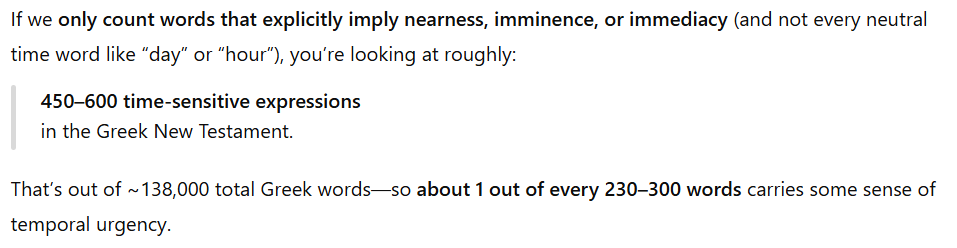
Are we to believe that one verse “with the Lord one day is as a thousand years, and a thousand years as one day” is supposed to negate the natural meaning of hundreds of imminent words? How are we supposed to interpret all of these time sensitive words if soon can mean a long time and a long time can mean soon? Do you see the chaotic mess caused by metaphorizing time?
Sadly, because we can’t fit verses like Revelation 1:1, “The revelation of Jesus Christ, which God gave him to show to his servants the things that must soon [tachos] take place” into our eschatological paradigm, many have chosen a hermeneutic that is foreign to all literature. Every time the words quickly and immediately are used in Scripture, we’re being told by godly authorities that those words may a long time in the future. How can we survive this nonsensical hermeneutic?
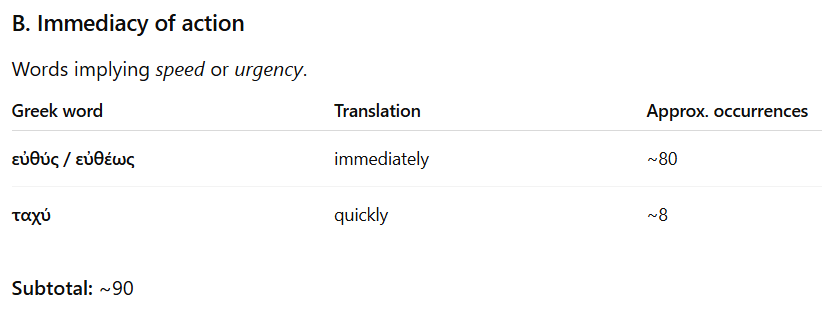
Consider this from the prophet Daniel. Notice the time referent. (Daniel 8:26) The vision of the evenings and the mornings that has been told is true, but seal up the vision, for it refers to many days from now.” From Daniel’s perspective (6th century BC), this event was centuries in the future. Daniel is referring primarily to the persecution of the Jews and the desecration of the Jerusalem Temple under Antiochus IV Epiphanes in the 2nd century BC (c. 167–164 BC). So, we know that “many days from now” meant exactly as prophesied. But, given the supposed hermeneutic of 2 Peter 3:8 (“a thousand years as one day”), “many days” could have meant “soon.” Do you see the absurdity of pretending that all time sensitive words are to be interpreted from God’s eternal perspective?
Following is another list of Greek words implying immediacy/nearness.
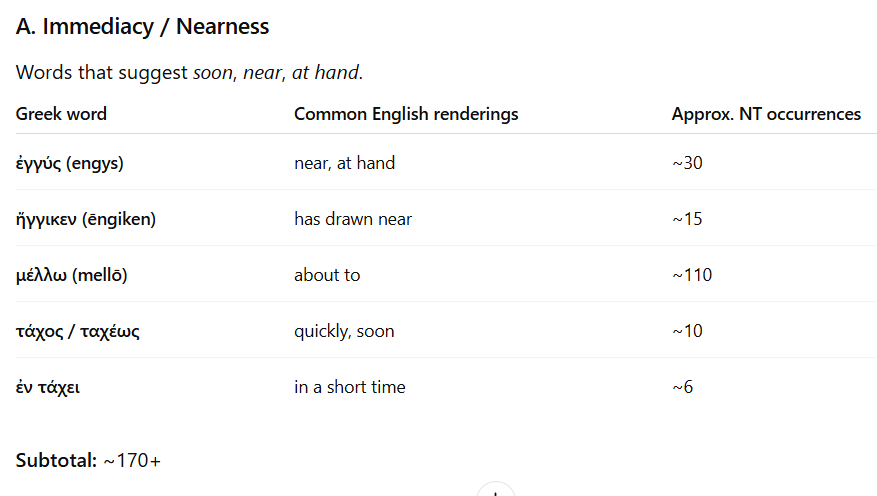
So, if we apply the elasticizing usage of 2 Peter 3:8 uniformly throughout the Bible, the reality is that the interpreter of Scripture (not the biblical author) becomes the judge as to what a passage means. Therefore, when God said that something was about to happen or that it would happen many days into the future, we supposedly have God’s authorization to determine what God meant. By this method too many believe that “must soon take place” was an idle statement which has been interminably delayed. But the reality is that the license to manipulate time is not found anywhere in the Bible. The below video exposes this gigantic fallacy that undermines the veracity and coherence of Scritpure.
2 Peter 3:8 is a quote from Psalm 90:4, “For a thousand years in your sight are but as yesterday when it is past, or as a watch in the night.” By Peter’s paraphrase of the Psalmist, he’s simply saying that everything is well under God’s control. Everything is going according to God’s preordained plan.
Yes, it had been a long time (34 years) since Jesus made His “this generation” prediction, but God was not fretting…and neither was Peter. He knew exactly what He was doing. The probationary period for the Jews was coming to a close and the vast majority were, as predicted, still rejecting Jesus as their Messiah. As Jesus sat at the right hand of the Father, as mentioned earlier, He stated emphatically, “The revelation of Jesus Christ, which God gave him to show to his servants the things that must soon take place.” The events to follow were within the scope of Peter’s timeframe. So, Peter wasn’t placating the scoffers in the least. He was excoriating their lack of faith in Jesus and His eternal plan.
Clearly, God is eternal, and He lives outside of time. There’s no question that God isn’t bound by time as are we. However, using this one verse to render all time related statements (throughout the Old and New Testaments) ambiguous, turns the Bible into an unintelligible book. To argue that God couldn’t communicate clearly, is, in my view, ludicrous… and at worst offensive.
I do not want to be unduly harsh but what piece of literature could be understood if time sensitive words are elasticized? As already stated, and shown in another chart below, there are literally hundreds of time sensitive statements just in the New Testament. If time means nothing, is relative, and can be elasticized to whatever duration the reader wants, understanding the Bible becomes a lesson in absurdity. I hope you see the elephant the room.
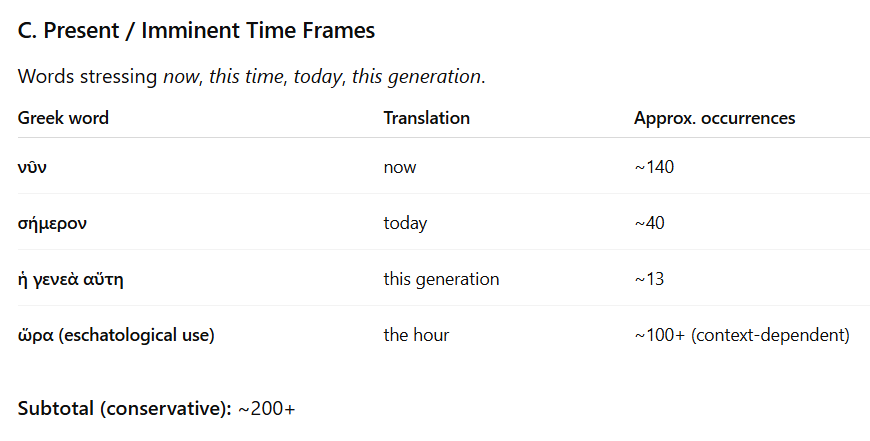
Another glaring problem is this. The first half of 2 Peter 3:8 is always overlooked. Not only is “a thousand years as one day” to the Lord, but it is equally true “that with the Lord one day is as a thousand years.” In this case, something that seems like a short period of time to us (one day) is said to be a long period of time (a thousand years) to God, rather than vice versa. The author is simply saying that God has it all under control.
The bottom line is that time is not relative. If “soon” can mean a “long time,” “at hand” can be extended to a few thousand years, and “many days from now” can be a very little while, this turns the Bible into an unintelligible mess.
In Biblical Hermeneutics (science of interpretation), highly respected 19th century theologian Milton S. Terry wrote the following regarding this odd interpretation of 2 Peter 3:8: “The language is a poetical citation from Psalm 90:4, and is adduced to show that the lapse of time does not invalidate the promises of God. . . . But this is very different from saying that when the everlasting God promises something shortly, and declares that it is close at hand, He may mean that it is a thousand years in the future. Whatever He has promised indefinitely He may take a thousand years or more to fulfill; but what He affirms to be at the door let no man declare to be far away.”
J. Stuart Russell, also a 19th century theologian, wrote with a bit more biting indignation. He lambasted those who so willingly turn the Bible on it’s ear.
“Few passages [2 Peter 3:8] have suffered more from misconstruction than this, which has been made to speak a language inconsistent with its obvious intention, and even incompatible with a strict regard to veracity. There is probably an allusion here to the words of the Psalmist, in which he contrasts the brevity of human life with the eternity of the divine existence. . . . But surely it would be the height of absurdity to regard this sublime poetic image as a calculus for the divine measurement of time, or as giving us a warrant for wholly disregarding definitions of time in the predictions and promises of God.
Yet it is not unusual to quote these words as an argument or excuse for the total disregard for the element of time in the prophetic writings. Even in cases where a certain time is specified in the prediction, or where such limitations as ‘shortly,’ or ‘speedily,’ or ‘at hand’ are expressed, the passage before us is appealed to in justification of an arbitrary treatment of such notes of time, so that soon may mean late, and near may mean distant, and short may mean long, and vice versa. . . .
It is surely unnecessary to repudiate in the strongest manner such a non-natural method of interpreting the language of Scripture. It is worse than ungrammatical and unreasonable, it is immoral. It is to suggest that God has two weights and measures in His dealings with men, and that in His mode of reckoning there is an ambiguity and variableness which will make it impossible to tell ‘What manner of time the Spirit of Christ in the prophets may signify’[cf. 1 Pet. 1:11]…”
The Scriptures themselves, however, give no countenance to such a method of interpretation. Faithfulness is one of the attributes most frequently ascribed to the ‘covenant-keeping God,’ and the divine faithfulness is that which the apostle in this very passage affirms. . . . The apostle does not say that when the Lord promises a thing for today He may not fulfill His promise for a thousand years: that would be slackness; that would be a breach of promise. He does not say that because God is infinite and everlasting, therefore He reckons with a different arithmetic from ours, or speaks to us in a double sense, or uses two different weights and measures in His dealings with mankind. The very reverse is the truth. . . .
It is evident that the object of the apostle in this passage is to give his readers the strongest assurance that the impending catastrophe of the last days were on the very eve of fulfillment. The veracity and faithfulness of God were the guarantees of the punctual performance of the promise. To have intimated that time was a variable quantity in the promise of God would have been to stultify and neutralize his own teaching, which was that ‘the Lord is not slack concerning His promise.’ ((J. Stuart Russell, The Parousia (Grand Rapids, MI: Baker Books, [1887] 1983), 321ff. Owen, “Providential Changes: An Argument for Universal Holiness,” 134–35.))
Russell didn’t hold back. He said that it wasn’t just ungrammatical, but it was immoral to accuse God’s inspired authors of such ambiguity. Let that sink in. We claim that the Bible is the inspired word of God (and I wholeheartedly concur), but then when pastors make these kinds of claims, though I know it’s not their intent, it demeans and distorts those inspired words that we argue are infallible and inerrant. We must be better stewards of God’s word.
Mocking birds
As I have said, The Apostle Peter, writing in AD 64 approximately 34 years after Jesus’s death, was rebuking the mockers. At the risk of being redundant, I want to do everything in my power to put this strange interpretational method permanently to bed, or better, to the grave.
Let’s revisit the arguments and consider more closely to what the mockers were saying that prompted Peter’s response?
(2 Peter 3:3-4) Know this first of all, that in the last days mockers will come with their mocking, following after their own lusts, 4 and saying, “Where is the promise of His coming? For ever since the fathers fell asleep, all things continue just as they were from the beginning of creation.”
What was the mockers’ justification for making such a claim? The context that precipitated their accusation couldn’t have been clearer:
(Matthew 24:32-34) “Now learn the parable from the fig tree: as soon as its branch has become tender and sprouts its leaves, you know that summer is near; 33 so you too, when you see all these things, recognize that He is near, right at the door. 34 Truly I say to you, this generation will not pass away until all these things take place.
Jesus had warned His disciples that which was to come. In the preceding verses in Matthew 24, Jesus laid out what they should expect in the years after His departure. There would be wars, earthquakes, famines, apostasy, lawlessness, persecution, tribulation, martyrdom and the complete and utter destruction of the temple. Notice first, that Jesus used the words “soon” and “near”. The meanings of “soon” and “near” were clear to all. So, why do these time sensitive words have relevance if ‘a day to the Lord can be a 1,000 years and a 1,000 years could be a single day’? The reality is that time is quintessential to prophetic fulfillments. So, Jesus is essentially telling them that they (His disciples) would be able to recognize the signs just as a farmer knows that summer is near when the leaves on the trees sprout.
Now to verse 34. “All these things” refers to the preceding 33 verses which include that ominous list of calamities. Jesus said that “all these things” would take place before the generation to whom Jesus was speaking passed away.
That brings us to back to the scoffers in 2 Peter 3. They were fully aware that Jesus predicted to return in judgment within a generation. We know that Peter wrote approx. 34 years after the cross. So when I think back 34 years I was only 37 and my youngest was 3. A whole lot has happened since my kids were little. And no less for the disciples. In the AD 60s, they had already witnessed many of the things on that list of “all these things” and persecution was intensifying.
We also know that a biblical generation was typically 40 years. So, the mockers who refused to trust God, were wagging their fingers at the Apostles telling chiding them with dripping sarcasm, “Where is the promise of His coming?” … With only 6 years left in their generation, you can feel the weight of their mocking.
Hopefully, you are beginning to understand why it’s completely inappropriate to use the delay excuse. Peter would be agreeing with the scoffers by basically saying, “Gosh, after all, a day to God is like a 1,000 years and God isn’t bound by time constraints…so I agree with you scoffers because it doesn’t appear that Jesus is returning any time soon.” Is that truly what Peter was doing? Was he in full agreement with the scoffers? Was Peter back peddling?
The reality is that God neither lies nor intentionally misleads. He does not promise something soon and then break that promise by delaying it thousands of years.
Further, regarding this supposed “delay”, what father tells his children that he’ll do something soon knowing the entire time that He has no such plans… that His plans are for a generation 2,000 years separated from the imminent promises. This just cannot be.
[Pastor] Do you know why Jesus has not come back? It’s because God of radical love. God is not willing that any would perish.”
Let’s focus on verse 9. It should be noted that there’s nothing in this passage that refers to a delay.
(2 Peter 3:8-9) 8 But do not let this one fact escape your notice, beloved, that with the Lord one day is like a thousand years, and a thousand years like one day. 9 The Lord is not slow about His promise, as some count slowness, but is patient toward you, not willing for any to perish, but for all to come to repentance.”
The pastor said that Jesus is delaying because He’s “not willing for any to perish.”
Let’s think through this claim. But first consider this chart. There have been approx. 55 billion born since the incarnation and 36B have died (65%) without faith in Christ. In AD 100 there were approx. 220M living, out of which was were 30k Christians (.014%).
*It should be noted that both the number of Christians worldwide in 2026 and the total number of Christians who have died since the incarnation are not necessarily those who have professed faith in Christ. So the numbers may be less.
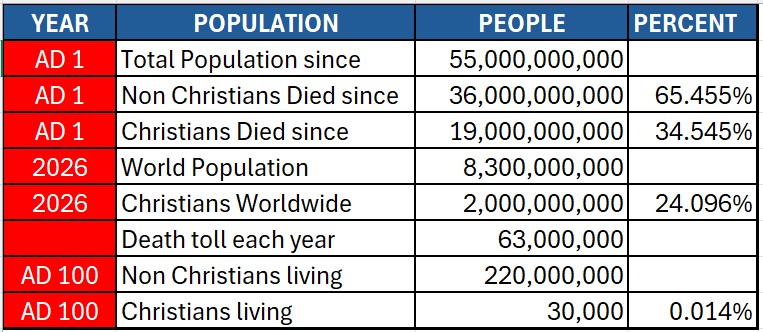
Every year approx. 63m people die (this number is far greater than it was in the 1st century).
Therefore, if the pastor is correct and Jesus has delayed 2,000 years (which I contend), somewhere north of 36 billion have died without Christ since the first century, compared to only 220 million unbelievers by the turn of the 1st century. So, did delaying send less people to hell? Do you see the point? Although the supposed “delay” has produced 19 billion Christians, there have been 36 billion who have died without Christ. Therefore, if the reason for the perceived delay was because God was “not willing for any to perish, but for all to come to repentance,” the delay has been a colossal failure. In AD 70 at the fall of Jerusalem, approx. 220m would have been forever lost without Christ. Tragic though that it was, but 220m is far less than 36B!
This notion that God was delaying because He was “not willing for any to perish” should be all the proof needed that the time frame in view was that generation which culminated in the AD 70 destruction of Jerusalem.
In Peter’s prior letter one year earlier, he made clear that “the end of all things is near” (1 Peter 4:7). People often dismiss this out of hand and assume Peter was referring to the end of the cosmos. But that’s not what Peter was referencing. Clearly the end of the planet was not in view and it was not nearing it’s end. So, then, to what “end” is Peter referring? The end of the Old Covenant system, the hub being the temple. Peter was talking about the end of the Old Covenant people and their system built upon animal sacrifices and temple rituals.
If God fulfilled everything on His prophetic timeclock, then there was no delay and God has continued to be fill the world with Christ followers…
To recap. How many people have died and gone to Hell since Jesus’s resurrection in AD 30? Perhaps 36 billion or more. So, although there are now approx. 2 billion Christians (which as I said I think is overstated), that means that 6 billion aren’t.
How did John Owen, a 17th century theologian, understand 2 Peter 3:9 in context.
Owen rejected the idea that the verse teaches that God is trying—but failing—to save every individual. Instead, he argued that:
“Not willing that any should perish” refers not to every human being universally, but to a specific group—the elect (God’s chosen people).
He emphasized the immediate context of the passage:
- The verse says God is “longsuffering toward us”
- So the key question becomes: Who is “us”?
Owen’s says the “us” is God’s elect, and “any” refers to any of US, and “all” refers to all of US. So the meaning becomes:
God is not willing that any of His elect should perish, but that all of them come to repentance.
The pastor went on to say that he doesn’t know all the reasons why Jesus hasn’t come yet. With the risk of sounding arrogant, I know the reason. What began with Jesus and the 12 has become a massive move of the Spirit reaching billions. But we’re far from done. There’s still far too much work yet to do. We are tasked to make disciples of all nations. think about it. There are billions of Muslims, Hindus, Buddhists and atheists who need Jesus. Consider the parable of the mustard seed!
He put another parable before them, saying, “The kingdom of heaven is like a grain of mustard seed that a man took and sowed in his field. 32 It is the smallest of all seeds, but when it has grown it is larger than all the garden plants and becomes a tree, so that the birds of the air come and make nests in its branches.” (Matthew 12:31-32)
The Parable of the Mustard Seed serves to illustrate the nature of the Kingdom of Heaven, and emphasizes its growth from humble beginnings to a significant presence.
It speaks of small, humble beginnings. The mustard seed is known for being one of the smallest seeds, but when planted it grows into a large plant, often described as a tree, symbolizing the expansive nature of God’s kingdom. And it provides shelter for Many. Why would we think the our job is done? Why are so many waiting for the rapture? Why, when the harvest is plentiful, do we simply put our hands to the plow and keep working until we’re called home? What builder looks for excuses to abandon his half built house?
Then there’s the Ezekiel 47 and Revelation 22 connection:
Ezekiel 47: A river flows from the temple, bringing life wherever it goes; trees on its banks bear fruit every month and their leaves are for healing.
Revelation 22:1–2: A river of the water of life flows from the throne of God and the Lamb; the tree of life yields fruit monthly, and “the leaves of the tree were for the healing of the nations.”

So the images of the mustard seed and the water flowing from the temple show the expanse of the church’s future. In no way does the Scripture teach us to expect the church will not reach the goals Jesus set.
Let’s again look at the first three verses in the book of Revelation and see if you can determine what Jesus timing was.
(Revelation 1:1-3) The revelation of Jesus Christ, which God gave him to show to his servants the things that MUST SOON TAKE PLACE. He made it known by sending his angel to his servant John, 2 who bore witness to the word of God and to the testimony of Jesus Christ, even to all that he saw. 3 Blessed is the one who reads aloud the words of this prophecy, and blessed are those who hear, and who keep what is written in it, for THE TIME IS NEAR.
It should be noted that Jesus is sitting at the right hand of the Father at this point. He has been fully restored to his former glory. And when Jesus stated that even He neither knew the day nor the hour of His return (in judgment – Matthew 24), He clearly knew all things at the time of His ascension. And He didn’t equivocate when, in approx. AD 64, He spoke of things that “Must shortly take place… for the time is near.”
So, what’s going on?
At this point you might be slightly confused. There’s one other issue I need to explain. Today, the majority of Christians (including the pastor who preached the sermon I’m critiquing) are premillennial dispensational. For our purposes here the details are unimportant but what you need to know is that dispensationalism is a type of theology that arose in the mid-1800s and was mainstreamed through the Scofield Reference Bible.
In 1908, C.I. Scofield ingeniously added notes to the margins that detailed and supported his system. Many assumed, as I did when I first became a Christian, that the notes were part of the Bible. So, they were not heavily scrutinized by the readers. Dispensationalism is primarily responsible for the defeatist eschatology that this pastor embraced.
Following are the salient points of this system founded by John Nelson Darby in the 1830s:
- We are living in the “last days”
- Evil is destined to increase from this point forward.
- An imminent pre-tribulation rapture of the Church
- A 7-year tribulation, the first half being peaceful and the latter after the Antichrist is revealed which will usher the most horrific time in human history
- A future restoration of national Israel with unfulfilled Old Testament promises
- Christ’s visible return to earth to reign for 1,000 years
Following are the tenets that the majority ascribe to:
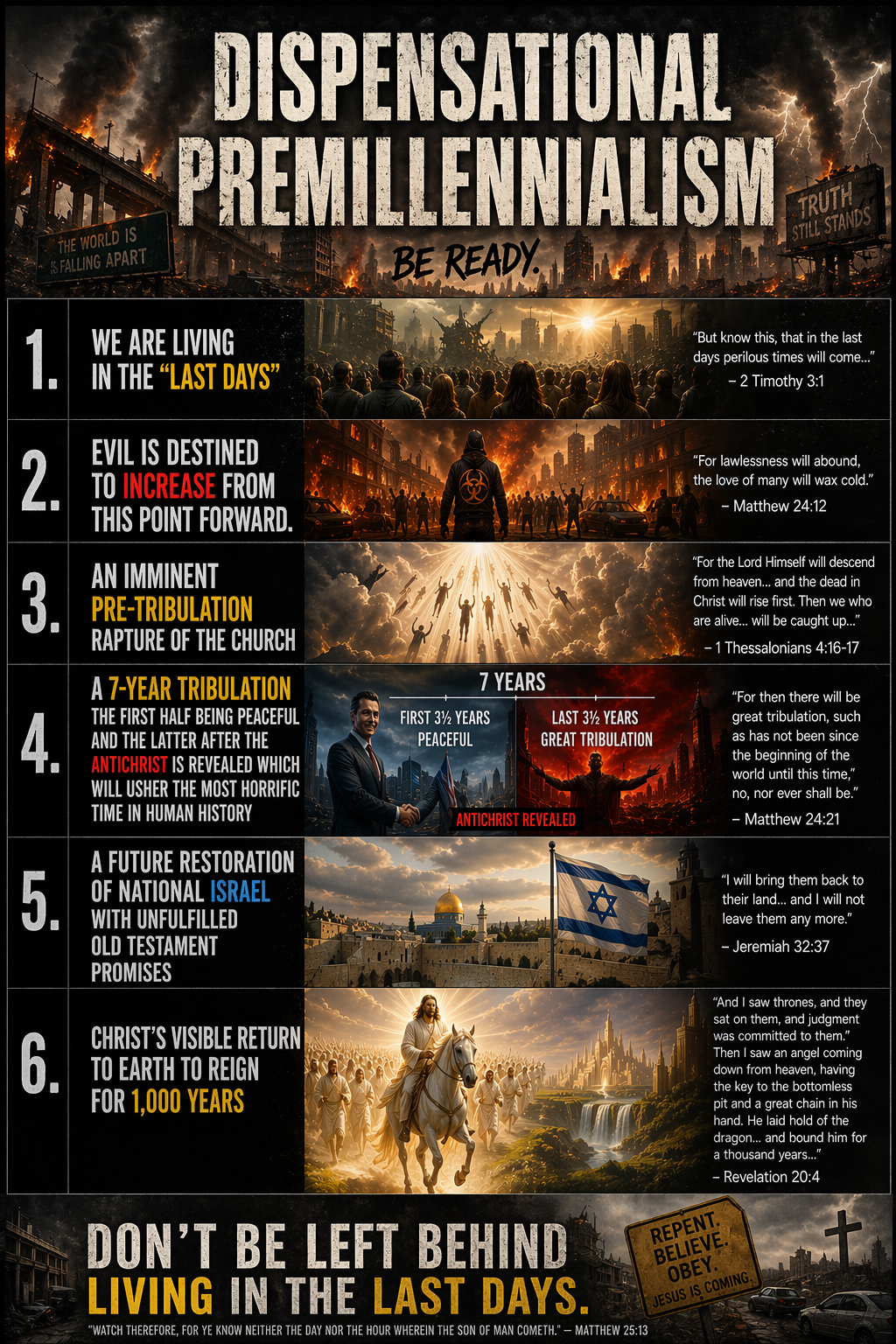
Eschatology is not foundational
As I reach the conclusion, it must be said that eschatology is not a foundational doctrine of our faith. As long as this pastor is grounded in the following, he is on solid turf. Though as I have attempted to demonstrate that eschatological conclusions are extremely impactful on one’s view of Scripture and our future expectations, the study of end times is not essential to our faith. Following is a list of what I believe are the non-negotiables.
- Sola Scriptura (by Scripture alone) – The Bible is uniquely God-breathed (2 Timothy 3:16) and therefore normative. All doctrines must be tested by Scripture (Acts 17:11). No church council, creed, pastor, or tradition is infallible—only Scripture is. Traditions and teachings are valuable, but they are subordinate to Scripture.
- Salvation by grace through faith alone in Christ alone
- Original sin (Rom 1:20) – humanity inherits a fallen nature as a result of Adam and Eve’s first disobedience (Genesis 3). Romans 5:12 – “Sin entered the world through one man, and death through sin…”; Psalm 51:5 – “Surely I was sinful at birth…” (poetic, but formative); 1 Corinthians 15:22 – “For as in Adam all die, so in Christ all will be made alive: Paul frames Adam as the head of humanity, just as Christ becomes the head of redeemed humanity.
- Jesus was born of a virgin
- Jesus resurrected bodily
- Jesus was glorified at His ascension
- Jesus, the God-man, is seated at the right hand of the Father on the throne of David in His glorified body
- The hyperstatic union – Jesus Christ, the second person of the Trinity, is fully God and fully man at the same time—not mixed, not divided, not alternating.
- Christ’s second coming (for salvation: Hebrews 9:28)
- The judgment
- The resurrection of the dead
- The trinity
- The atonement
- The indwelling Holy Spirit (in every believer)
- The sovereignty of God: God reigns supreme—He has ultimate authority and control over all creation, history, and events, and nothing ultimately thwarts His purposes. He rules — God is King, not merely an observer (Psalm 103:19).
- Jesus has all authority — all power belongs to Him (Daniel 4:35).
- The triune Godhead acts with purpose — history is not random (Isaiah 46:9–10).
- Biblical inerrancy – According to the Chicago Statement of Inerrancy (1978)
- Biological death is the result of sin
- At death, all Christians will receive glorified spiritual bodies patterned after Christ’s glorious body (Phil 3:21)

Eschatological views simplified
There are many eschatological flavors but to simplify there are two overriding expectations behind the two main views.
- Futurist View: We are living at the tail end of the world’s “last days,” we are rapidly descending into times of pervading evil, and the Lord’s return is imminent. In other words, things are destined to get worse until Jesus soon returns. (2 Tim 3:1-13) Prophetic fulfillment of Bible prophecy (found primarily in Matthew 24, Mark 13, Luke 21, and the book of Revelation) has been delayed, and therefore is yet unfulfilled. This view not only creates a short-term mentality, but it is also decidedly pessimistic. The rapture of the church (removal of Christians from the earth) can come at any moment, 3 ½ years after which the world will descend into the Greatest Tribulation ever. As Forest Frank said in that short video, “He’s coming back soon, get your life right because we don’t know if today is our last day.” The underlying assumption is that all of the New Testament “time statements” (soon, shortly, at hand and in a very little while) have been delayed for 2,000 years. 2 Peter 3:8 (a day is as 1,000 years and a thousand years is as a day) is used to nullify all of the time sensitive promises in the Bible.
- Preterist View (praeter meaning past i.e. fulfilled): The “last days” was the period between the AD 30 resurrection of Christ and the AD 70 destruction of Jerusalem/Temple, marking the end of the Old Covenant system. Jesus’s coming in judgment upon the wicked and perverse, Christ-killing generation of Jews, marked the end of the Old Covenant people. Bible prophecy was fulfilled on time (or as some believe, mostly fulfilled) within the “this generation” parameter Jesus and the New Testament authors predicted. Since the ascension of Christ (40 days after the resurrection), Christianity has been advancing and will continue to advance, fulfilling Christ’s ultimate mandate for us to disciple of nations. This view creates not only a long-term view but is decidedly optimistic. It’s a pollyannish view of evil, because it is realistic… things are still messy. But the underlying assumption is that God fulfills all of His prophetic promises and judgments on time.
(Daniel 7:13–14) “To him was given dominion and glory and a kingdom, that all peoples, nations, and languages should serve him.”
(Revelation 11:15) “The kingdom of the world has become the kingdom of our Lord and of his Christ, and he shall reign forever and ever.”
(Isaiah 2:2–4) “All the nations shall flow to it…They shall beat their swords into plowshares…”
(Psalm 72:8–11) “May he have dominion from sea to sea…All kings fall down before him, all nations serve him!”
(Psalm 22:27–28) “All the ends of the earth shall remember and turn to the Lord, and all the families of the nations shall worship before you.”
(Daniel 2:34–35, 44) “The stone… became a great mountain and filled the whole earth…The God of heaven will set up a kingdom that shall never be destroyed.”
(Matthew 13:31–33) (Mustard Seed & Leaven) “The kingdom of heaven is like a mustard seed… the smallest of all seeds, but when it has grown it is larger than all the garden plants…”
“The kingdom… is like leaven that a woman took and hid in three measures of flour, till it was all leavened.”
(Matthew 28:18–20) “All authority in heaven and on earth has been given to me… make disciples of all nations.”
(1 John 4:4) You are from God, little children, and have overcome them; because greater is He who is in you than he who is in the world.
So, from a practical standpoint there are two dominant eschatological views. One that completely denies that God’s time sensitive promises and judgments have been fulfilled as stated, that the “last days” refers to a time at the end of the world, and that this world is cascading toward obliteration.
The other is that all of God’s promises and judgments came to pass on time, that the “last days” was the time period between Jesus’s resurrection (AD 30) and the destruction of the Temple/dissolution of the Old Covenant (AD 70), and that the Gospel would continue to be spread to every nation. Christ will be victorious over time as the Holy Spirit moves to convert the nations.