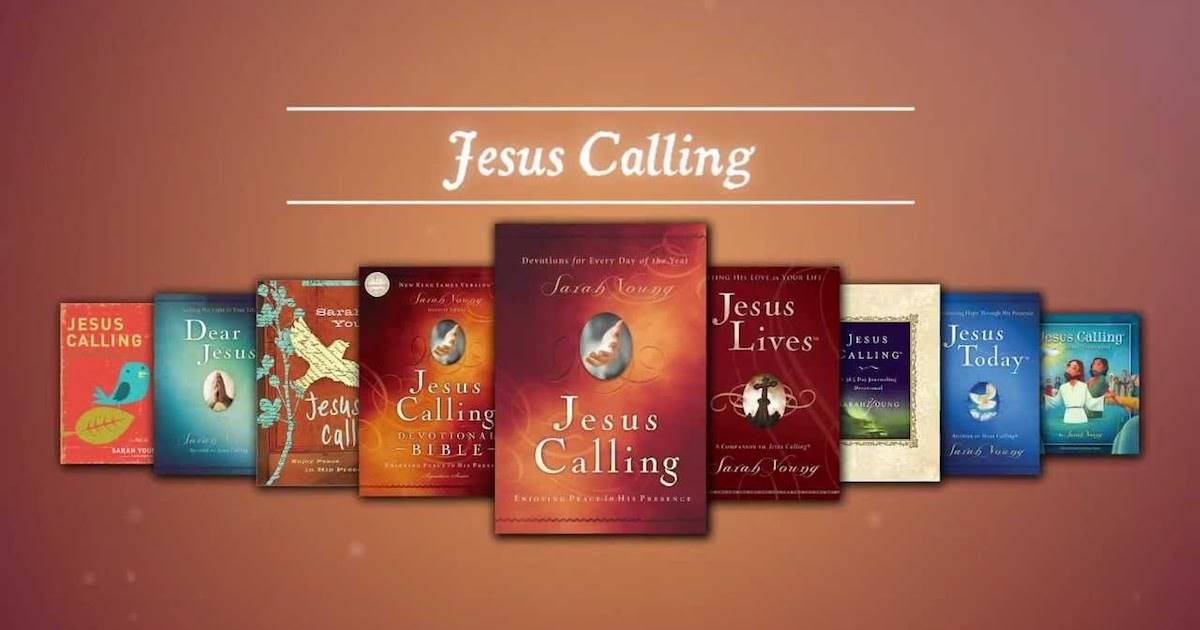
 During a sermon, a pastor made a pejorative comment concerning Jesus Calling, a best-selling devotional he later admitted he never read. My wife, who is a huge fan of both Sarah Young, the author, and her plethora of devotionals, took issue with what she felt was an uninformed, mean-spirited attack. Note to self: Be intimately familiar with that which you assail, especially in a large group setting.
I’d watched a couple of very critical YouTube videos of Jesus Calling and had a cursory understanding of their reasoning, but I was far too ignorant to engage in a serious discussion with one of Sarah’s biggest fans. My hope was to end up agreeing with my wife, especially since she’d spoken of it in such glowing terms. So, given my ignorance on the matter, I decided to do some serious research.
It should be noted that a startling 50 million copies have been sold!
I began by purchasing both the Audible and Kindle versions of Jesus Calling and I read the first month of daily entries to gain the necessarily context. I wanted to understand Sarah’s style and experience Jesus Calling for myself.
I spent quite a few days working through it, reading numerous online resources and watching critiques both positive and negative. Some were brutal. Others were glowing. I scoured through literally hundreds of comments under the videos which ranged from, “It changed my life” to “It wrecked my understanding of Scripture.” I congealed those thoughts into my analysis, attempting to be as objective as possible.
The majority of my initial impressions were derived from Sarah’s daily entries. Since writing her devotional in 2004, Jesus Calling has been at the center of controversy. It elicits very strong emotions, either very positive or very negative. Why the passionate divide? Since it’s merely a devotional centered around the Bible, that may seem innocuous. Then why the harsh reactions? I will attempt to explain the main issue in a variety of ways, refraining from being overly cerebral so as not to dismiss the millions who testify to the vast benefits from Sarah’s writings.
Each daily reading begins with what Sarah describes as a message directly from Jesus followed by various Scripture passages. In the introduction she wrote:
“The Bible is the only infallible, inerrant Word of God, and I endeavor to keep my writings consistent with that unchanging standard. I have written from the perspective of Jesus speaking, to help readers feel more personally connected with Him. So the first person singular (“I,” “Me,” “My,” “Mine”) always refers to Christ; “you” refers to you, the reader.”
Following are my thoughts. For risk of being misunderstood, excuse my redundance.
The Positives:
- Based upon book sales of 15m and glowing testimonials, Sarah Young is driving vast numbers of people into God’s Word. This is a big deal that must not be discounted. Many who have never read the Bible have begun to read it regularly.
- The Scripture passages included each day are very helpful in acclimating readers to the Bible, encouraging them to dig deeper.
- She helps readers become more connected to the heart of Jesus.
- She inspires readers to take positive steps toward following Jesus.
- Overall, saying that Jesus Calling’s impact has been significant, is an understatement.
It is undeniable how Sarah’s gifted writing has benefited so many.
As I move toward criticisms, I want to make it abundantly clear that I am not questioning the legion of testimonies praising her work. Any time people are confronted with God’s Word they are changed.
For clarity, Sarah has repeatedly stated that she was not adding to Scripture, and that:
- Her words are not inerrant
- Her journal is a devotional and is not prophetic
- Scripture and Scripture alone, is final authority
In her 2004 introduction she wrote: “I knew that these writings were not inspired as Scripture is.”
Sarah’s husband, Steve Young, recently speaking to the PCA general assembly which was considering an inquiry into Jesus Calling‘s potential encroachment on Sola Scriptura, defended his wife:
“Her writings did not add to Scripture but explain it. She would stand with Martin Luther and declare that her conscience was captive to the Word of God.”
He went on:
“Sarah is a sister in Christ and wife who delighted in the law of the Lord, and on his law she meditated day and night. She was led to share her meditations with the world.”
Sarah made clear that her devotionals were meant to be read “with your Bible open.”
Before I balance the positives with some concerns, let me say that though my apprehensions may be lengthier, this is not only a function of avoiding being misunderstood, but is the result of echoing the main issue from different angles. It should be noted that many theologians and Bible scholars are not simply being critical for the sake of being critical. Some are, but most have shared legitimate misgivings which have broad-reaching implications.
My Concerns:
#1 Straight from the Heart of Jesus?
Sarah begins each day with words that she said came straight from Jesus. My understanding is that in her prayer time she wrote down exactly what she believed Jesus was telling her to write. And she wanted to share those thoughts and exhortations with the world.
The tension lies between what is canonical and what isn’t. If Jesus inspired her to write down His exact words, perhaps you can sense the potential conflict. The book was written in the first-person voice of Jesus, with no theological disclaimers on the daily writings. To reiterate, Sarah has been very straightforward about the fact that these are not her words. On the one hand she states that her words are not inerrant, prophetic or are scripturally authoritative, but on the other she says that these were Jesus’s exact words… which is an apparent problem.
Though she makes clear that her writings are not inspired and are in no way on par with God’s word, it is nonetheless a rather bold assertion to claim that Jesus spoke to her word for word which were not merely for her personal edification but for the benefit of millions. So, they essentially become Jesus’s words to both Sarah and all who read Jesus Calling. This kind of transcendence definitely ups the ante.
The issue at stake is that the words she attributes to Jesus are either inspired by God or they’re not. She says they’re not, but that doesn’t settle the issue. Based upon her foreword, she believes that God has spoken directly through her. To give you a flavor, I have excerpted a small section of January 1. Notice the personal pronouns are capitalized which refer to Jesus.
“COME TO ME with a teachable spirit, eager to be changed. A close walk with Me is a life of continual newness. Do not cling to old ways as you step into a new year. Instead, seek My Face with an open mind, knowing that your journey with Me involves being transformed by the renewing of your mind. As you focus your thoughts on Me, be aware that I am fully attentive to you.” Young, Sarah. Jesus Calling, with Scripture References: Enjoying Peace in His Presence (A 365-Day Devotional) (Jesus Calling®) (p. 2). Thomas Nelson. Kindle Edition.
Notice the perspective. “Come to ME” and “Seek MY face with an open mind.” This immediately begs the question as to what biblical inspiration means. If Jesus inspired the exact words in Sarah’s daily entries, how can they be less than quotes of Jesus recorded in the Gospels? In Matthew’s Gospel Jesus said, “Truly I say to you, this generation will not pass away until all these things take place.” Jesus is speaking in the first person. Matthew was inspired to write those exact words.
*And we should take note at this point to realize how the Gospels and Epistles were written. God inspired men through the Holy Spirit to write through their personalities and experiences. The words were not dictated to them as Sarah claims was done for her. So why wouldn’t the words Jesus spoke directly to her not be even more inspired than the biblical books?
The question is, can Jesus ever speak non authoritatively? How is the above any different than when Sarah wrote, “A close walk with Me is a life of continual newness.” Some Bibles put Jesus’s words in red because they were spoken by the King of Kings. Therefore, could the opening words of her daily devotional be colored red? If not, why not?
This might sound like hair-splitting but it’s not. She is not saying that they are merely personal directives gleaned from her prayer time. I believe God speaks directly to His people, but if we take what we believe we hear from God in our daily prayer time and say, “Thus saith the Lord,” it must not only be 100% accurate, but it must come from the Lord. There is no fudge factor. Mishandling God’s Word is serious.
How is what she’s writing not Scripture? She and her husband saying that it’s different, are mere words.
If you know anything about Sarah, it’s obvious that her intent was not to elevate the words in her book to Scriptural authority. According to a friend who knew Sarah quite well, he said that she was extremely humble and she lived an exemplary life of service to Jesus.
But the question remains: In what category do we place the words of Jesus if they were not written by an inspired author with the Holy Spirit’s divine authority e.g. the Apostles Paul or Peter. It’s one thing to include a number of Scripture passages and congeal your understanding of them into a daily reading. That would be similar to a commentary, and is the method employed in every other modern-day devotional. I’m not aware of any other modern author who writes in first person Jesus.
At this point it should be noted that Sarah Young is not the only one to have written in this manner. Below are a few others.
Classical mystics / visionaries who reported direct speech from Christ in visions, dreams, or locutions. These writings often contain first-person divine speech like Young’s format.
- Julian of Norwich (Revelations of Divine Love) – (1500s)
- Hildegard of Bingen (visions recorded as divine speech) – (1151)
- Catherine of Siena – (1379)
- Teresa of Ávila (Teresa of Jesus) (1577)
- Anne Catherine Emmerich – (1819-1824)
Modern “Prophetic” or “Charismatic” Writers claim direct dictation or prophecy from Jesus and/or the Holy Spirit:
- Mark Virkler (“two-way journaling”) – (2021)
- Bill Johnson / Bethel-associated prophetic writings – (Current)
- Louise Hay / God Calling (not evangelical, but directly influenced Jesus Calling) – (1932)
Non-Evangelical Modern Visionaries
- Maria Valtorta (The Poem of the Man-God) – claimed dictation from Jesus – (1947)
- Gabrielle Bossis (He and I) – daily first-person speech from Jesus – (1985)
- Anne a Lay Apostle (Direction for Our Times) – (2004)
So, in my view, this leaves us with a serious dilemma. If the words are uninspired as Sarah says (most of those listed above say that they are reporting what God said to them), then I find it strange for her to write as if they came directly from the mind of Christ. Again, how can anything Jesus said be uninspired?
This concerns me a great deal. To be transparent, I have no dog in this fight. The reality is that I would prefer to agree with the throngs who say they have benefited from Jesus Calling. And I want to avoid stepping on the toes of those who think the world of Sarah’s writings. I have no interest in casting aspersions on someone far godlier than me. But what I am passionate about is defending God’s word from the constant attacks of Muslims, atheists, and many other religions. And Jesus Calling is, in my view, blurring the lines that must be drawn somewhere.
Many conservative apologetic’s scholars who regularly debates Muslims, Mormons and other groups claiming to have heard directly from God (Quran, Doctrine and Covenants and the book of Mormon), are very concerned with Jesus Calling. No critic that I’ve read is deliberately attempting to squelch the Spirit of God or anything of the kind. Rather, they are fighting to preserve the integrity of the Bible. Once we go down this slippery slope, where does it end? That’s why I think this discussion is worth having.
Let’s say you have a vision that you believe came from Jesus, and you put it to paper professing that it is from the Lord. How should others treat it? What if many similar Jesus Calling books are written claiming to speak for Jesus? And the broader question is, do all believers indwelt by the Holy Spirit have this same capability as Sarah? If Jesus gives you His unvarnished Words, are they meant for everyone?
You may think it’s preposterous scenario, but what if thousands of similar devotionals are written, fueled by Sarah’s passion to hear directly from Jesus… each with messages directed to all Christians? What if we were to coalesce only Jesus’s words from hundreds of these devotionals into one hardbound book and call it “The Modern Sayings of Jesus?” Is it possible? Why not?
I would be far more comfortable if Sarah spoke as though her words were written through her eyes with the qualification that she felt that the Holy Spirit guided her commentary. Instead of speaking in the first person, what if Sarah had begun, “COME TO JESUS with a teachable spirit, eager to be changed”? If that had been the case, we wouldn’t be engaged in this discussion because this would be similar to every other devotional.
I see no way around the implication that to write as though the words came directly from Jesus makes them God inspired, no matter how Sarah protests to the contrary. I do not believe she can have it both ways i.e. on the one hand saying that the words are directly from Jesus, but on the other admitting that they are not biblically authoritative. Again, how can anything Jesus said not have supreme authority? How is this not adding to Scripture?
For example, the Epistle of Barnabas did not make it into the Canon even though Barnabas was a pivotal member of early church. Barnabas had been a direct companion of the Apostle Paul, but, because his writing was not deemed inspired, it did not become the 28th NT book. Yes, it’s worth reading, but it has no divine authority. I realize Sarah is not claiming that her words are inspired, but why would Jesus’s exact words which she said flowed from the mind of Christ directly to her, not be more inspired than Barnabas’s Epistle?
#2 Are Jesus’s words not authoritative?
Sarah claims to have heard directly from Jesus as if Jesus was channeling through her. I know some may bristle at the word “channeling” since it carries a new age connotation, but that’s in fact what she’s saying. Sarah said that she was a conduit for the Lord to speak through her.
When so many have claimed to benefit from Jesus Calling, if anyone puts her words (ostensibly Jesus’s words) to the test, then Sarah’s devout followers have often branded dissenters as mean-spirited. But the reality is that if those words are uninspired, even if she says they came directly from Jesus, they must be scrutinized like any other writing. However, do you find not find it awkwardly strange criticizing the words of Jesus? Seriously, how can anyone criticize or even question anything Jesus said? This unwittingly elevates the words she attributes to Jesus to another category.
I’ve seen some extremely critical comments online from the usual heretic hunters, and I don’t think it’s fair to impugn Sarah’s motives. I believe she was convinced that Jesus actually spoke His words directly through her. She said she was a mere instrument and I believe her. However, as she has clearly stated, those words do not rise to the level of Scripture… and, therefore, we have an insurmountable problem.
How can we be critical of what she said Jesus spoke directly? To reiterate, if the words came from Jesus, how can they be scrutinized? If anyone says to one of Sarah’s devout readers, “Jesus couldn’t have said that”, can you imagine the outcry? How dare they quibble with the Messiah!
The most significant issue is that if those words are not breathed out by Jesus as she agrees they aren’t, then there is a guarantee that Jesus could not have spoken the words that are attributed to Him. Saying “thus saith the Lord” puts humanly spoken words into a very different category. If these were, in fact, Jesus’ words, completely reliable and true, then Jesus Calling would be Scripture. One can protest that conclusion but on what grounds? I don’t think this point can be overemphasized. So, though Sarah’s intent appears as pure and noble, she is unwittingly sending seriously mixed messages to her millions of readers. How are they to understand the difference between the 66 and writings like Sarah’s? This, in my view, is a very treacherous path.
#3 Is the Bible enough?
Sarah said that she yearned for more than the Bible. “I knew that God communicated with me through the Bible, but I yearned for more. Increasingly, I wanted to hear what God had to say to me personally on a given day.” At this point we’ve changed the discussion from inspiration to sufficiency. Is Scripture sufficient? The reformers argued that the Bible was not only God breathed but that it was also sufficient for all things.
I think I understand her deep desire for intimacy with Jesus, and though I believe her quest was certainly heartfelt, why doesn’t she read, study and meditate on Scripture and allow the Word of God to speak to her (and us)? Why does she need other words that she says mirror what Scripture already teaches? Why not instead ask the Holy Spirit to help her to more fully understand what a Bible passage meant and how it should be applied on any given day?
Getting a personal word from Jesus is far different than receiving words from Jesus meant for the masses. For example. God may be leading you, but if you tell me how I should live based upon some directive you think you heard from God, that changes things. What should be my immediate reaction? To compare whatever you heard with Scripture, right? Therefore, what’s the reason for the redundancy. Just go to the Bible first and bypass the middle-man.
We all yearn to hear from God and I’m not arguing that God doesn’t still lead and guide his people. David heard regularly from the Lord regarding strategies of warfare etc. But is it a prudent precedent to believe that we not only hear directly from the mind of God, but that what we hear becomes a directive for all? It’s one thing to believe we have a leading from the Spirit, but quite another if we believe it applies to everyone else. That seems rather presumptuous.
What if I study diligently, pray fervently and then think I hear Jesus say, “Write down these words. I want you to write an eschatological commentary which will be directly from Me (Jesus). Put the words I’m about to tell you in the first person.” So, what would be the reaction if I wrote the following:
The things I’m writing to you have come directly from the mind of Jesus.
“Contrary to what too many of MY beloved children believe, I (Jesus) returned exactly as I said I would as I empowered the Roman army to destroy the wicked and perverse generation that had Me murdered. They were an abomination in MY eyes. And just as in the days of Noah, I annihilated the city of wickedness, Jerusalem, and I used the Roman army to raze the Temple to ground so that not one stone was left upon another. I detest those who continued to sacrifice after my once-for-all shedding of blood on that despicable cross. When I said that some standing here would not taste death until they saw ME coming in the clouds of glory, I meant it. When I said, You will not have finished going through the cities of Israel until I come, I meant it. For I am the Lamb of God who takes away the sins of this world. I am the Alpha and the Omega.
What I speak I will always do. Through my beloved Apostle Paul, I inspired him to write, “In a very little while HE who is coming will come and will not delay.” Through the man who denied ME three times, I filled him with these words, “The end of all things is near.” So why do the people question ME? Why do they make up excuses for ME as though I cannot do exactly what and when I promised? Why do they have so little faith not to believe that when I said, “This generation will not pass away until all these things have taken place”, I meant it? Every eye saw Me, that is, those who had Me pierced. I avenged the martyred saints who cried out to ME with a loud voice, saying, “How long, O Lord, holy and true, will YOU refrain from judging and avenging our blood on those who live on the earth? Do you think I did not hear their incessant cries? Not long, my children for I told them “I am coming soon,: for I, the Lord your God, am faithful.”
How would the above be received if I wrote an entire book this way, as if Jesus wrote it? I believe everything I wrote can be defended by Scripture and it could have come from Jesus. But others might sharply disagree. If I claimed that Jesus spoke those exact words to me, and I felt compelled to share them as Jesus’s words to the Church, I would be excoriated. I can hear them now. How dare you put words in Jesus’s mouth! And I would agree with the critics. So, why is Jesus Calling any different?
I think at the very least it’s presumptuous to believe that God would speak directly through Sarah as though she was a prophet, though as mentioned earlier, she doesn’t claim to be prophet. But I’d still like to understand the difference. Does a prophet not speak on God’s behalf?
If a pastor said God told him something specific that must happen which will impact his entire congregation, would that not cause concern within the membership and therefore prompt further investigation and inquiry? Should his congregation simply yield assuming this is God’s will? I hope someone would judge the pastor’s words to determine if they are, in fact, from the Lord? If there is no corroboration within the church, has the pastor elevated himself above his congregants. Has he moved from pastor to mediator? Would the congregation be required to blindly follow him assuming that he is speaking directly for God?
Wouldn’t the leadership have the responsibility to first weigh the pastor’s vision against the backdrop of Scripture? Does it set a healthy precedent to think that we need more than what God has provided in His Word. 2 Tim 3:16 comes to mind. Everybody knows it. “All Scripture is inspired by God and is profitable for teaching, for reproof, for correction, and for training in righteousness, that the man of God may be complete, equipped for every good work.” The above example may not be a fair one-to-one comparison with what has been done in Jesus Calling, but when we say that we need more than what God has provided in His word, are we not wading into dangerous waters?
#4 God Calling was Sarah’s inspiration
Sarah modeled her book after God Calling, a “new age” type book whose two authors also claim to have heard directly from God. They mention channeling and auto-writing. It should be noted that Sarah’s publisher removed the reference to God Calling in later editions possibly because it drew backlash. After critics in the evangelical world began pointing out the similarities and the association with the channeling and automatic writing in God Calling, those explicit references to God Calling were removed in newer printings of Jesus Calling. In fairness, Thomas Nelson, the publisher, said that the reference to God Calling was removed for clarity. That may be true, but if that was Sarah’s inspiration why was it excised? Wouldn’t that be helpful information?
Sarah wrote regarding the “God Calling” authors, “These women practiced waiting quietly in God’s Presence, pencils and paper in hand, recording the messages they received from [God]. This little paperback became a treasure to me. It dove-tailed remarkably well with my longing to live in Jesus’ Presence.”
Longing to live in the presence of Jesus is a wonderful aspiration. But why isn’t Scripture sufficient? Why not meditate on the very Word of God as per the Psalmist?
Resources: https://beggarsbread.org/2020/10/25/concerns-about-jesus-calling/ and https://www.lighthousetrailsresearch.com/newsletters/2016/newsletter20160125.htm
#5 Canonical lines blurred
Sarah doesn’t draw a clear distinction between her words ascribed to Jesus and Jesus’s actual words as recorded in Scripture. As I’ve mentioned to the point of redundancy, I don’t understand why Sarah never attempts to explain why her words are not inspired Scripture. Saying so doesn’t make it so. If she didn’t use first person pronouns as if they came directly from Jesus, and instead she said something like, “These are thoughts which I believe God brought to my mind,” then what she wrote could be evaluated against the backdrop of the Bible. But she doesn’t give the reader any leeway since her quotes are directly attributed to Jesus.
So, when people read these words in first person Jesus, the Canonical lines are blurred. I’ve seen a number of reader responses, whether either consciously or subconsciously, who appear to believe that these are Jesus’s words and therefore directives for them. I’m not arguing that this is Sarah’s fault since she never makes that claim, but it is a problem since she never makes clear why Jesus’s actual words as given to her are not authoritative. Perhaps even if she made the disclaimer that, although she believes Jesus was telling her what to write, she could have said, “I believe this came from Jesus but I can’t be absolutely certain that they are for you, my reader.”
#6 Scripture compared to Jesus Calling
Following is what I believe is the key theological distinction:
Scripture = universal, infallible, binding revelation (canonical authority)
Jesus Calling = Private revelation = personal, fallible, non-binding impressions
First-person divine speech implies revelation. If Jesus says something, it must be binding.
Therefore, it functionally creates new Scripture. How can anything Jesus said not be binding?
#7 The Dilemma
In practice, I believe this is the dilemma:
A. Sarah denies that her words from Jesus are scriptural inspiration.
B. Sarah says that her revelations are classified as private and fallible.
C. Therefore, they are subject to biblical testing.
D. But in effect, the first-person divine voice that she writes in, blurs the category, which is why many theologians and apologists are uncomfortable at least and call it heretical at worst.
E. In the mind of the reader, how can words from Jesus be any less authoritative than the Bible? If the words are from God, how are they not inspired?
F. And if Sarah’s daily writings are mere summarizations of other Bible passages (which summaries are open to scrutiny) then why attribute those words directly to Jesus even if she believes that’s what she heard Jesus tell her? Wouldn’t that be the safer path?
#8 Sola Scriptura
Sola Scriptura — means that the Bible is the only infallible revelation of God. This prohibits any new revelation outside of Scripture — which means that modern claims to hear direct words from Jesus which are presented as divine (rather than clearly personal meditation or paraphrase) is of grave theological concern.
#9 Should Jesus’s words ever be questioned?
The fact that so many have benefited from Jesus Calling is often the justification for squelching scrutiny. Since millions proclaim its praises, this puts critics in a precarious position. This unwittingly makes unqualified readers who have no background in Canonicity, the ultimate judge whether it rises to a level of inspiration. Unfortunately, even questioning whether Sarah’s words are actually from the very mind of Jesus, immediately brands one a mean-spirited ogre. And if anyone attempts to determine if the daily readings accurately reflect Scripture, they are assumed to be questioning Jesus.
#10 Unwittingly Infringing on Scripture
Sarah is unwittingly infringing on the sufficiency of Scripture. Clearly that is not her intent, but she’s nonetheless creating expectations in the minds of many that Scripture is not enough. The truth is that the Bible is not only inspired but it is sufficient which means that the Bible contains everything necessary for salvation, for knowing God, and for living a godly life—no additional binding revelation is required.
#11 Ex-Mormons have serious concerns
I hope I have made it clear that I am in no way questioning Sarah’s deep conviction, her motivation, or her love for Jesus. As one who has spent a great deal of time studying how we got our Bible which I believe is inspired, infallible, authoritative and inerrant, this issue matters a great deal. And this is the reason Ex-Mormons have serious concerns with Jesus Calling.
#12 Is Jesus Calling hermeneutically sound?
Since I already quoted this, let’s take another look at a snippet of Sarah’s January 1st entry which begins:
I [Jesus] also know the plans I [Jesus] have for you: plans to prosper you and not to harm you, plans to give you hope and a future.
Admittedly, I feel odd examining Jesus’s words… This is a quote from Jeremiah 29:11 as if Jesus said it. Considering the context in which it was written, is this statement true? Is this a promise for every person who reads this at all times and in all circumstances? Could Jesus have said this?
Is this truly a promise that God has plans to prosper us. Is Jesus promising wellbeing for all who trust Him in this new year? If Jesus said it, then it must apply to the first century Christ followers as well. Let’s take a look at whether this was true for the disciples/apostles.
Considering the severe persecution of the Apostles, would health, wealth, and prosperity be hallmarks of their personal experiences? As the author of Hebrews wrote, “For you had compassion on those in prison, and you joyfully accepted the plundering of your property, since you knew that you yourselves had a better possession and an abiding one.” (Hebrews 10:34) This verse seems to be in complete contradiction to what Jesus is said to have promised above?
Brian Chilton, who writes for Frank Turek’s “Cross Examined” ministry wrote:
“It is critically important to note that Jeremiah 29:11 is part of Jeremiah’s letter to the Israelites who would become Babylonian exiles. This is key to understanding the context of the verse. If the interpreter misses this point, he or she will not comprehend the nature of the verse. Quite frankly, I do not know that anyone would want this to be their graduation theme because God is telling the nation that they are about to experience difficult days ahead.”
Chilton went on, “Jeremiah 29:11 can be likened to Romans 8:28 which states, “We know that all things work together for the good of those who love God, who are called according to his purpose” (Rom. 8:28, CSB). In like manner, God tells those who would be exiled, “I will restore your fortunes and gather you from all the nations and places where I banished you … I will restore you to the place from which I deported you” (Jeremiah 29:14, CSB). While the people would face severe difficulty in their days ahead, they could live with the assurance that God would restore the fortunes of their people and their land.”
But many did not live long enough to see their fortunes restored. Did they experience the promised blessings as they entered into 70 years of Babylonian captivity?
So, did Jesus really cherry-pick a verse meant for a beleaguered people who were about to be devastated, and say that this was His plan for all those who would read Jesus Calling?
Further, consider the testimony of the Apostle Paul as he recounted his rather tumultuous journey since following Jesus. Did God have plans to prosper him and not allow harm to come to him?
“Five times I received at the hands of the Jews the forty lashes less one. 25 Three times I was beaten with rods. Once I was stoned. Three times I was shipwrecked; a night and a day I was adrift at sea; 26 on frequent journeys, in danger from rivers, danger from robbers, danger from my own people, danger from Gentiles, danger in the city, danger in the wilderness, danger at sea, danger from false brothers; 27 in toil and hardship, through many a sleepless night, in hunger and thirst, often without food, in cold and exposure. 28 And, apart from other things, there is the daily pressure on me of my anxiety for all the churches. (2 Corinthians 11:23-27)
Not exactly a life of prosperity! And He was not alone.
- Stephen’s martyrdom (Acts 7) — likely early AD 30s.
- Paul’s own persecution of Christians before his conversion (Acts 8–9).
- James the son of Zebedee executed by Herod Agrippa I (Acts 12:2, c. AD 44).
- James the brother of Jesus executed around AD 62 by High Priest Ananus ben Ananus (reported by Josephus, Antiquities 20.9.1).
- Peter and Paul were executed under Nero.
The Neronic Persecution broke out in AD 64 after Christians were scapegoated for the fire many scholars say that Nero intentionally started. It lasted 2 years and many Christians were martyred. The earliest and most important account comes from Tacitus (Annals 15.44), a hostile but highly credible Roman historian:
“Nero fastened the guilt and inflicted the most exquisite tortures on a class hated for their abominations, called Christians by the populace.”
During the AD 60s, Christians lived and died during extremely tumultuous times.
- Being covered in animal skins and torn apart by dogs
- Crucifixion
- Being burned alive as human torches to light Nero’s gardens at night
- State sponsored violence
- False accusations
- Public executions
- Betrayal and fear
- Excluded from trade guilds
- Accused of secret crimes (incest, cannibalism—misunderstandings of Eucharist language)
- Viewed as disloyal for refusing emperor worship
This was the first documented state-sponsored persecution of Christians. Tertullian would later summarize their legacy:
“The blood of the martyrs is the seed of the Church.”
In China as I write, there are widespread crackdowns on “house churches”.
Chinese authorities have conducted major police operations against unregistered Protestant congregations — including large raids in Wenzhou (“China’s Jerusalem”), detaining hundreds of worshippers and demolishing church buildings just before Christmas. These actions involved significant police deployment and have been described as among the largest crackdowns on Christians in decades. Source
Arrests of pastors and church members. Multiple leaders and members of underground churches — such as Early Rain Covenant Church — were detained in early January 2026, with some still held in undisclosed locations and charging information limited. Source
China still ranks as a top persecutor of Christians globally. Watchdog lists of countries where Christians face the most severe persecution continue to include China among the worst places for believers. Source
Many scholars and researchers estimate there are 70 million to 100 million+ Christians which includes registered and unregistered (house) churches.
Is this not proof that to apply
I am not trying to be obtuse, but this undermines Sarah’s contention that Jesus uttered this blanket statement to all Christians in all times. It is dubious at best.
I [Jesus] also know the plans I [Jesus] have for you: plans to prosper you and not to harm you, plans to give you hope and a future.
I truly don’t want to offend people who love Jesus Calling. And, as I said, it’s very difficult to challenge words uttered by Jesus. But I have spent the last 25 years doing everything in my power to promote apologetics and accentuate the Bible’s supreme authority. In this woke, subjective world, I think it’s critically important to maintain the foundations of our faith. And Sola Scriptura is a bedrock. We need to defend the Bible against all skeptics. It’s being viciously attacked from every quarter. And I think the way Sarah has written her Jesus Calling causes major concern.
#13 The Jesus in Jesus Calling does not sound like the Jesus of the Bible.
In 10 Serious Problems with Jesus Calling, Tim Challies wrote:
It can’t be denied: The Jesus of Sarah Young sounds suspiciously like a twenty-first century, Western, middle-aged woman. If this is, indeed, Jesus speaking, we need to explain why he sounds so markedly different from the Jesus of the gospels or the Jesus of the book of Revelation. Nowhere in Scripture do we find Jesus (or his Father) speaking like this: “When your Joy in Me meets My Joy in you, there are fireworks of heavenly ecstasy.” Or again, “Wear my Love like a cloak of Light, covering you from head to toe.” And, “Bring me the sacrifice of your precious time. This creates sacred space around you—space permeated with My Presence and My Peace.” Why does Jesus suddenly speak in such different language?
#14 Is the sole criteria of a book’s validity the fact that many praise it?
Many are inclined to think so. But are we are challenged to be faithful Bereans, testing everything against the Bible. We do it with every book except Jesus Calling. It is bulletproofed because Sarah proclaims she’s written the direct words of Jesus?
Will it help people? The testimony of millions shout, “Yes and Amen”. But is that the proper measuring stick? People benefit from unsound theological books all the time. Many came to Christ because of the fear mongering of being “Left Behind” after reading the Late Great Planet Earth…which, in my view, was one of the most biblically unsound books written in the modern era. God can and does use all means to shape and mold His people. But, the question is, is it prudent to use Jesus Calling when there are hundreds of soundly written devotionals which don’t speak in first person Jesus? And if you say yes, who’s going to pick up the pieces when a torrent of similar books flood the scene blurring the lines of biblical inspiration and authority?
Additional Critiques:
- https://www.9marks.org/review/book-review-jesus-calling-by-sarah-young/
- https://www.epm.org/resources/2018/Jun/18/some-concerns-about-jesus-calling-and-thoughts-suf/
- https://www.thegospelcoalition.org/blogs/justin-taylor/kathy-keller-why-sarah-youngs-jesus-calling-is-unhelpful-and-to-be-avoided/
- https://www.gotquestions.org/Jesus-Calling.html
- https://www.challies.com/articles/10-serious-problems-with-jesus-calling/