
Eschatology, a branch of theology concerning the “end times”, can be divisive, so it’s not surprising that many pastors strongly discourage opposing views. It’s understandable why taking their lead from the Apostle Paul, “let there be no divisions among you , but that you be united in the same mind and the same judgment”, is paramount. Church splits over secondary or tertiary issues understandably make church leadership cautious about entertaining unfamiliar views.
However, this is too often taken to the extreme and can therefore lead to complacency and ultimately to stagnation. The motto “reformed and always reforming” is abandoned for the status quo. Just don’t rock the boat! It’s definitely a balancing act, but one that we must engage in. On the one hand being united on matters of supreme importance but not at the exclusion of seeking scriptural truth. We must always attempt to be faithful Bereans, “examining the Scriptures daily to see if these things were so.”
As Thaddeous wrote on his Theotivity blog, “Some end-times zealots are even willing to call others heretics for differing with their particular view.” These gatekeepers don’t even allow questioning much less disagreement on views that don’t compromise the foundations of our faith. This is in large part the reason some eschatological views are never challenged. If its all going to pan out as God intends, and if questioning the accepted view can be hazardous to peaceful coexistence, why take the time to study? Even if you are not satisfied with a end times conclusion, the risk of causing disruption is deemed not worth the reward of finding truth.
Though eschatological conclusions are NOT foundational like the trinity, salvation by grace through faith alone, or the atonement, the convictions derived have a far more significant impact on our worldview than is readily recognized. Eschatology is like the tail wagging the dog. Not fundamental to our faith but nonetheless a powerful shaper of our expectations.
The Eschatological Road to Destruction
The dominant eschatological view which has controlled the Church’s expectations for more than 50 years has created:
- A pervading pessimism – Immorality, wars, apostacy, natural disasters, famines and pestilences are destined to increase.
- A short-term mentality – Jesus is coming soon which has obvious implications.
- Geopolitical chaos – Blessing Israel regardless of what they do, creates instability in the Middle East and beyond.
- Bible credibility issues and an interpretative schizophrenia – Jesus said and the NT authors corroborated that Jesus would return within a generation while some of His followers were still alive. That was 2,000 years ago.
Let’s break them down…
1. Pervading Pessimism – Since becoming a Christian in 1972, I’ve been assured by pastors and theologians alike that the world is spiraling out of control, is about to implode and there’s nothing we can do about it. It’s all baked into the prophetic cake. The Scofield Reference Bible, the Late Great Planet Earth, the Left Behind Series and the chilling 1973 movie, Thief in the Night, have shaped our collective expectations of imminent doom.
Wars, natural disasters, famines and immorality are signs of the times, and the best we can do is save a few lost souls before everything crashes and burns. The antichrist is coming and a conflagration of unprecedented evil is ready to breakthrough! The worse things get the closer Jesus is to returning. Or so the story goes.
So, after 2,000 years of Kingdom advancement (growing from a band of 12 to over a billion strong) everything will worsen and then the end will come. Even the most optimistic among this eschatological majority report, repeat the mantra, “Occupy until He comes”, which in all sincerity sounds more like a water treading contest than a victorious swim for the gold. The default premise, “Why polish brass on a sinking ship?”, says it all. J. Vernon McGee (1904–1988) used it rhetorically in sermons to illustrate a pessimistic view of the present world system. He argued that if the world is soon destined for judgment and destruction, then investing heavily in improving society or culture is like polishing the brass fixtures on a sinking ship.
Culture is irredeemably lost and the recent spate of moral insanity proves it. We wait expectantly for Jesus’s return while the world crumbles.
2. Short-term Mentality – Going hand in glove with this defeatist expectation is the common refrain, “Jesus is coming soon”. Jesus has been “coming soon” since the day I trusted Him to save me from my sins. That’s been the constant battle cry. And whether we realize it or not, everything in our lives is flavored by this near-term expectation of Christ’s coming. I considered quitting college 52 years ago during a Middle East crisis when Jerry Falwell and Pat Robertson convinced us that the end was near. I didn’t expect to get married or have kids, much less grandkids. (My oldest is 43) And largely because of this imminent doom and gloom expectation, many Christians have ceded culture to the Marxists. Sin flourishes in a vacuum.
Consider the song “Jesus Is Coming Soon” written by R. E. Winsett in 1926, shortly after the Spanish Flu and WW1 resulted in the deaths of many millions. Can you imagine the feeling of confirmation when the Great Depression hit 3 years later? The suicide rates went through the roof. Talk about times of distress!
Troublesome Times Are Here, Filling Men’s Hearts With Fear, Freedom We All Hold Dear Now Is At Stake. Humbling Your Heart To God Saves From The Chastening Rod Seek The Way Pilgrim’s Trod, Christians Awake!
Jesus Is Coming Soon, Morning Or Night Or Noon. Many Will Meet Their Doom, Trumpets Will Sound. All Of The Dead Shall Rise, Righteous Meet In The Skies, Going Where No One Dies, Heaven-Ward Bound.
Love Of So Many Cold, Losing Their Home Of Gold, This In God’s Word Is Told; Evils Abound. When These Signs Come To Pass, Nearing The End At Last, It Will Come Very Fast; Trumpets Will Sound.
Troubles Will Soon Be O’er; Happy Forevermore, When We Meet On That Shore, Free From All Care. Rising Up In The Sky, Telling This World Goodbye; Homeward We Then Will Fly, Glory To Share.
Given the fact that this song was written 100 years ago, do you see the glaring irony? We sing “Jesus is coming soon morning night or noon” as if it was written today. Did Jesus come “soon?” If not, why not? If “troublesome times” is a reliable indicator of Jesus’s soon coming judgment, then why weren’t the Black Death, the Great Depression, or two world wars troublesome enough to trigger the end? The last stanza of John Newton’s 1772 “Amazing Grace” begins with, “The earth shall soon dissolve like snow, The sun forbear to shine”. That was 254 years ago!
Reminds me of the famous Steve Miller song, Fly Like an Eagle:
“Time keeps on slippin’, slippin’, slippin’ into the future…”
Or perhaps my favorite cover of Chicago’s “Does Anybody Really Know What Time It Is”.
Does anybody really know what time it is?
Does anybody really care?
Too few think God knows what time it is or if He even really cares since He is not constrained by time. They’ve convinced themselves that although Jesus told His first century followers that time was fast ticking toward a climax of events (Matthew 24) He wasn’t even referring to them… rather it’s all about us in our 2026 generation. He’s supposedly in an interminable delay. He told them that it’ll shortly come to pass, that it will be within a generation, and as the time grew near, that it was the last hour… but time keeps on slippin’ into the future.
It’s a sad reality that we have been conditioned to believe that God is careless with time. Did God inspire James to warn his readers, “the coming of the Lord is at hand…for the judge is standing at the door”, but not really mean it? Absolutely not. The sovereign God I worship knows exactly what time it is and He really cares because His beleaguered AD 60s followers depended upon it! Can you imagine the level of cruelty to warn someone about some impending danger but know that it wouldn’t ever affect them? That it didn’t really pertain to them, but you were using it simply as a motivational tool?
If you believe in an any-moment rapture, it is affecting your life. It is altering how you plan for your future. Whether you should sell your house, get married or even have children.
Talking about planning for our future. It seems like most don’t believe we’ll be here in 10-20 years. And therein lies the problem. My wife and I visited the Cologne Cathedral in 2018, and it is without a doubt the most magnificent intricate structure I’ve ever seen. So immense that we could not capture its colossal entirety and us in the same frame. So, I had to use a photo from quite a distance.

Construction began in 1248 and this massive edifice was completed in 1880. Let that sink in for a moment. That’s a six hundred and sixty year building project! During that time, the Bubonic Plague (1347-1351) killed 40% of Europe and yet the project continued. Have you ever wondered why we no longer create these kinds of incredible structures testifying to the glory of God? We build churches to last for decades not millennia. Why? Because of we, unlike Christians of centuries past, have a very short-term outlook. We don’t play the long game.
In 1 Corinthians 7:17-31, the Apostle Paul exhorted the Corinthians to remain in the life situation in which God called them (social status, legal status, ethnicity [circumcision or non], marital status, etc.) Why?
In verses 26–31, Paul explicitly says his advice is given “in view of the present distress” and because “the appointed time has grown very short.” That context shapes everything that follows.
Why the context matters? Without those statements, several instructions would seem strange or even unreasonable today:
-
Advising people not to seek marriage
-
Saying married people should live “as though they had none”
-
Telling believers to treat possessions and normal life affairs as though they barely mattered
If those statements were treated as timeless universal commands, they would conflict with other biblical teachings that affirm that:
-
Marriage as a good gift
-
Ordinary responsibilities (family, work, provision) as legitimate parts of faithful life
There are clear consequences to living today as though you are heeding Paul’s first century warning.
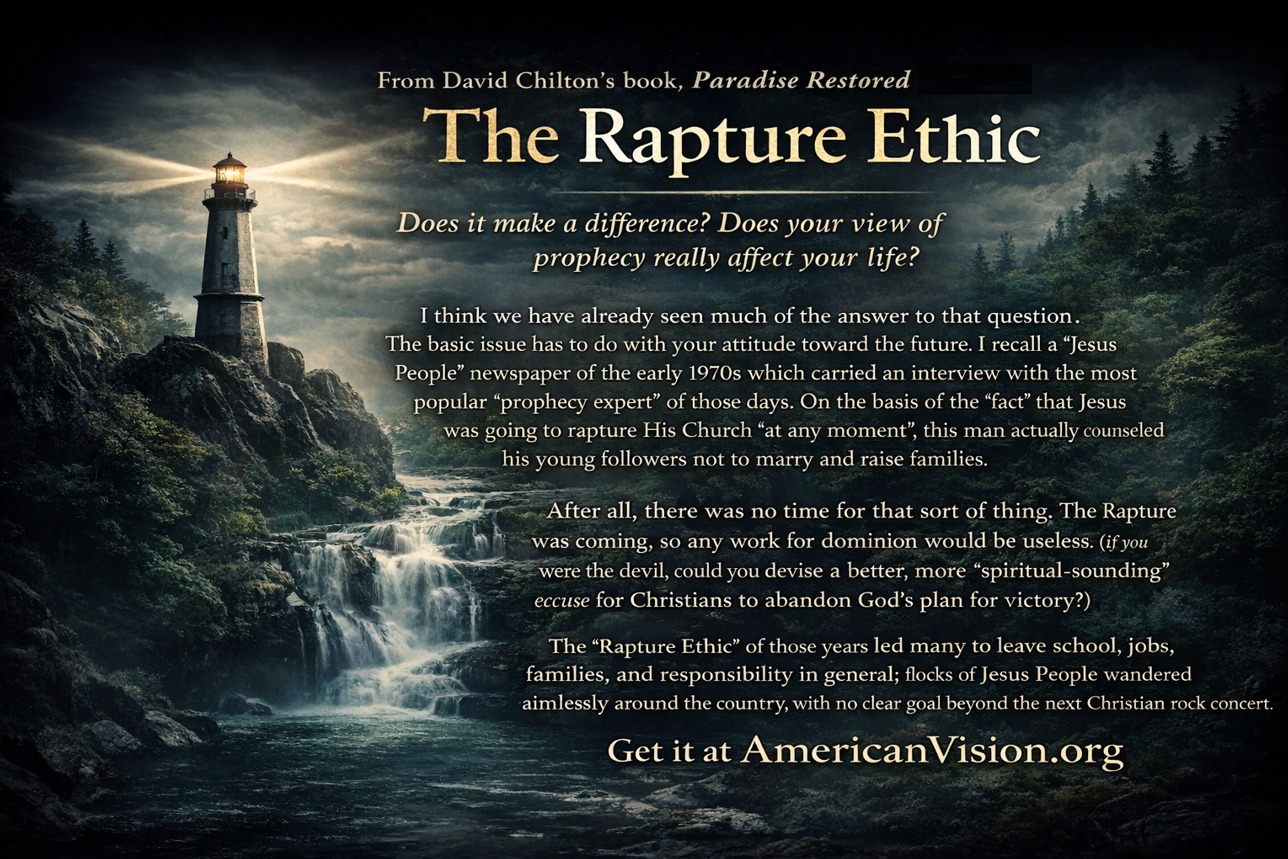
What happens if what we believe is still future was actually fulfilled almost 2,000 years ago? It will change everything about the way you view the world, your future and your responsibility to leave the planet better than when you arrived.
3. Geopolitical chaos – If the Modern state of Israel, founded in 1948, is home to “God’s chosen people,” and if Israel must be blessed lest those who refuse are cursed (Genesis 12:3), then this will continue to have wide-ranging Middle East implications. Christian Zionists, who support Israel based upon what they believe is an OT biblical mandate, posit that anyone critical of Israeli policies is antisemitic. Therefore, Israel enjoys a preferred status as the apple of God’s eye.
Recently, the U.S. Ambassador to Israel, Mike Huckabee, was asked if he believed Israel’s borders should eventually be expanded to the borders defined by Genesis 15:18.
On that day the LORD made a covenant with Abram, saying, “To your offspring I give this land, from the river of Egypt to the great river, the river Euphrates,
Since Huckabee believes these borders are eternally binding, his response, “It would be fine if they took it all”, was as expected. So, one can understand how this disturbs the surrounding Arab nations who occupy what Christian Zionists argue is land God gave Israel forever. The below map shows the expanded borders in red, which encompass Jordan, Syria, Iraq, and significant portions of Egypt and Saudi Arabia. Given the fact that the U.S. has traditionally favored Israel over their Arab counterparts, this has caused serious geopolitical tension within the region and beyond.

For an alternative to Christian Zionism, watch this series.
4. Bible Credibility Issues and Interpretive schizophrenia – Jesus said that He would return before His disciples finished going through the cities of Israel, while some of them were still alive and all within the generation to which He spoke. (Matt 10:23; 16:27-28; 24:34) This has prompted many an atheist to mock the deity of Christ.
When they persecute you in one town, flee to the next, for truly, I say to you, you will not have gone through all the towns of Israel before the Son of Man comes. (Matthew 10:23)
For the Son of Man is going to come with his angels in the glory of his Father, and then he will repay each person according to what he has done. 28Truly, I say to you, there are some standing here who will not taste death until they see the Son of Man coming in his kingdom.” (Matthew 16:27-28)
Truly, I say to you, this generation will not pass away until all these things take place. (Matthew 24:34)
In “Why I Am Not a Christian”, atheist Bertrand Russell wrote: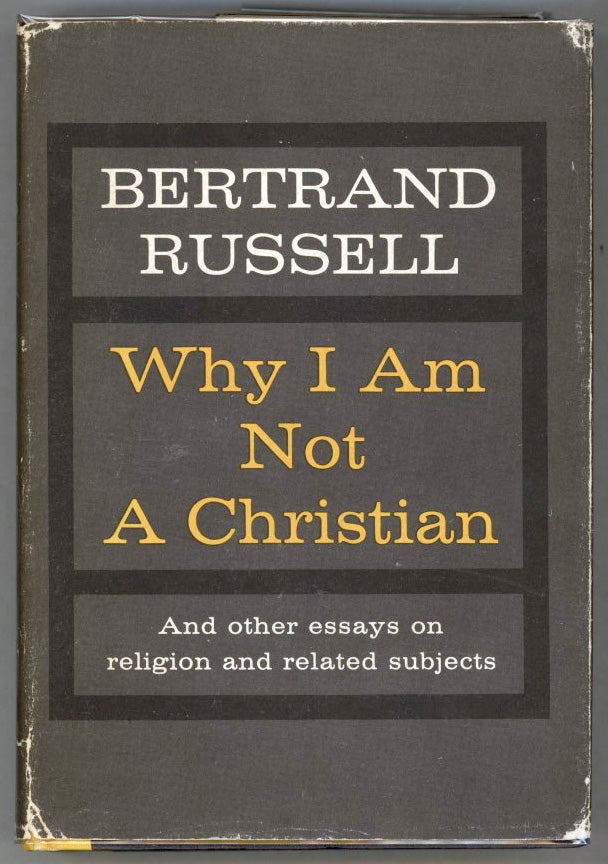
“I am concerned with Christ as he appears in the Gospel narrative as it stands, and there does one find some things that do not seem to be very wise. For one thing He certainly thought that His second coming would occur in clouds of glory before the death of all of the people who were living at that time. There are great many texts that prove and there are a lot of places where it is quite clear that He believed that his coming would happen during the lifetime of many then living. That was the belief of His earlier followers, and it was the basis of a good deal of His moral teaching.”
Russell rejected Christ in large part because he saw the obvious…that Jesus said it, but didn’t do it. And sadly, no one ever challenged Russell at that point, partly because those who held this premillennial dispensational paradigm were unable to provide a plausible, biblically-valid answer to his objection. And, tragically, Russell died in his sins believing Jesus was a false prophet, much less the Savior of the world. Did you know that in the New Testament there are over 100 imminent time statements regarding Christ’s coming. Following are but a few.
- “The end of all things IS NEAR.” (1 Peter 4:7)
- “The Revelation of Jesus Christ, which God gave Him to show His servants—things which MUST SHORTLY TAKE PLACE…for the time is near (Revelation 1:1;3b)
- “For yet A LITTLE WHILE, And He who is coming will come and WILL NOT DELYAY.” (Hebrews 10:37)
- “Be patient, therefore, brethren, until the coming of the Lord is AT HAND…. Behold, the Judge IS STANDING at the door! ” (James 5:8-9)
- Children, IT IS THE LAST HOUR, and as you have heard that antichrist is coming, so now many antichrists have come. Therefore we know that IT IS THE LAST HOUR. (1 John 2:18)
If our immediate reaction is to provide excuses for these kinds of imminent statements, something is amiss. In order to rescue an eschatological view, if we are forced to argue that soon, near, at hand, in a very little while and it is the last hour, don’t mean what they have meant in every context throughout history, we’re engaging in interpretive schizophrenia.
Ask yourself this: If these words should be elasticized into thousands of years, how could God have communicated that something was actually imminent? Would the Holy Spirit have been forced to inspire Peter to write, “No, seriously, I really, really mean it when I’m warning you that the end of all things is near? Absurd? Of course. But these are the lengths we have traveled to normalize this bizarre hermeneutic.
I’ve even heard pastors try to argue that the Greek word “tachos” (shortly) in Revelation 1:1 means that after a 2,000+ delay, that it will happen with the speed of light. Cringeworthy. In all 8 NT usages, it never means a delay followed by supersonic speed.
Not surprisingly, during that same sermon the pastor conveniently neglected to mention the imminence in the 3rd verse in the Revelation, “for the time is NEAR (eggus).”
“Eggus” means near in terms of time or distance. “Now the Jews’ Feast of Tabernacles was at hand (eggus).” (John 7:2) No matter how you slice it, eggus cannot be tortured to mean that it wasn’t really near at that time but is it now near to us. So when you combine “things that MUST take place” with “for the time is near”, it is unmistakable that what was to follow would soon take place.
Therefore, if we ignore the timing to fit a preconceived paradigm, we have left the intellectually honest high ground for a valley of subterfuge. The New Testament is inundated with these kinds of near-term expectations of Christ’s coming in judgment and rescue that are crying out to be understood. (I dealt with the most common objection HERE.)
In an attempt to maintain this “everything is going to Hell in a handcart” paradigm, it has caused many to abandon interpretive principles like audience relevance, the analogy of faith, and context is king.
Dispensationalism, the dominant eschatological system of our day, requires one to ignore many bedrock principles of interpretation. For example, the concept of “audience relevance” i.e. the supremacy of the original audience, which is essential in understanding any piece of literature in its historical context, no less the Bible, is completely invisible to far too many. We have been trained to read the New Testament as though it was delivered with our daily mail. Even though it must not be read with a 21st century western lens, many do. Case in point:
Many read this verse as though Jesus is coming quickly in the year 2026.
“He who testifies to these things says, “Surely I am coming quickly.” Amen. Even so, come, Lord Jesus! (Revelation 22:20)
Let’s consider another example. Jesus used the first-person plural “you” 21 times in Matthew’s Olivet Discourse account. To whom was Jesus warning? (Note: We must first understand what a passage was intended to mean to the direct recipients before finding principles of application.) All too often we read the Gospels and epistles as though they were written directly to us. This is not only tragic but it will lead you astray.
Consider these snippets from Matthew 24 and view them through the eyes of the disciples.
4 And Jesus answered THEM, “See that no one leads YOU astray. Who was told not to be led astray? Us, or the disciples?
6 And YOU will hear of wars and rumors of wars. See that YOU are not alarmed… Who was to hear of wars and rumors of war? Who was not to be alarmed? Us, or the disciples?
9 “Then they will deliver YOU up to tribulation and put YOU to death, and YOU will be hated by all nations for my name’s sake. Who was to be delivered up to Tribulation, be put to death and hated by all nations? Us, or the disciples?
15 “So when YOU see the abomination of desolation spoken of by the prophet Daniel, Who was to see the abomination of desolation (Luke equates this with “Jerusalem being surrounded by armies)? Us or the disciples?
25 See, I have told YOU beforehand. 26 So, if they say to YOU, ‘Look, he is in the wilderness,’ do not go out. If they say, ‘Look, he is in the inner rooms,’ do not believe it. Who was told beforehand what would happen, and who was warned not too look in the wilderness or the inner rooms? Us, or the disciples?
33 So also, when YOU see all these things, YOU know that he is near, at the very gates. 34 Truly, I say to YOU, this generation will not pass away until all these things take place. Who was to see “all these things”? Who was to know that when they saw all these things that Jesus was near (eggus)? Which generation would not pass away until everything in the preceding verses took place? Our generation or the wicked and perverse generation in which the disciples lived?
All of today’s major prophecy pundit completely ignore the fact that Jesus was warning His disciples that which would come upon their generation. We are not the YOU to whom Jesus was addressing. We are aren’t the ones who would be delivered up to tribulation or put to death, or would “see all these things.”
What if these first 3 presuppositions which have been assumed true for over a century, are false? What if the pervading pessimism and short-term mentality are the result of misinterpreting God’s word by assuming that we have been stuck in a time warp for 2000 years? What if that which was prophesied to take place “shortly” and “in a very little while”, did in fact take place, but in a manner not expected? We have been conditioned to believe that the issues which the first century Christians were dealing with and the events they were imminently waiting for, little to do with them because they are in our near future. So, it is argued that ostensibly nothing has changed since the Canon was completed in the AD 60s.
Ask yourself how can that which was imminent to the first century Christians still be imminent today? So many attempt to make clever excuses for unfulfillment and the beat goes on. The nasty conflagration of events targeting the wicked and perverse Christ-killing generation (Matthew 23:36), took place on time as planned.
At what point will the many begin to realize that something is wrong in their interpretive scheme? If the Bible is the inerrant, inspired, infallible God-breathed word, and it is, then when will the those who continue to rely on the apocalyptic writers who have made literally hundreds of errant prophetic predictions, be more seriously scrutinized? Something is awry and it’s not the Bible. It’s how the Bible has been interpreted.
Our mandate to the disciple the nations and although it is gradually being fulfilled since Jesus’s ascension, it has a long way to go. So, why do we assume that it’s supposed to end before the job is done. Is it possible that this near-term gloom and doom expectation is errant? If we believe that “greater is He that is in you then he that is in the world”, and “for everyone who has been born of God overcomes the world,” are we selling our mission short? Is it possible that a famous pastor’s statement, “we lose down here”, is not true… and that we’re actually supposed to win down here? How long will we accept the mantra “Jesus is coming soon” before we realize that there’s a massive amount of work yet to be done? Has the entire world been filled with the glory of the Lord?
If this is confusing to you, I would highly recommend the following series from Pastor Kendall Lankford. He painstakingly and eloquently trudges through the Olivet Discourse as a precursor to delving into the book of Revelation. Begin with the first episode in this series which is #136, Revelation (An Olivet Introduction). You will be challenged but you will not be disappointed.